. 2011 Feb;77(4):1483-92.
doi: 10.1128/AEM.01877-10. Epub 2010 Dec 17.

High-throughput plasmid content analysis of Borrelia burgdorferi B31 by using Luminex multiplex technology

Affiliations

High-throughput plasmid content analysis of Borrelia burgdorferi B31 by using Luminex multiplex technology

Steven J Norris et al. Appl Environ Microbiol. 2011 Feb.

Abstract

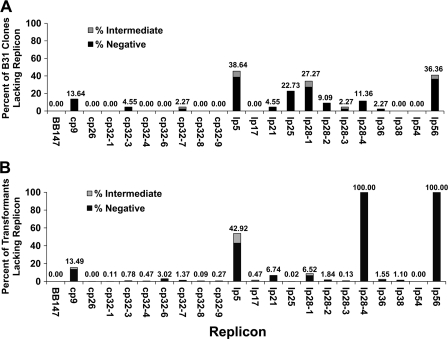
Borrelia burgdorferi, the causative agent of Lyme disease in North America, is an invasive pathogen that causes persistent multiorgan manifestations in humans and other mammals. Genetic studies of this bacterium are complicated by the presence of multiple plasmid replicons, many of which are readily lost during in vitro culture. The analysis of B. burgdorferi plasmid content by plasmid-specific PCR and agarose gel electrophoresis or other existing techniques is informative, but these techniques are cumbersome and challenging to perform in a high-throughput manner. In this study, a PCR-based Luminex assay was developed for determination of the plasmid content of the strain B. burgdorferi B31. This multiplex, high-throughput method allows simultaneous detection of the plasmid contents of many B. burgdorferi strains in a 96-well format. The procedure was used to evaluate the occurrence of plasmid loss in 44 low-passage B. burgdorferi B31 clones and in a library of over 4,000 signature-tagged mutagenesis (STM) transposon mutant clones. This analysis indicated that only 40% of the clones contained all plasmids, with (in order of decreasing frequency) lp5, lp56, lp28-1, lp25, cp9, lp28-4, lp28-2, and lp21 being the most commonly missing plasmids. These results further emphasize the need for careful plasmid analysis in Lyme disease Borrelia studies. Adaptations of this approach may also be useful in the evaluation of plasmid content and chromosomal gene variations in additional Lyme disease Borrelia strains and other organisms with variable genomes and in the correlation of these genetic differences with pathogenesis and other biological properties.


Figures
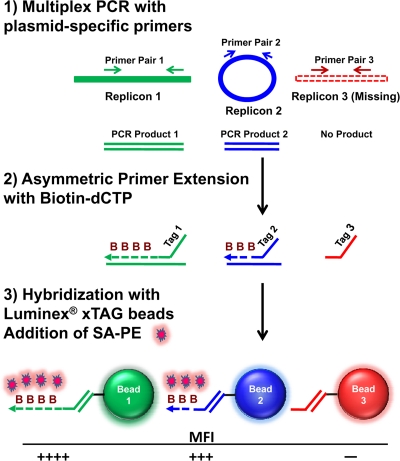
FIG. 1.
FIG. 1.
Overview of Luminex procedure for determining plasmid content. (1) Plasmid-specific regions are amplified by multiplex PCR, using genomic DNA or B. burgdorferi culture as the template. Unincorporated primers and dNTPs in amplified PCR products are removed by treatment with exonuclease I and alkaline phosphatase. (2) Primers that contain an xTAG sequence are utilized in an asymmetric PCR that incorporates biotin-dCTP. (3) Biotinylated products are hybridized with xTAG microspheres that are coupled to antitag sequences and detected by binding of streptavidin-R-phycoerythrin. MFI, mean fluorescence intensity.
FIG. 2.
FIG. 2.
Reproducibility of Luminex plasmid assay. (A) Mean MFI values obtained using RPP templates. The MFI values for each B. burgdorferi replicon in 10 independent experiments were averaged, and standard errors (SE) were calculated. (B) A culture of the B. burgdorferi strain B31-5A2 was assayed 10 times. The mean MFI values and standard errors are presented. (C) The MFI values were normalized by dividing the MFI value for the B. burgdorferi sample by the MFI value for the RPP from the same experiment. The A and B designations for plasmids lp25 and lp28-1 represent the two different primer sets that were used for these two plasmids.
FIG. 3.
FIG. 3.
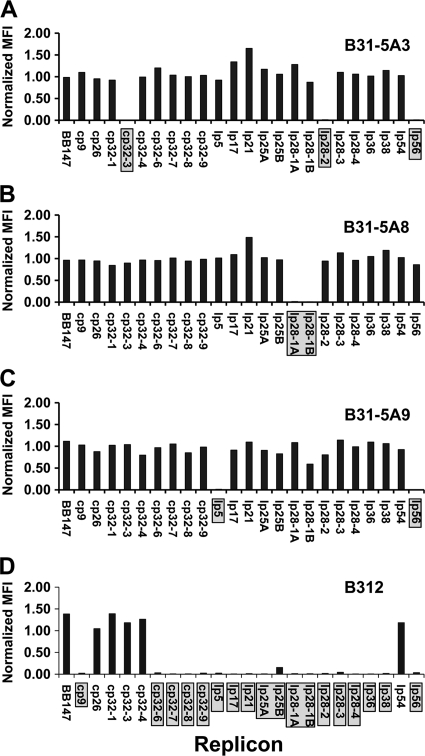
Plasmid content analysis of B. burgdorferi B31 clones by using LPAA. Diluted liquid cultures or scrapings of frozen B. burgdorferi stocks were used as templates. The MFI for each B. burgdorferi replicon was normalized by dividing culture MFI values by RPP MFI values. (A) B31-5A3 lacks replicons cp32-3, lp28-2, and lp56. (B) B31-5A8 lacks replicon lp28-1. (C) B31-5A9 lacks replicons lp5 and lp56. (D) B312 is a high-passage strain that contains only the chromosome (BB147), cp26, cp32-1, cp32-3, cp32-4, and lp54.
FIG. 4.
FIG. 4.
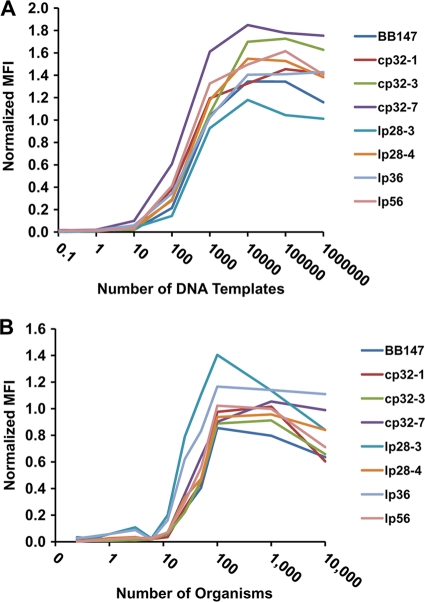
Sensitivity of B. burgdorferi Luminex plasmid analysis assay. (A) The RPP containing the PCR amplicons was diluted serially and used as a template in the Luminex assay. The MFIs were normalized by dividing culture MFI values by RPP MFI values. (B) Cultures of B. burgdorferi strain B31-5A4, which contains all replicons except for lp5, were used as templates. Spirochete concentrations of the cultures were determined, and cultures were serially diluted to yield the indicated number of organisms in each reaction. MFIs were normalized by dividing culture MFI values by RPP MFI values.
FIG. 5.
FIG. 5.
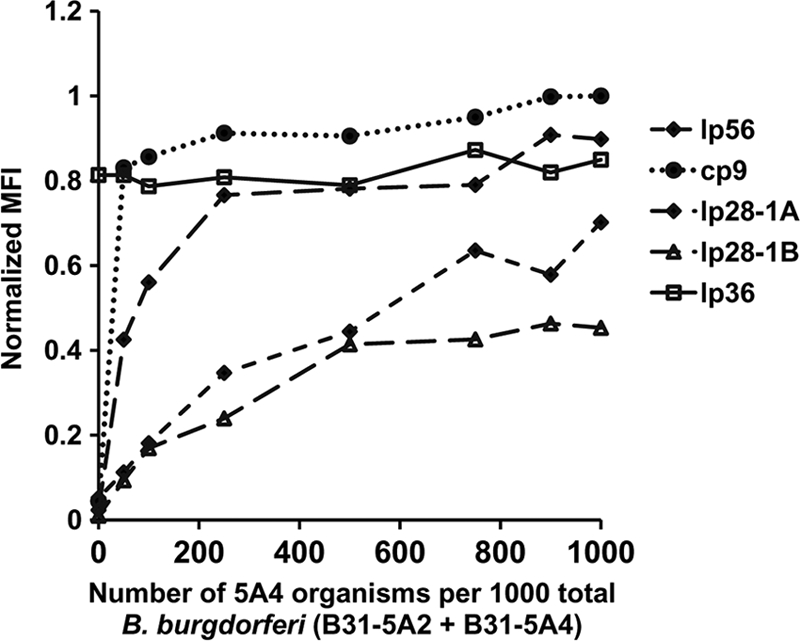
Detection of B. burgdorferi replicons in mixed cultures. B. burgdorferi strain B31-5A2, which lacks cp9, lp56, cp28-1, and lp28-1, was mixed with strain B31-5A4, which contains those replicons. Each sample contained 1,000 organisms, with different proportions of B31-5A2 and -5A4. The mixed cultures were used as templates for the LPAA. Normalized MFI values from these cultures were graphed against the number of organisms from strain B31-5A4 in each sample.
FIG. 6.
FIG. 6.
Frequency of plasmid loss. (A) Samples of 44 clones obtained from subcloning an uncloned passage 5 B. burgdorferi B31 culture were analyzed using the Luminex plasmid content assay. The percentage of clones that had lost each replicon is presented. (B) A total of 4,464 transformants obtained from an STM screen were analyzed using the Luminex plasmid content assay. The percentage of clones that had lost each replicon is presented.
FIG. 7.
FIG. 7.
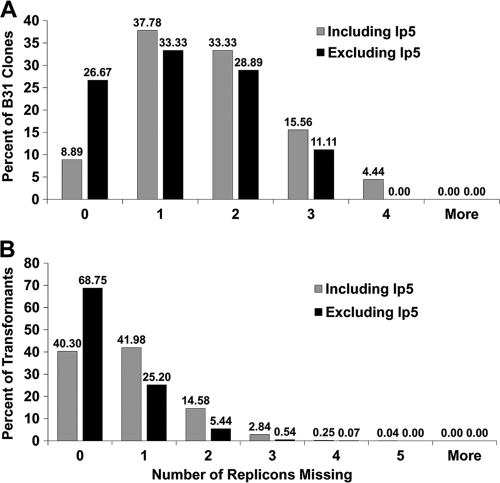
Number of plasmids lost per B. burgdorferi clone. The histograms represent the percentages of clones that had lost the indicated numbers of replicons. (A) Number of replicons lost from 44 clones obtained by subcloning passage 5 B. burgdorferi B31. (B) Results obtained with 4,464 transformants from an STM library.

References

    1. Barbour, A. G. 1984. Isolation and cultivation of Lyme disease spirochetes. Yale J. Biol. Med. 57:521-525. - PMC - PubMed
    1. Barbour, A. G. 1988. Plasmid analysis of Borrelia burgdorferi, the Lyme disease agent. J. Clin. Microbiol. 26:475-478. - PMC - PubMed
    1. Barbour, A. G., and D. Fish. 1993. The biological and social phenomenon of Lyme disease. Science 260:1610-1616. - PubMed
    1. Bestor, A., et al. 2010. Use of the Cre-lox recombination system to investigate the lp54 gene requirement in the infectious cycle of Borrelia burgdorferi. Infect. Immun. 78:2397-2407. - PMC - PubMed
    1. Burgdorfer, W., et al. 1982. Lyme disease, a tick-borne spirochetosis? Science 216:1317-1319. - PubMed

Publication types

MeSH terms

LinkOut - more resources