


Review
doi: 10.4161/cam.5.2.14401.
Epub 2011 Mar 1.
The filamins: organizers of cell structure and function
Affiliations
- PMID: 21169733
- PMCID: PMC3084982
- DOI: 10.4161/cam.5.2.14401
Item in Clipboard
Review
The filamins: organizers of cell structure and function
Cell Adh Migr.
2011 Mar-Apr.
Abstract
Filamin A (FLNa), the first non-muscle actin filament cross-linking protein, was identified in 1975. Thirty five years of FLNa research has revealed its structure in great detail, discovered its isoforms (FLNb and c), and identified over 90 binding partners including channels, receptors, intracellular signaling molecules, and even transcription factors. Due to this diversity, mutations in human FLN genes result in a wide range of anomalies with moderate to lethal consequences. This review focuses on the structure and functions of FLNa in cell migration and adhesion.
Figures
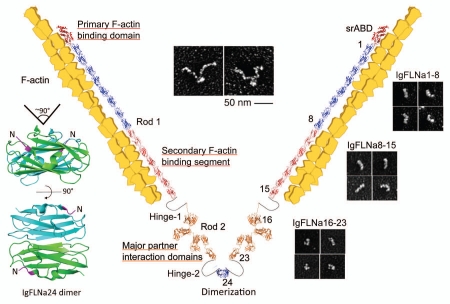
A schematic structure of FLNa molecule and the F-actin crosslink. This model was generated on PyMOL (www.pymol.org ) by assembling Ig domains uploaded on protein data bank and by fitting them within rotary shadowed images of FLNa molecules. Structures were modeled using the Swiss model database (http://swissmodel.expasy.org ). Rotary shadowed images of full-length FLNa and its subfragments are adopted from reference . The atomic structure of IgFLNa24 was generated on PyMOL (PDB accession number: 3CNK).
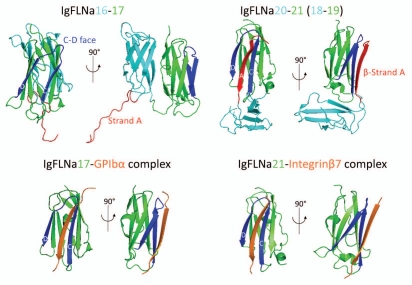
Atomic structures of FLNa rod 2 subdomains and the binding interfaces of known FLNa-partner complexes. The models were generated on PyMOL (PDB accession number: IgFLNa16–17, 2K7P; IgFLNa20–21, 2J3S; IgFLNa18–19, 2K7Q; IgFLNa17-GPIbβ, 2BP3; IgFLNa21-integrinβ7, 2BRQ). The CD faces of repeats and strand A are indicated with blue and red, respectively.
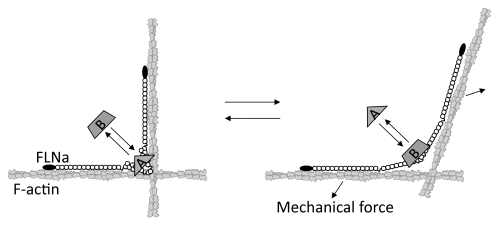
Model for how mechanical force regulates FLNa-partner interactions. Mechanical force changes the conformation of the rod 2 domain to release partner A by changing the geometry between the two FLNa subunits, while exposing the cryptic binding for partner B by unfolding the A strand interaction between repeats 20 and 21.
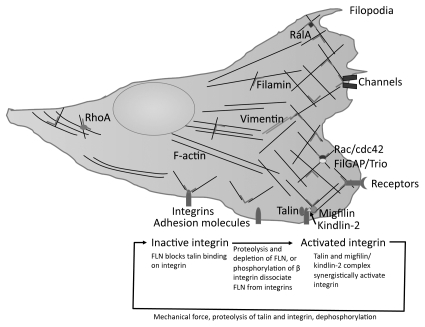
Schematic of how certain FLN-partner complexes regulate cell adhesion and motility. Top part: FLN crosslinks actin filaments and attaches them to signaling molecules, membrane proteins and the extracellular matrix through adhesion molecules such as integrins. FLN is required for the recycling, trafficking and stabilization of membrane proteins. FLN also scaffolds multiple partners in close proximity on rod 2, thereby facilitating signal transduction at specific locations within cells. Note that the expression levels of FLN-binding partners are dependent on the cell type and, therefore not all partners necessarily participate in cell adhesion and migration in the same cell. Bottom part: Model for how FLN regulates integrin activation. FLN acts as a negative regulator for integrin activation by blocking talin binding to the β integrin tail. Perturbation of this interaction allows talin to interact with β integrin, thereby activating integrin at the leading edge of a migrating cell.
References
-
- Hartwig JH, Stossel TP. Isolation and properties of actin, myosin and a new actinbinding protein in rabbit alveolar macrophages. J Biol Chem. 1975;250:5696–5705. - PubMed
-
- Feng Y, Walsh CA. The many faces of filamin: a versatile molecular scaffold for cell motility and signalling. Nat Cell Biol. 2004;6:1034–1038. - PubMed
-
- Robertson SP, Filamin A. phenotypic diversity. Curr Opin Genet Dev. 2005;15:301–307. - PubMed
-
- Stossel TP, Condeelis J, Cooley L, Hartwig JH, Noegel A, Schleicher M, et al. Filamins as integrators of cell mechanics and signalling. Nat Rev Mol Cell Biol. 2001;2:138–145. - PubMed
-
- Popowicz GM, Schleicher M, Noegel AA, Holak TA. Filamins: promiscuous organizers of the cytoskeleton. Trends Biochem Sci. 2006;31:411–419. - PubMed
Publication types
MeSH terms
Substances
Grants and funding
LinkOut - more resources
Full Text Sources
Other Literature Sources
Miscellaneous
