


Dichloroacetate- and Trichloroacetate-Induced Modulation of Superoxide Dismutase, Catalase, and Glutathione Peroxidase Activities and Glutathione Level in the livers of Mice after Subacute and Subchronic exposure
- PMID: 21170174
- PMCID: PMC3002262
- DOI: 10.1080/02772248.2010.509602
Dichloroacetate- and Trichloroacetate-Induced Modulation of Superoxide Dismutase, Catalase, and Glutathione Peroxidase Activities and Glutathione Level in the livers of Mice after Subacute and Subchronic exposure
Abstract
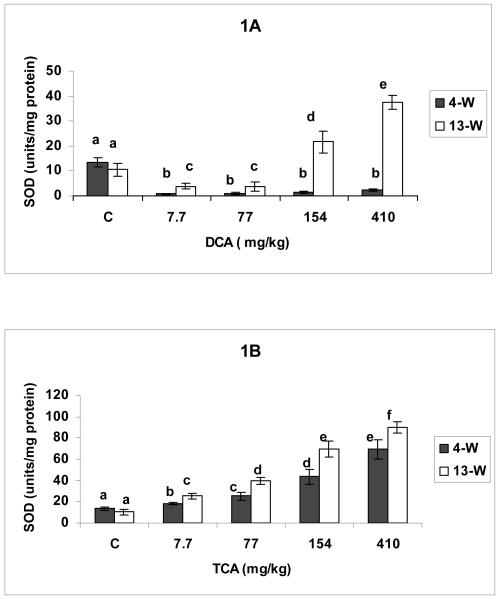
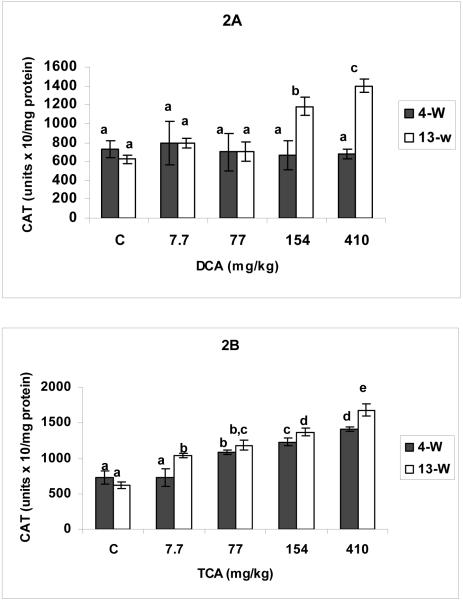
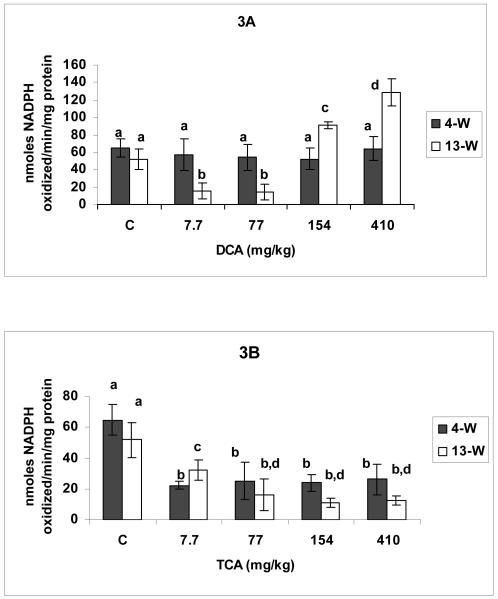
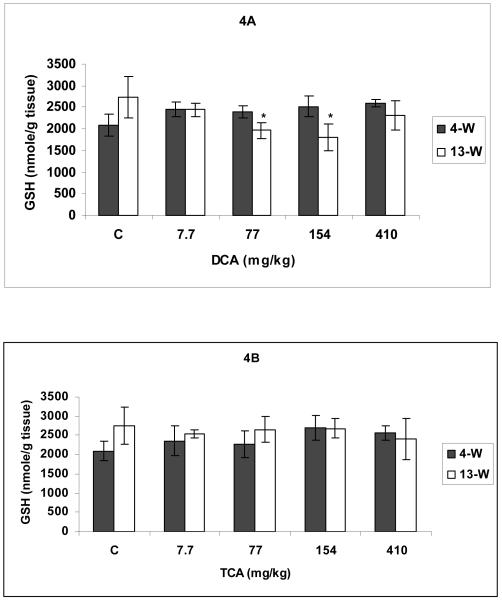
Dichloroacetate (DCA) and trichloroacetate (TCA) were previously found to induce various levels of oxidative stress in the hepatic tissues of mice after subacute and subchronic exposure. The cells are known to have several protective mechansims against production of oxidative stress by different xenobiotics. To assess the roles of the antioxidant enzymes and glutathione (GSH) in DCA- and TCA-induced oxidative stress, groups of B6C3F1 mice were administered either DCA or TCA at doses of 7.7, 77, 154 and 410 mg/kg/day, by gavage for 4 weeks (4-W) and 13 weeks (13-W), and superoxide dismutase (SOD) catalase (CAT) and glutathione peroxidase (GSH-Px) activities, as well as GSH were determined in the hepatic tissues. DCA at doses ranging between 7.7-410, and 7.7-77 mg/kg/day, given for 4-W and 13-W, respectively, resulted in either suppression or no change in SOD, CAT and GSH-Px activities, but doses of 154-410 mg DCA/kg/day administered for 13-W were found to result in significant induction of the three enzyme activities. TCA administration on the other hand, resulted in increases in SOD and CAT activities, and suppression of GSH-Px activity in both periods. Except for the DCA doses of 77-154 mg/kg/day administered for 13-W that resulted in significant reduction in GSH levels, all other DCA, as well as TCA treatments produced no changes in GSH. Since these enzymes are involved in the detoxification of the reactive oxygen species (ROS), superoxide anion (SA) and H(2)O(2), it is concluded that SA is the main contributor to DCA-induced oxidative stress while both ROS contribute to that of TCA. The increases in the enzyme activities associated with 154-410 mg DCA/kg/day in the 13-W period suggest their role as protective mechanisms contributing to the survival of cells modified in response to those treatments.
Figures
References
-
- Anderson ME. Determination of glutathione and glutathione disulfide in biological samples. Meth. Enzymol. 1985;113:548–555. - PubMed
-
- Austin EW, Parrish JM, Kinder DH, Bull RJ. Lipid peroxidation and formation of 8-hydroxyguanosine from acute doses of halogenated acetic acids. Fundam. Appl. Toxicol. 1996;31:77–82. - PubMed
-
- Blackburn AC, Matthaei KI, Lim C, Taylor MC, Cappello JY, Hayes JD, Anders MW, Board PG. Deficiency of glutathione transferase zeta causes oxidative stress and activation of antioxidant response pathways. Mol. Pharmacol. 2006;69:650–657. - PubMed
-
- Bull RJ, Sanchez IM, Nelson MA, Larson JL, Lansing AJ. Liver tumor induction in B6C3F1 mice by dichloroacetate and trichloroacetate. Toxicology. 1990;63:341–359. - PubMed
-
- Cohen G, Dembiec D, Marcus J. Measurement of catalase activity in tissue extracts. Anal. Biochem. 1970;34:30–38. - PubMed
Grants and funding
LinkOut - more resources
Full Text Sources
Miscellaneous