


Follow-up period of 13 years after endoscopic total extraperitoneal repair of inguinal hernias: a cohort study
- PMID: 21170663
- PMCID: PMC3071468
- DOI: 10.1007/s00464-010-1462-7
Follow-up period of 13 years after endoscopic total extraperitoneal repair of inguinal hernias: a cohort study
Abstract
Background: Endoscopic inguinal hernia repair was introduced in the Netherlands in the early 1990s. The authors' institution was among the first to adopt this technique. In this study, long-term hernia recurrence among patients treated by the total extraperitoneal (TEP) approach for an inguinal hernia is described. A cohort study was conducted.
Methods: Between January 1993 and December 1997, 346 TEP hernia repairs were performed for 318 patients. After a mean follow-up period of 13-years, a senior resident examined each patient. An experienced surgeon subsequently examined the patients with a diagnosis of recurrent hernia. Data were collected on an intention-to-treat basis, meaning that conversions were included in the analysis. Univariant tests were used to analyze age older than 50 years, chronic obstructive pulmonary disease, body mass index, smoking habit, hernia type, history of open hernia repair, conversion, and surgeon as potential risk factors.
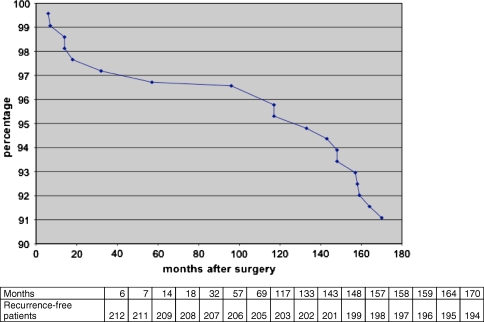
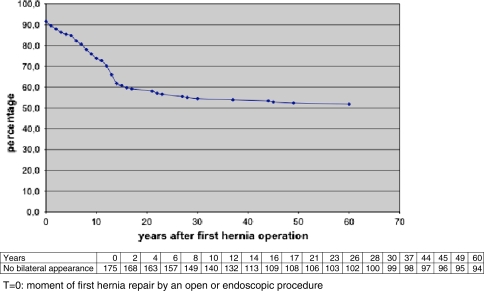
Results: The analysis included 191 patients (62%) with 213 hernias. Of the original 318 patients, 59 patients died, and 68 were lost to follow-up evaluation. Perioperatively, 105 lateral, 55 medial, and 53 pantalon hernias were observed. Of the 213 hernias, 176 were primary and 37 were recurrent. The overall recurrence rate was 8.9% (8.5% for primary and 10.8% for recurrent hernias). Of the total study group, 48% of the patients experienced a bilateral inguinal hernia during their lifetime. No predicting factor for recurrent hernia could be identified.
Conclusions: The current long-term results for TEP repair of primary and secondary inguinal hernia show an overall recurrence rate of 8.9%, which is slightly higher than in previous studies. The thorough examination at follow-up assessment, the learning curve effect, and the intention-to-treat-analysis may have influenced the observed recurrence rate. Also, the percentage of bilateral hernias was higher than known to date. Therefore, examination of the contralateral side should be standard procedure.
Figures
References
MeSH terms
LinkOut - more resources
Full Text Sources
