. 2010 Dec 20:7:369.
doi: 10.1186/1743-422X-7-369.

An RNAi in silico approach to find an optimal shRNA cocktail against HIV-1

Affiliations

An RNAi in silico approach to find an optimal shRNA cocktail against HIV-1

María C Méndez-Ortega et al. Virol J. .

Abstract

Background: HIV-1 can be inhibited by RNA interference in vitro through the expression of short hairpin RNAs (shRNAs) that target conserved genome sequences. In silico shRNA design for HIV has lacked a detailed study of virus variability constituting a possible breaking point in a clinical setting. We designed shRNAs against HIV-1 considering the variability observed in naïve and drug-resistant isolates available at public databases.

Methods: A Bioperl-based algorithm was developed to automatically scan multiple sequence alignments of HIV, while evaluating the possibility of identifying dominant and subdominant viral variants that could be used as efficient silencing molecules. Student t-test and Bonferroni Dunn correction test were used to assess statistical significance of our findings.

Results: Our in silico approach identified the most common viral variants within highly conserved genome regions, with a calculated free energy of ≥ -6.6 kcal/mol. This is crucial for strand loading to RISC complex and for a predicted silencing efficiency score, which could be used in combination for achieving over 90% silencing. Resistant and naïve isolate variability revealed that the most frequent shRNA per region targets a maximum of 85% of viral sequences. Adding more divergent sequences maintained this percentage. Specific sequence features that have been found to be related with higher silencing efficiency were hardly accomplished in conserved regions, even when lower entropy values correlated with better scores. We identified a conserved region among most HIV-1 genomes, which meets as many sequence features for efficient silencing.

Conclusions: HIV-1 variability is an obstacle to achieving absolute silencing using shRNAs designed against a consensus sequence, mainly because there are many functional viral variants. Our shRNA cocktail could be truly effective at silencing dominant and subdominant naïve viral variants. Additionally, resistant isolates might be targeted under specific antiretroviral selective pressure, but in both cases these should be tested exhaustively prior to clinical use.


Figures
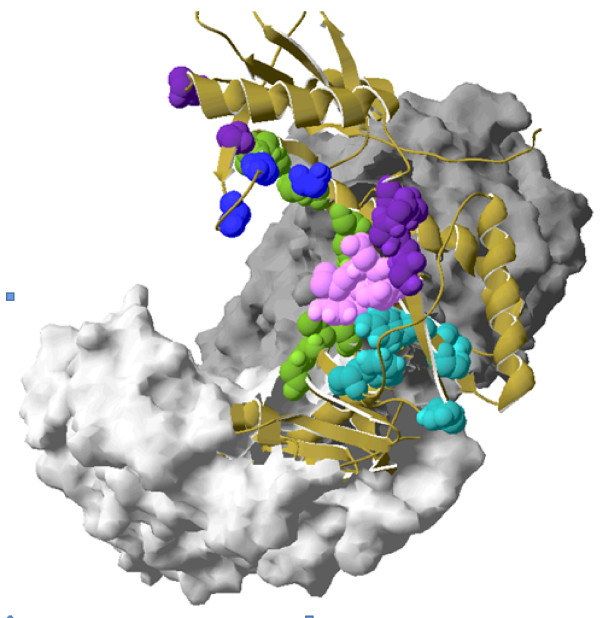
Figure 1
Figure 1
Crystallographic structure of RT indicating Selected Regions. (a) RT crystallographic structure 2ZD1 (1.8 Å) highlights the residues within the selected regions, Dark gray = p66 subunit, light gray = p55, dark blue = active site residues involved in dNTP binding (K65, R72, D110, V111, G112, D113, A114, Y115, Q151), green = active site residues involved in DNA binding (L74, V75, D76, R78, N81, E89, Q91, L92, I94, G152, K154, P157, M230, G231), purple = active site residues with no specific annotations (W24, P25, F61), pink = YMDD motif (Y183, M184, D185, D186), and light blue = residues involved in NNRTI binding (L100, K101, K102, K103, V179, Y188, G190, F227; not conserved). Ribbon shows continuity between amino acid chains.
Figure 2
Figure 2
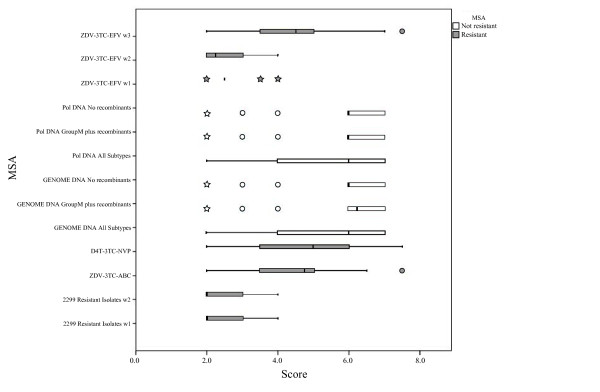
Score Distribution among MSAs. No scores under 2.0 are shown because this score value was the threshold used for selection by the algorithm. Circles indicate outlier values and stars indicate outlier extreme values.
Figure 3
Figure 3
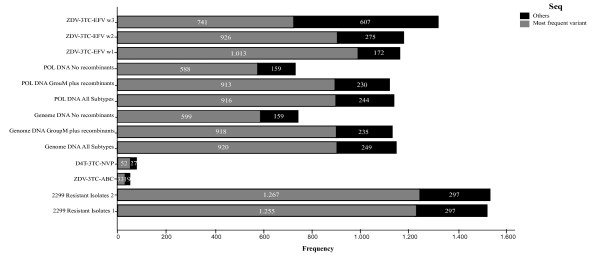
Proportion of dominant or most frequent viral variants. The total number of sequences is the amount of sequences that the algorithm analyzed. In the case of MSAs that have more than one window, the total number of analyzed sequences may be different. Other viral variants correspond to subdominant or totally infrequent viral sequences.
Figure 4
Figure 4
Information Entropy and Scores correlation. The ellipses highlight the score distribution for resistant MSAs (a.) and the correlation observed for non- resistant MSAs (b.).
Figure 5
Figure 5
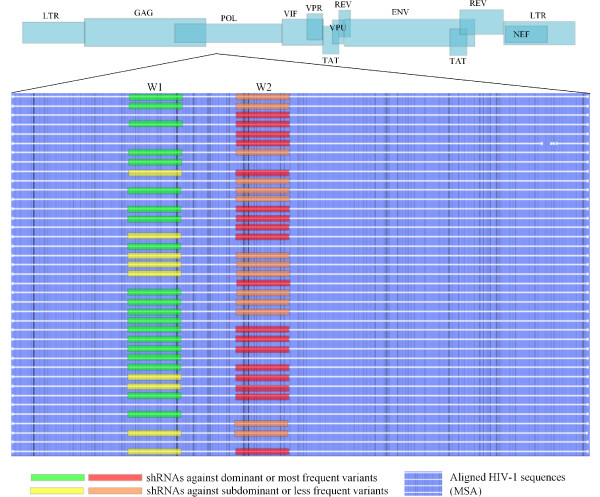
Silencing Model. Targeting dominant variants from two or more regions leaves several subdominant viral variants untargeted. The optimal approach would be a cocktail of carefully selected molecules targeting dominant as well as subdominant variants from more than one conserved region. The figure shows a schematic representation of HIV-1 genome and an MSA of HIV-1 pol gene, in which the strategy of silencing is drawn. Some sequences would be targeted by two shRNAs, some just by one, and a few would not be targeted at all, but are not frequent. W1 and W2 represent the hypothetical targeted regions, where "W" stands for "window".
Figure 6
Figure 6
shRNA diagram. (a) Schematic representation of shRNA showing important sequence features with corresponding positions in the antisense strand. (b) DNA antisense strand indicating the correction of positions with respect to antisense strand from shRNA (c) DNA vector (only shRNA is shown, partial sequence). Correction of sequence features positioning is fundamental for seeking them in MSA with the algorithm, since MSA are DNA sequences.

References

    1. Cohen MS, Hellmann N, Levy JA, DeCock K, Lange J. The spread, treatment, and prevention of HIV-1: evolution of a global pandemic. J Clin Invest. 2008;118:1244–1254. doi: 10.1172/JCI34706. - DOI - PMC - PubMed
    1. Colin L, Van Lint C. Molecular control of HIV-1 postintegration latency: implications for the development of new therapeutic strategies. Retrovirology. 2009;6:111. doi: 10.1186/1742-4690-6-111. - DOI - PMC - PubMed
    1. Hubner A, Kruhoffer M, Grosse F, Krauss G. Fidelity of human immunodeficiency virus type I reverse transcriptase in copying natural RNA. J Mol Biol. 1992;223:595–600. doi: 10.1016/0022-2836(92)90975-P. - DOI - PubMed
    1. Boasso A, Shearer GM. Chronic innate immune activation as a cause of HIV-1 immunopathogenesis. Clin Immunol. 2008;126:235–242. doi: 10.1016/j.clim.2007.08.015. - DOI - PMC - PubMed
    1. Alimonti JB, Ball TB, Fowke KR. Mechanisms of CD4+ T lymphocyte cell death in human immunodeficiency virus infection and AIDS. J Gen Virol. 2003;84:1649–1661. doi: 10.1099/vir.0.19110-0. - DOI - PubMed

Publication types

Substances

LinkOut - more resources