


Contingency management to reduce methamphetamine use and sexual risk among men who have sex with men: a randomized controlled trial
- PMID: 21172026
- PMCID: PMC3016390
- DOI: 10.1186/1471-2458-10-774
Contingency management to reduce methamphetamine use and sexual risk among men who have sex with men: a randomized controlled trial
Abstract
Background: Methamphetamine use is associated with HIV acquisition and transmission among men who have sex with men (MSM). Contingency management (CM), providing positive reinforcement for drug abstinence and withholding reinforcement when abstinence is not demonstrated, may facilitate reduced methamphetamine use and sexual risk. We compared CM as a stand-alone intervention to a minimal intervention control to assess the feasibility of conducting a larger, more definitive trial of CM; to define the frequency of behavioral outcomes to power such a trial; and, to compute preliminary estimates of CM's effectiveness.
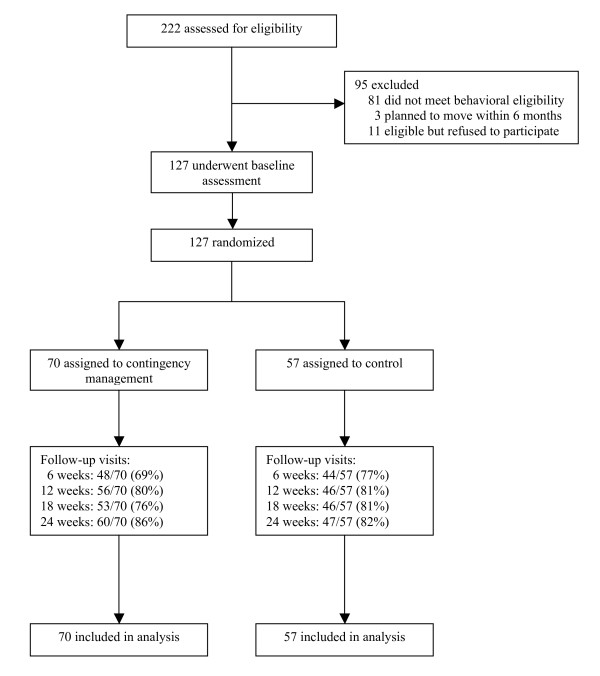
Methods: We randomly assigned 127 MSM from Seattle, WA who use methamphetamine to receive a 12-week CM intervention (n = 70) or referral to community resources (n = 57).
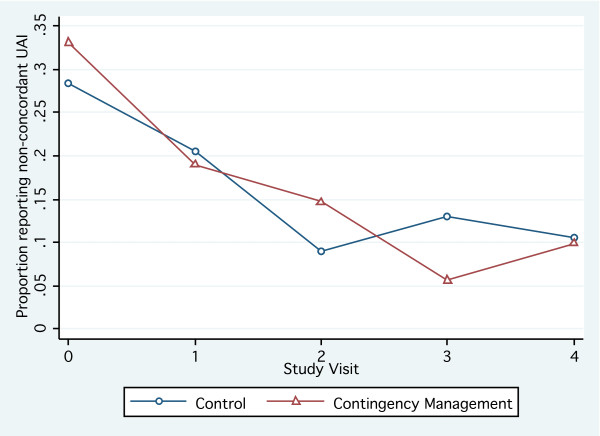
Results: Retention at 24 weeks was 84%. Comparing consecutive study visits, non-concordant UAI declined significantly in both study arms. During the intervention, CM and control participants were comparably likely to provide urine samples containing methamphetamine (adjusted relative risk [aRR] = 1.09; 95%CI: 0.71, 1.56) and to report non-concordant UAI (aRR = 0.80; 95%CI: 0.47, 1.35). However, during post-intervention follow-up, CM participants were somewhat more likely to provide urine samples containing methamphetamine than control participants (aRR = 1.21; 95%CI: 0.95, 1.54, P = 0.11). Compared to control participants, CM participants were significantly more likely to report weekly or more frequent methamphetamine use and use of more than eight quarters of methamphetamine during the intervention and post-intervention periods.
Conclusions: While it is possible to enroll and retain MSM who use methamphetamine in a trial of CM conducted outside drug treatment, our data suggest that CM is not likely to have a large, sustained effect on methamphetamine use.
Trial registration: ClinicalTrials.gov NCT01174654.
Figures
References
-
- Burcham JL, Tindall B, Marmor M, Cooper DA, Berry G, Penny R. Incidence and risk factors for human immunodeficiency virus seroconversion in a cohort of Sydney homosexual men. Med J Aust. 1989;150(11):634–639. - PubMed
-
- SFDPH. HIV/AIDS Epidemiology Annual Report. San Francisco, CA: HIV/AIDS Statistics, Epidemiology, and Intervention Research Section, San Francisco Department of Public Health; 2005.
