Comparative Study
. 2011 Apr 18:1385:151-62.
doi: 10.1016/j.brainres.2010.12.038. Epub 2010 Dec 21.

Intracranial volume and dementia: some evidence in support of the cerebral reserve hypothesis

Affiliations
Comparative Study

Intracranial volume and dementia: some evidence in support of the cerebral reserve hypothesis

D F Tate et al. Brain Res. .

Abstract

The brain reserve hypothesis has been posited as being one important mediating factor for developing dementia, especially Alzheimer's disease (AD). Evidence for this hypothesis is mixed though different methodologies have made these findings difficult to interpret. We examined imaging data from a large cohort (N=194) of mixed dementia patients and controls, 65years old and older from the Cache County, Utah Study of Memory and Aging for evidence of the brain reserve hypothesis using total intracranial volume (TICV) as a quantitative measure of pre-morbid brain size and a vicarious indicator of reserve. A broader spectrum of non-demented elderly control subjects from previous studies was also included for comparison (N=423). In addition, non-parametric Classification and Regression Tree (CART) analyses were performed to model group heterogeneity and identify any subgroups of patients where TICV might be an important predictor of dementia. Parametrically, no main effect was found for TICV when predicting a dementia diagnosis; however, the CART analysis did reveal important TICV subgroups, including a sex differential wherein ε4 APOE allele presence in males and low TICV predicted AD classification. TICV, APOE, and other potential mediator/moderator variables are discussed in the context of the brain reserve hypothesis.


Conflict of interest statement

DISCLOSURE STATEMENT There are no actual or potential conflicts on interest to be disclosed by any of the authors. Recruitment and consent procedures for human subjects and subsequent data usage were approved by the respective institutional review boards.

Figures

Figure 1
Figure 1
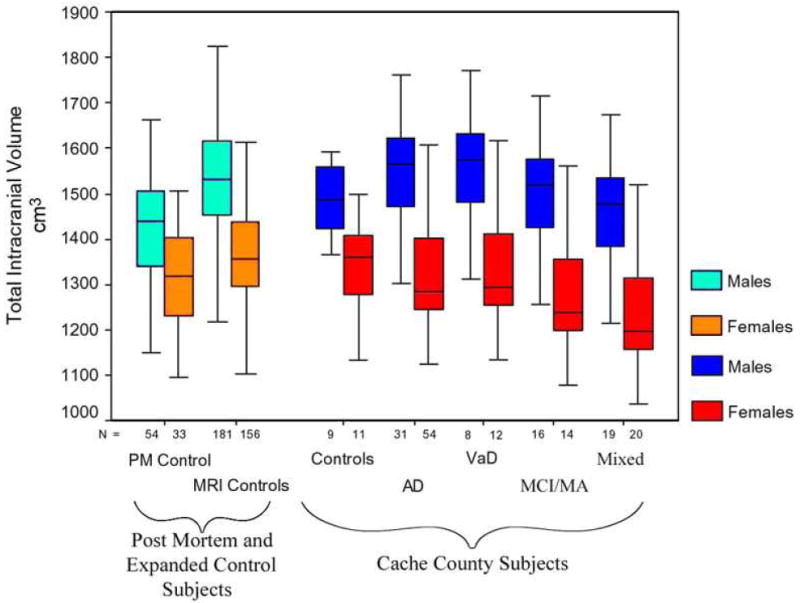
Box plots displaying the distribution of total intracranial volume (TICV) for each group (medium, quartiles, and range). The subjects in the magnetic resonance imaging (MRI) controls and Post-Mortem (PM) Controls are from other studies (see Bigler, Tate, 2001) and were used to establish the appropriateness of the 20 control subjects in the Cache County, Utah project. As can be seen there is considerable overlap between the control groups but the differences were not significant. Note the ordinate is truncated, starting at 1,000 cm3. No significant main effect of TICV X diagnostic group was observed. By examination of the range of variability, it is obvious that there is considerable overlap resulting in no significant mean difference in TICV between subjects with dementia and/or neuropsychiatric disorder and controls.
Figure 2
Figure 2
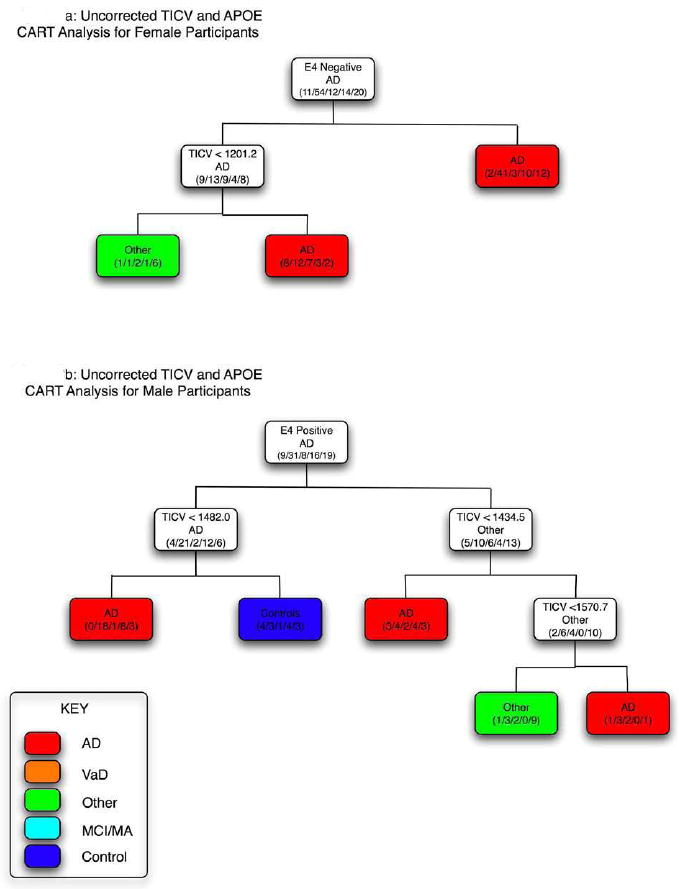
(a) Classification and Regression Tree (CART) analysis by total intracranial volume (TICV) and diagnostic classification for females. The title of each line represents the cut-point where the model initially classifies by the Alzheimer disease (AD) diagnosis. The classification criterion is read to the left. Thus, for the first classification, TICV < 1203.8 is satisfied to the left. The numbers beneath each cut-score represent the number classified as AD for each category, read from left to right, where the first category is controls, followed by AD, vascular dementia (VaD), and mild ambiguous/mild cognitive impairment (MA/MCI), and mixed neuropsychiatric subjects. The ‘tree’ evolves as it attempts to classify by the diagnosis of AD at each ‘branch’ by TICV in the beginning of the CART analysis. In so doing the model looks at the best fit and classification rate at each branch and continues to branch until all subjects have been classified. Note that initially each heading is AD, because the model parameters for this CART analysis were based solely on TICV and AD classification until the lower branches were reached and then it classified by other diagnostic categories. (b) CART analysis by TICV and diagnostic classification for males. The decision tree is read in an identical manner as described above.
Figure 3
Figure 3
Classification and Regression Tree (CART) analysis by total intracranial volume (TICV) and presence of the ε4 allele for females (a) and males (b). As in Figure 2, when the criterion heading for each line is met, the direction is to the left. Accordingly, there is a cluster (asterisk) where Alzheimer disease (AD) subjects had brain volume ≤ 1482.04 and no controls were in this branch. No branching occurred by TICV that appeared meaningful in females, as the CART analysis classified AD strictly by apolipoprotein E (APOE) genotype on the first branch and those who were ε4+ (right branch) were not further subdivided by TICV. Likewise almost all other subjects who were classified by the ε4- condition had TICV > 1201.2 cm3.

References

    1. Agosta F, Vossel KA, Miller BL, Migliaccio R, Bonasera SJ, Filippi M, Boxer AL, Karydas A, Possin KL, Gorno-Tempini ML. Apolipoprotein E ε4 is associated with disease-specific effects on brain atrophy in Alzheimer’s disease and frontotemporal dementia. PNAS. 2009;106(6):2018–2022. - PMC - PubMed
    1. Alexander GE, Furey ML, Grady CL, Pietrini P, Brady DR, Mentis MJ, Schapiro MB. Association of premorbid intellectual function with cerebral metabolism in Alzheimer’s disease. Am J Psychiatry. 1997;154(2):165–172. - PubMed
    1. Andreasen NC, Flaum M, Swayze V, II, O’Leary D, Alliger R, Cohen G, Ehrhardt J, Yuh WT. Intelligence and brain structure in normal individuals. Am J Psychiatry. 1993;150:130–134. - PubMed
    1. Anthony JC, Breitner JCS, Zandi PP, Meyer MR, Jurasova I, Norton MC, Stone SV. Reduced prevalence of AD in users of NSAIDs and H2 blockers. The Cache County Study. Arch Gen Psychiatry. 2000;54(11):2066–2071. - PubMed
    1. Armstrong E, Falk D. Primate Brain Evolution: Methods and Concepts. New York: Plenum Press; 1982.

Publication types

Substances