


Distributed lag analyses of daily hospital admissions and source-apportioned fine particle air pollution
- PMID: 21172759
- PMCID: PMC3080925
- DOI: 10.1289/ehp.1002638
Distributed lag analyses of daily hospital admissions and source-apportioned fine particle air pollution
Abstract
Background: Past time-series studies of the health effects of fine particulate matter [aerodynamic diameter ≤ 2.5 µm (PM2.5)] have used chemically nonspecific PM2.5 mass. However, PM2.5 is known to vary in chemical composition with source, and health impacts may vary accordingly.
Objective: We tested the association between source-specific daily PM2.5 mass and hospital admissions in a time-series investigation that considered both single-lag and distributed-lag models.
Methods: Daily PM2.5 speciation measurements collected in midtown Manhattan were analyzed via positive matrix factorization source apportionment. Daily and distributed-lag generalized linear models of Medicare respiratory and cardiovascular hospital admissions during 2001-2002 considered PM2.5 mass and PM2.5 from five sources: transported sulfate, residual oil, traffic, steel metal works, and soil.
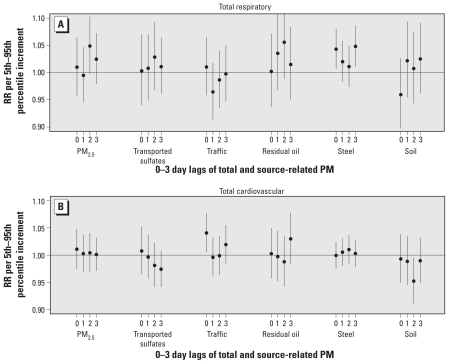
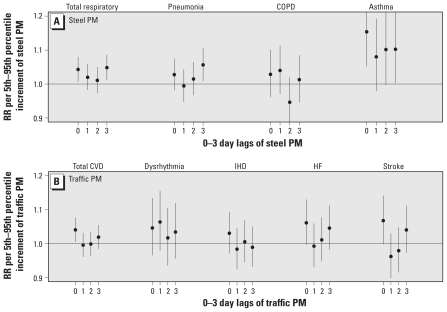
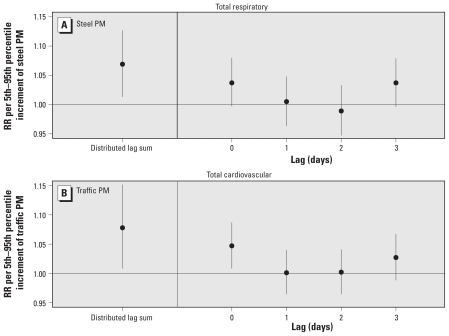
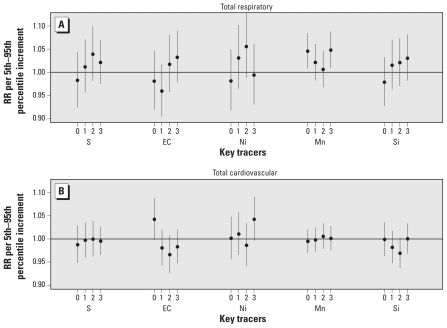
Results: Source-related PM2.5 (specifically steel and traffic) was significantly associated with hospital admissions but not with total PM2.5 mass. Steel metal works-related PM2.5 was associated with respiratory admissions for multiple-lag days, especially during the cleanup efforts at the World Trade Center. Traffic-related PM2.5 was consistently associated with same-day cardiovascular admissions across disease-specific subcategories. PM2.5 constituents associated with each source (e.g., elemental carbon with traffic) were likewise associated with admissions in a consistent manner. Mean effects of distributed-lag models were significantly greater than were maximum single-day effect models for both steel- and traffic-related PM2.5.
Conclusions: Past analyses that have considered only PM2.5 mass or only maximum single-day lag effects have likely underestimated PM2.5 health effects by not considering source-specific and distributed-lag effects. Differing lag structures and disease specificity observed for steel-related versus traffic-related PM2.5 raise the possibility of distinct mechanistic pathways of health effects for particles of differing chemical composition.
Figures
References
-
- Braga AL, Zanobetti A, Schwartz J. The lag structure between particulate air pollution and respiratory and cardiovascular deaths in 10 U.S. cities. J Occup Environ Med. 2001;43((11)):927–933. - PubMed
-
- Dominici F, Daniels M, Zeger SL, Samet JM. Air pollution and mortality: estimating regional and national dose–response relationships. J Am Stat Assoc. 2002;97((457)):100–111.
Publication types
MeSH terms
Substances
Grants and funding
LinkOut - more resources
Full Text Sources
Medical
Miscellaneous