A time course of hepcidin response to iron challenge in patients with HFE and TFR2 hemochromatosis
- PMID: 21173098
- PMCID: PMC3069225
- DOI: 10.3324/haematol.2010.033449
A time course of hepcidin response to iron challenge in patients with HFE and TFR2 hemochromatosis
Abstract
Background: Inadequate hepcidin production leads to iron overload in nearly all types of hemochromatosis. We explored the acute response of hepcidin to iron challenge in 25 patients with HFE-hemochromatosis, in two with TFR2-hemochromatosis and in 13 controls. Sixteen patients (10 C282Y/C282Y homozygotes, 6 C282Y/H63D compound heterozygotes) had increased iron stores, while nine (6 C282Y/C282Y homozygotes, 3 C282Y/H63D compound heterozygotes) were studied after phlebotomy-induced normalization of iron stores.
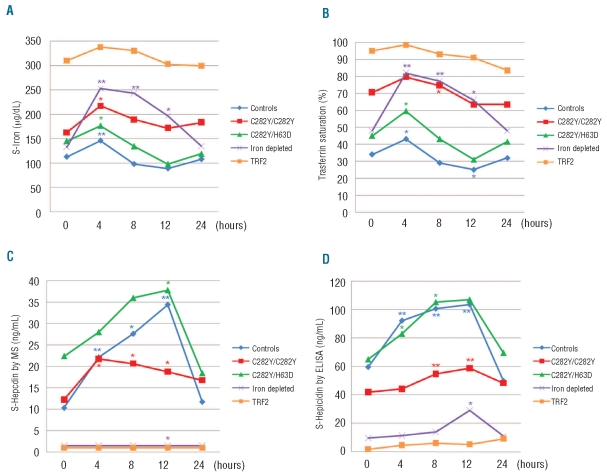
Design and methods: We analyzed serum iron, transferrin saturation, and serum hepcidin by both enzyme-linked immunosorbent assay and mass-spectrometry at baseline, and 4, 8, 12 and 24 hours after a single 65-mg dose of oral iron.
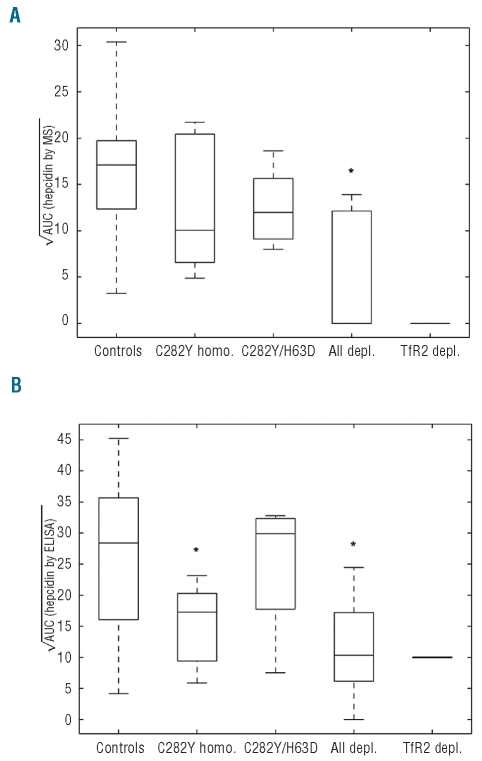
Results: Serum iron and transferrin saturation significantly increased at 4 hours and returned to baseline values at 8-12 hours in all groups, except in the iron-normalized patients who showed the highest and longest increase of both parameters. The level of hepcidin increased significantly at 4 hours and returned to baseline at 24 hours in controls and in the C282Y/H63D compound heterozygotes at diagnosis. The hepcidin response was smaller in C282Y-homozygotes than in controls, barely detectable in the patients with iron-depleted HFE-hemochromatosis and absent in those with TFR2-hemochromatosis. Conclusions Our results are consistent with a scenario in which TFR2 plays a prominent and HFE a contributory role in the hepcidin response to a dose of oral iron. In iron-normalized patients with HFE hemochromatosis, both the low baseline hepcidin level and the weak response to iron contribute to hyperabsorption of iron.
Figures
Comment in
-
Novel observations in hereditary hemochromatosis: potential implications for clinical strategies.Haematologica. 2011 Apr;96(4):485-8. doi: 10.3324/haematol.2011.042036. Haematologica. 2011. PMID: 21454877 Free PMC article. No abstract available.
References
-
- Camaschella C. Understanding iron homeostasis through genetic analysis of haemochromatosis and related disorders. Blood. 2005;106(12):3710–7. - PubMed
-
- Nemeth E, Tuttle MS, Powelson J, Vaughn MB, Donovan A, Ward DM, et al. Hepcidin regulates cellular iron efflux by binding to ferroportin and inducing its internalization. Science. 2004;306(5704):2090–3. - PubMed
-
- Roetto A, Papanikolaou G, Politou M, Alberti F, Girelli D, Christakis J, et al. Mutant antimicrobial peptide hepcidin is associated with severe juvenile haemochromatosis. Nat Genet. 2003;33(1):21–2. - PubMed
-
- Papanikolaou G, Samuels ME, Ludwig EH, MacDonald ML, Franchini PL, Dubé MP, et al. Mutations in HFE2 cause iron overload in chromosome 1q-linked juvenile haemochromatosis. Nat Genet. 2004;36(1):77–82. - PubMed
-
- Piperno A, Girelli D, Nemeth E, Trombini P, Bozzini C, Poggiali E, et al. Blunted hepcidin response to oral iron challenge in HFE-related haemochromatosis. Blood. 2007;110(12):4096–100. - PubMed
Publication types
MeSH terms
Substances
Grants and funding
LinkOut - more resources
Full Text Sources
Medical
Molecular Biology Databases