Review
. 2011 Feb 25;286(8):5935-41.
doi: 10.1074/jbc.R110.191429. Epub 2010 Dec 20.

Emerging role of alpha2,6-sialic acid as a negative regulator of galectin binding and function

Affiliations
Review

Emerging role of alpha2,6-sialic acid as a negative regulator of galectin binding and function

Ya Zhuo et al. J Biol Chem. .

Abstract

Galectins are β-galactoside-binding lectins that regulate diverse cell behaviors, including adhesion, migration, proliferation, and apoptosis. Galectins can be expressed both intracellularly and extracellularly, and extracellular galectins mediate their effects by associating with cell-surface oligosaccharides. Despite intensive current interest in galectins, strikingly few studies have focused on a key enzyme that acts to inhibit galectin signaling, namely β-galactoside α2,6-sialyltransferase (ST6Gal-I). ST6Gal-I adds an α2,6-linked sialic acid to the terminal galactose of N-linked glycans, and this modification blocks galectin binding to β-galactosides. This minireview summarizes the evidence suggesting that ST6Gal-I activity serves as an "off switch" for galectin function.


Figures
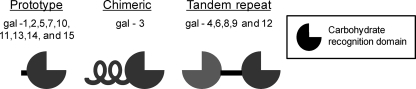
FIGURE 1.
FIGURE 1.
Galectins are categorized into three distinct groups. The prototype group contains one CRD and a short N-terminal sequence. The chimeric group, of which Gal-3 is the only member, contains one CRD and an extended N-terminal domain with a repeated collagen-like sequence. The tandem repeat group is composed of a single polypeptide chain that forms two distinct but homologous CRDs, separated by a short linker domain.
FIGURE 2.
FIGURE 2.
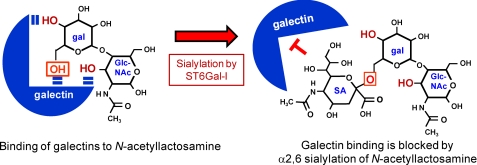
Structural studies suggest that three free OH groups are necessary for galectin binding to N-acetyllactosamine: 4-OH and 6-OH on galactose (gal) and 3-OH on GlcNAc (note that N-acetyllactosamine is defined as the GlcNAc-Gal disaccharide). The ST6Gal-I enzyme adds a sialic acid (SA; depicted as Neu-5-Ac) to 6-OH of galactose (boxed OH shown in red). The addition of sialic acid at this position blocks galectin binding.
FIGURE 3.
FIGURE 3.
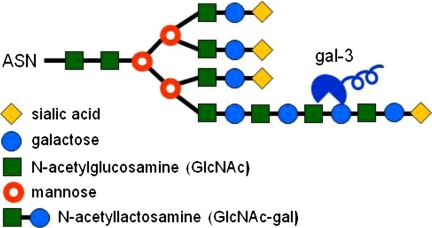
Gal-3 may bind internal N-acetyllactosamine units on an extended poly-N-acetyllactosamine chain, thus attenuating the inhibitory effect of the terminal α2,6-sialic acid.

References

    1. Chen X., Varki A. (2010) ACS Chem. Biol. 5, 163–176 - PMC - PubMed
    1. Schauer R. (2009) Curr. Opin. Struct. Biol. 19, 507–514 - PMC - PubMed
    1. Varki A., Angata T. (2006) Glycobiology 16, 1R–27R - PubMed
    1. Dall'Olio F. (2000) Glycoconj. J. 17, 669–676 - PubMed
    1. Crocker P. R., Paulson J. C., Varki A. (2007) Nat. Rev. Immunol. 7, 255–266 - PubMed

Publication types