


Association of parental ADHD and depression with externalizing and internalizing dimensions of child psychopathology
- PMID: 21173429
- PMCID: PMC6613577
- DOI: 10.1177/1087054710387264
Association of parental ADHD and depression with externalizing and internalizing dimensions of child psychopathology
Abstract
Objective: To study the independent association of parental depression and ADHD on three dimensions of child psychopathology among 178 children aged 5 to 10 years.
Method: Self-reported measures of parental depression and ADHD as well as rating scales and structure diagnostic interviews of child internalizing, ADHD, and externalizing problems were obtained.
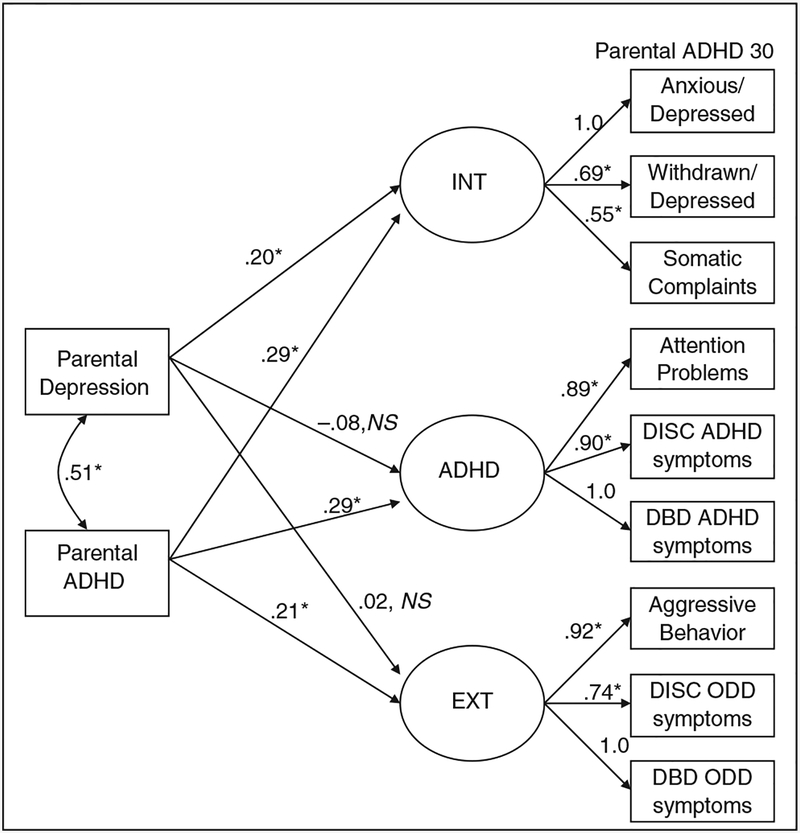
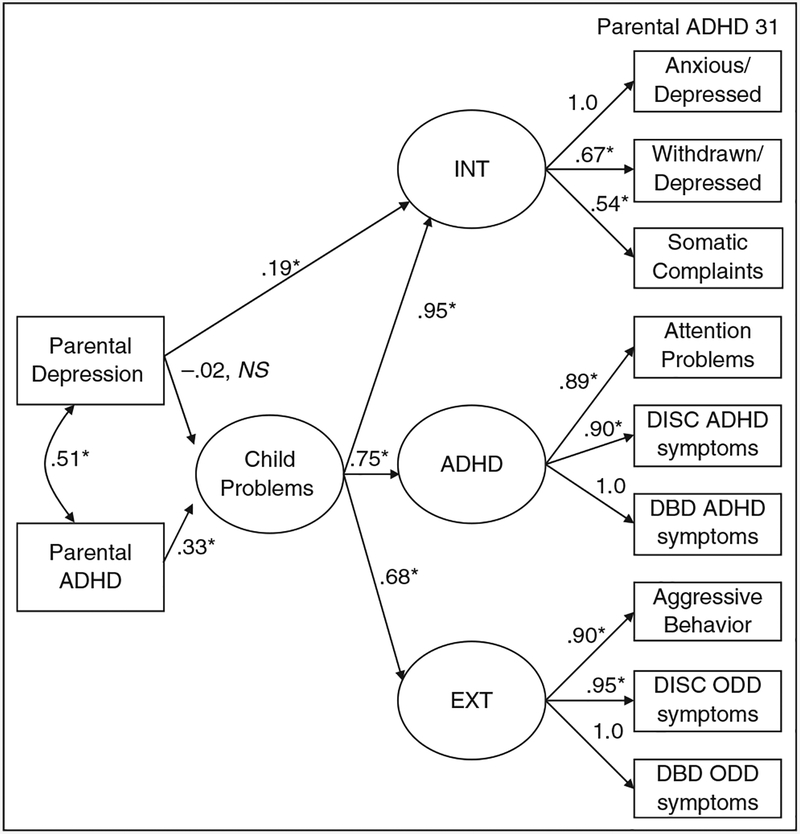
Results: Structural equation modeling indicated that parental ADHD was positively associated with a broad child problems factor after a second-order factor of child problems best accounted for the high intercorrelations among the internalizing, ADHD, and externalizing child psychopathology factors. Parental depression did not significantly predict the second-order child problems factor, but it specifically predicted the child internalizing factor.
Conclusion: These results suggest that parental ADHD may be a nonspecific risk factor for child psychopathology broadly, whereas parental depression may function as a specific risk factor for child internalizing problems.
Conflict of interest statement
Declaration of Conflicting Interests
The author(s) declared no potential conflicts of interests with respect to the authorship and/or publication of this article.
Figures
References
-
- Achenbach TM, & Edelbrock CS (1978). The classification of child psychopathology: A review and analysis of empirical efforts. Psychological Bulletin, 85, 1275–1301. - PubMed
-
- Achenbach TM, & Rescorla LA (2001). Manual for the ASEBA school-age forms and profiles: An integrated system of multi-informant assessment. Burlington, VT: Research Center for Children, Youth, and Families.
-
- American Psychiatric Association. (1994). Diagnostic and statistical manual of mental disorders (4th ed.). Washington, DC: Author.
-
- Banks T, Ninowski JE, Mash EJ, & Semple DL (2008). Parenting behavior and cognitions in a community sample of mothers with and without symptoms of attention-deficit/hyperactivity disorder. Journal of Child and Family Studies, 17, 28–43.
-
- Barkley RA (1989). Attention deficit-hyperactivity disorder In Mash EJ & Barkley RA (Eds.), Treatment of childhood disorders (pp. 39–72). New York, NY: Guilford.
Publication types
MeSH terms
Grants and funding
LinkOut - more resources
Full Text Sources
Medical
