Review
. 2010 Nov-Dec;7(6):775-87.
doi: 10.4161/rna.7.6.14249. Epub 2010 Nov 1.

RNA helicases: emerging roles in viral replication and the host innate response

Affiliations
Review

RNA helicases: emerging roles in viral replication and the host innate response

Arnaz Ranji et al. RNA Biol. 2010 Nov-Dec.

Abstract

RNA helicases serve multiple roles at the virus-host interface. In some situations, RNA helicases are essential host factors to promote viral replication; however, in other cases they serve as a cellular sensor to trigger the antiviral state in response to viral infection. All family members share the conserved ATP-dependent catalytic core linked to different substrate recognition and protein-protein interaction domains. These flanking domains can be shuffled between different helicases to achieve functional diversity. This review summarizes recent studies, which have revealed two types of activity by RNA helicases. First, RNA helicases are catalysts of progressive RNA-protein rearrangements that begin at gene transcription and culminate in mRNA translation. Second, RNA helicases can act as a scaffold for alternative protein-protein interactions that can defeat the antiviral state. The mounting fundamental understanding of RNA helicases is being used to develop selective and efficacious drugs against human and animal pathogens. The analysis of RNA helicases in virus model systems continues to provide insights into virology, cell biology and immunology, and has provided fresh perspective to continue unraveling the complexity of virus-host interactions.


Figures
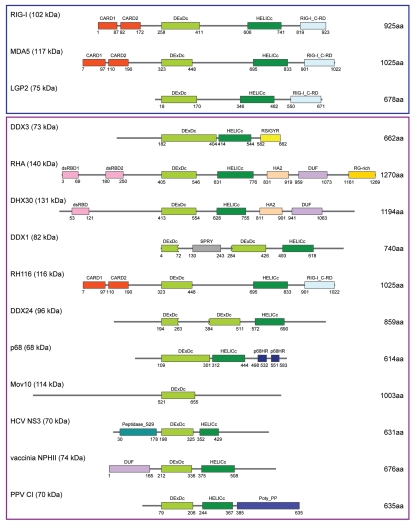
Figure 1
Figure 1
Domain structure of DExH/D helicases involved in viral replication. Upper rectangle: RNA helicases of the RIG-I-like receptor family are components of the innate antiviral response that attenuates viral replication. Lower rectangle: RNA helicases that promote viral replication. Protein sequences were retrieved from the NCBI conserved domains database and domains determined by annotation and query of the Uniprot database. The predicted molecular weight (kDa) and number of amino acid residues (aa) are indicated. Jagged edges indicate interruption by additional sequence or domains. Domains are: CARD, Caspase-activation and recruitment domain; DExDc, DEAD-like helicase superfamily ATP binding domain; HELICc, Helicase superfamily C-term domain associated with DExH/D box proteins; RIG-I_CRD, Regulatory domain of RIG-I; RS/GYR, Arginine/serine, glycine tyrosine-rich domain; dsRBD, Double-stranded RNA binding domain; HA2, Helicase-associated domain of unknown function; DUF, Domain of unknown function; RG-rich, arginine and glycine-rich domain; SPRY, SP1a and RYanodine receptor domain; p68HR, Characteristic of p68-like RNA helicase; Peptidase_S29, serine protease domain with trypsin-like fold; Poty_PP, Observed in polyproteins of the Potyviridae.
Figure 2
Figure 2
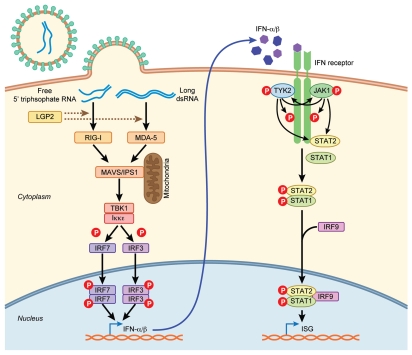
RNA helicases of the RIG-I-like receptor (RLR) family play a crucial role in the innate antiviral response. RLR family members, retinoic acid-inducible gene 1 (RIG-I/DDX58) and melanoma differentiation-associated gene 5 (MDA-5) are cytoplasmic sensors that detect viral RNA and trigger induction of the antiviral state. RIG-I and MDA-1 recognize viral RNA as foreign by features including free 5′ triphosphate ends, short double-stranded RNA (dsRNA) and long dsRNA (≥1 kb), respectively. RLR family member, laboratory of genetics and physiology 2 (LGP2) can antagonize this activity (dashed line) by regulation that is poorly understood. Interaction with their RNA ligands induces conformational changes in RIG-I and MDA-5 that favor interaction with mitochondria antiviral signaling (MAVS), also called interferon-beta promoter stimulator 1 (IPS-1). MAVS/IPS-1 activates the TANK-binding kinase 1 (TBK1)/IκB kinase-ε (IKKε) complex, which phosphorylate IFN-regulatory factor (IRF)-3, IRF-7 and NFκB (not shown). The IRFs dimerize, translocate to the nucleus and bind to target genes. Transcriptional activation of interferon (IFN) genes leads to production of IFNs (α and β), which are secreted from the cell. IFN binding to the IFN receptor activates the janus kinase (JAK)-signal transducer and activator of transcription (STAT) pathway. The JAK and tyrosine kinase 2 (TYK2) phosphorylate one another, the receptor and STAT2. STAT2 binds STAT1 and triggers phosphorylation and STAT1/2 dimerization. The STAT heterodimer translocates to the nucleus with IRF-9. They activate transcription of interferon stimulated genes (ISG), which generate the anti-viral state that attenuates viral replication.
Figure 3
Figure 3
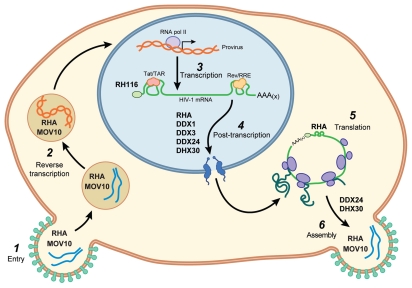
Cellular helicases involved in HIV-1 replication. DExH/D helicases with a known function in HIV-1 replication are indicated beside the corresponding step in the replication cycle of HIV-1: (1) Receptor-mediated entry; (2) Reverse transcription of viral genomic RNA to DNA and integration into host chromosome to render the provirus; (3) Transcription of HIV -1 provirus and accumulation of viral mRNA; (4) Post-transcription includes RNA processing and export from the nucleus; (5) Translation of viral transcripts on polysomes; (6) Assembly of viral structural and enzymatic proteins and unspliced viral transcript into progeny virions that bud from the plasma membrane.

References

    1. Silverman E, Edwalds-Gilbert G, Lin RJ. DExD/H-Box proteins and their partners: Helping RNA helicases unwind. Gene. 2003;312:1–16. - PubMed
    1. Rocak S, Linder P. DEAD-Box proteins: the driving forces behind RNA metabolism. Nat Rev Mol Cell Biol. 2004;5:232–241. - PubMed
    1. Fuller-Pace FV. DExD/H Box RNA helicases: Multifunctional proteins with important roles in transcriptional regulation. Nucleic Acids Res. 2006;34:4206–4215. - PMC - PubMed
    1. Linder P. Dead-Box proteins: a family affair—active and passive players in RNP-remodeling. Nucleic Acids Res. 2006;34:4168–4180. - PMC - PubMed
    1. Cordin O, Banroques J, Tanner NK, Linder P. The DEAD-Box protein family of RNA helicases. Gene. 2006;367:17–37. - PubMed

Publication types

MeSH terms

LinkOut - more resources