. 2011 Mar;106(2):263-72.
doi: 10.1007/s00395-010-0136-x. Epub 2010 Dec 21.

Diastolic dysfunction and arrhythmias caused by overexpression of CaMKIIδ(C) can be reversed by inhibition of late Na(+) current

Affiliations

Diastolic dysfunction and arrhythmias caused by overexpression of CaMKIIδ(C) can be reversed by inhibition of late Na(+) current

Samuel Sossalla et al. Basic Res Cardiol. 2011 Mar.

Abstract

Transgenic (TG) Ca(2+)/calmodulin-dependent protein kinase II (CaMKII) δ(C) mice develop systolic heart failure (HF). CaMKII regulates intracellular Ca(2+) handling proteins as well as sarcolemmal Na(+) channels. We hypothesized that CaMKII also contributes to diastolic dysfunction and arrhythmias via augmentation of the late Na(+) current (late I(Na)) in early HF (8-week-old TG mice). Echocardiography revealed severe diastolic dysfunction in addition to decreased systolic ejection fraction. Premature arrhythmogenic contractions (PACs) in isolated isometrically twitching papillary muscles only occurred in TG preparations (5 vs. 0, P < 0.05) which could be completely terminated when treated with the late I(Na) inhibitor ranolazine (Ran, 5 μmol/L). Force-frequency relationships revealed significantly reduced twitch force amplitudes in TG papillary muscles. Most importantly, diastolic tension increased with raising frequencies to a greater extent in TG papillary muscles compared to WT specimen (at 10 Hz: 3.7 ± 0.4 vs. 2.5 ± 0.3 mN/mm²; P < 0.05). Addition of Ran improved diastolic dysfunction to 2.1 ± 0.2 mN/mm² (at 10 Hz; P < 0.05) without negative inotropic effects. Mechanistically, the late I(Na) was markedly elevated in myocytes isolated from TG mice and could be completely reversed by Ran. In conclusion, our results show for the first time that TG CaMKIIδ(C) overexpression induces diastolic dysfunction and arrhythmogenic triggers possibly via an enhanced late I(Na). Inhibition of elevated late I(Na) had beneficial effects on arrhythmias as well as diastolic function in papillary muscles from CaMKIIδ(C) TG mice. Thus, late I(Na) inhibition appears to be a promising option for diastolic dysfunction and arrhythmias in HF where CaMKII is found to be increased.


Figures
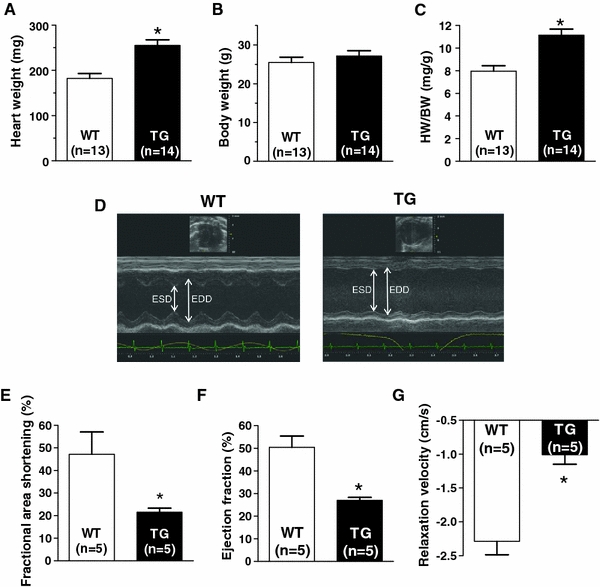
Fig. 1
Fig. 1
Cardiac phenotype characteristics. a Heart weight of TG CaMKIIδc mice was increased compared to WT (n = 14 vs. 13, P < 0.05), while b body weight remained unchanged. c Mean values of heart weight/body weight ratio (HW/BW). d Representative echocardiographic recordings of a WT and TG CaMKIIδc mouse. Mean values of e fractional area shortening and f ejection fraction (n = 5 each, P < 0.05). g A reduced relaxation velocity in TG CaMKIIδc mice indicates diastolic dysfunction (P < 0.05)
Fig. 2
Fig. 2
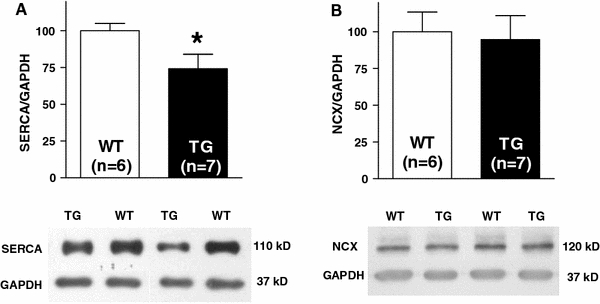
Protein analysis of SERCA and NCX. a Mean values of SERCA protein levels indicate a downregulation in TG CaMKIIδc mice (n = 6 vs. 7 WT, P < 0.05). b There was no difference in NCX protein expression between WT and TG CaMKIIδc (n = 7 vs. 6)
Fig. 3
Fig. 3
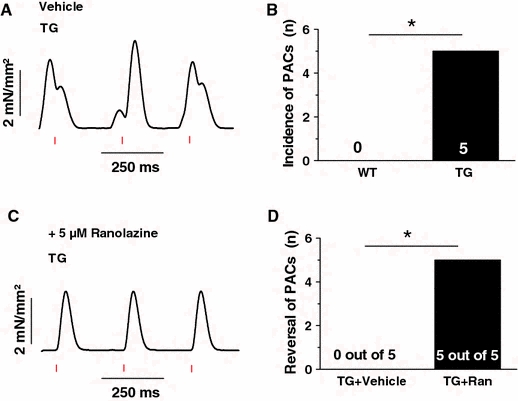
Spontaneous premature arrhythmogenic contractions (PACs). a Original tracings showing PACs in a TG CaMKIIδc muscle treated with vehicle control. The red marks indicate regular stimulation pulses (4 Hz). b Mean values of PACs in WT and CaMKIIδc muscles (n = 0 vs. 5, P < 0.05, Fisher′s test). c Addition of 5 μmol/L ranolazine (Ran) reversed the PACs in the same preparation back to a stimulation-dependent rhythm. d All PACs in CaMKIIδc muscles could be reversed by Ran addition (P < 0.05, Fisher′s test)
Fig. 4
Fig. 4
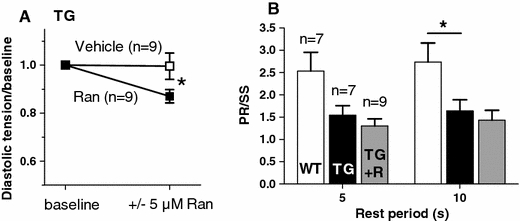
a Basal effects of 5 μmol/L ranolazine (Ran) on diastolic tension of TG CaMKIIδc muscles (n = 9 each, P < 0.05). b Mean values of post-rest behavior (ratio of first twitch after rest normalized to the last one before rest, PR/SS) indicating impaired post-rest behavior in TG CaMKIIδc mice (at 10 s of rest: n = 7 each, P < 0.05). Ran did not cause contractile differences compared to vehicle treated specimen (n = 7 vs. 9)
Fig. 5
Fig. 5
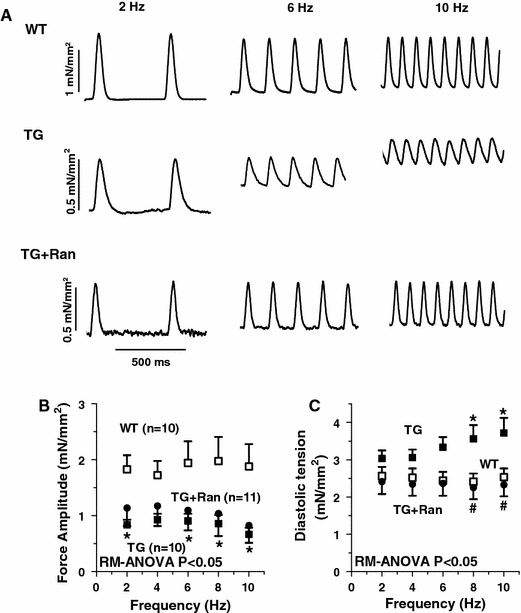
Force–frequency relationships. a Original tracings of muscles isolated from WT and CaMKIIδc TG mice without and with 5 μmol/L ranolazine (Ran) at increasing frequencies. While the WT muscle did not develop an increase in diastolic tension, the CaMKIIδc TG muscle exhibit a marked diastolic dysfunction that could be reduced Ran. b Mean data of twitch force amplitude of WT and CaMKIIδc TG muscles with and without Ran (n = 10 vs. 11 vs. 11, WT vs. TG, P < 0.05). c Average values showing increases in diastolic tension in CaMKIIδc TG muscles that could be reduced in the presence of Ran (P < 0.05)
Fig. 6
Fig. 6
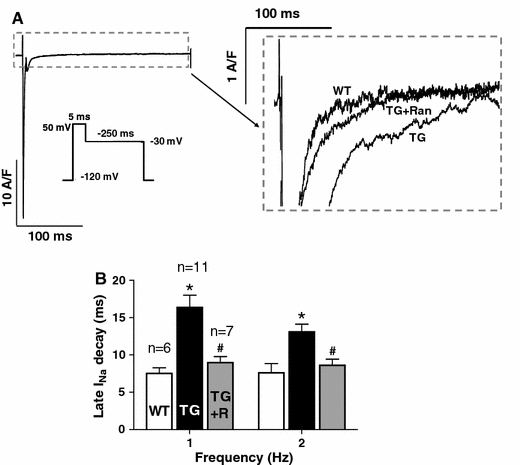
a Original late I Na tracings at 1 Hz in WT and CaMKIIδc TG myocytes in the presence and absence of 5 μmol/L ranolazine (Ran). The voltage protocol is shown in the inset. b Na+ current decay was fitted with a double exponential equation. The time constant of the late decay phase was markedly prolonged in myocytes from CaMKIIδc TG mice vs. WT (n = 11 vs. 6, P < 0.05). Addition of Ran shortened this time constant in myocytes from CaMKIIδc TG mice consistent with substantial late I Na inhibition (n = 7, P < 0.05)

References

    1. Aiba T, Hesketh GG, Liu T, Carlisle R, Villa-Abrille MC, O’Rourke B, Akar FG, Tomaselli GF. Na+ channel regulation by Ca2+/calmodulin and Ca2+/calmodulin-dependent protein kinase II in guinea-pig ventricular myocytes. Cardiovasc Res. 2010;85:454–463. doi: 10.1093/cvr/cvp324. - DOI - PMC - PubMed
    1. Antzelevitch C, Belardinelli L, Zygmunt AC, Burashnikov A, Di Diego JM, Fish JM, Cordeiro JM, Thomas G. Electrophysiological effects of ranolazine, a novel antianginal agent with antiarrhythmic properties. Circulation. 2004;110:904–910. doi: 10.1161/01.CIR.0000139333.83620.5D. - DOI - PMC - PubMed
    1. Beuckelmann DJ, Nabauer M, Erdmann E. Intracellular calcium handling in isolated ventricular myocytes from patients with terminal heart failure. Circulation. 1992;85:1046–1055. - PubMed
    1. Collins KA, Korcarz CE, Lang RM. Use of echocardiography for the phenotypic assessment of genetically altered mice. Physiol Genomics. 2003;13:227–239. - PubMed
    1. Despa S, Islam MA, Weber CR, Pogwizd SM, Bers DM. Intracellular Na+ concentration is elevated in heart failure but Na+/K+ pump function is unchanged. Circulation. 2002;105:2543–2548. doi: 10.1161/01.CIR.0000016701.85760.97. - DOI - PubMed

Publication types

MeSH terms

Substances