


Review
doi: 10.1007/s00467-010-1714-8.
Epub 2010 Dec 21.
Fetal environment, epigenetics, and pediatric renal disease
Affiliations
- PMID: 21174217
- PMCID: PMC3063864
- DOI: 10.1007/s00467-010-1714-8
Item in Clipboard
Review
Fetal environment, epigenetics, and pediatric renal disease
Pediatr Nephrol.
2011 May.
Abstract
The notion that some adult diseases may have their origins in utero has recently captured scientists' attention. Some of these effects persist across generations and may involve epigenetic mechanisms. Epigenetic modifications, DNA methylation together with covalent modifications of histones, alter chromatin density and accessibility of DNA to cellular machinery, modulating the transcriptional potential of the underlying DNA sequence. Here, we will discuss the different epigenetic modifications and their potential role in and contribution to renal disease development.
Figures
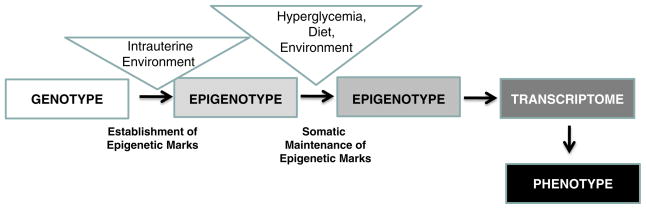
The phenotype (or disease) development depends on genetic and epigenetic factors. During normal development, somatic cells descending from a single progenitor and containing a similar genotype will differentiate to acquire diverse biological functions by expressing and repressing different sets of genes via establishing new epigenetic marks. While the genotype of an individual does not change, hyperglycemia, uremia, different dietary and environmental factors might change the epigenome of cells leading to differences in gene and protein expression. Differences in the epigenotype might be responsible for the development of a differing (including disease) phenotype. While the genotype is stable, there is a more dynamic link between environmental factors and phenotype development
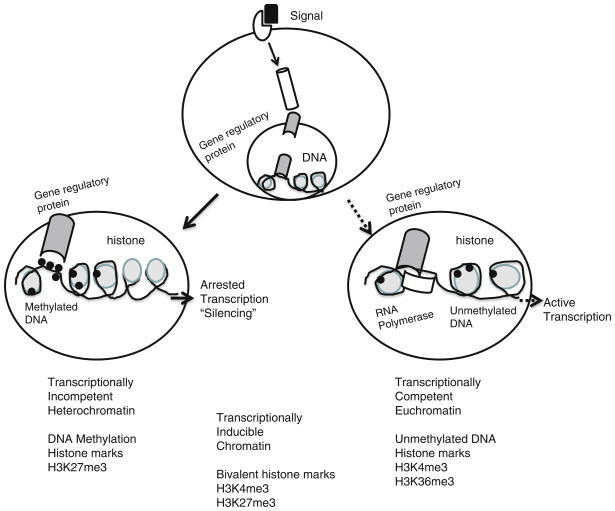
The effect of different external signals depends on epigenetic modification in the target cells. The cellular response to external signals may reflect chromatin-based (epigenetic) differences superimposed on the static genetic code. In this example, the 5-regulatory region of a disease susceptibility gene is depicted in cells. In some cells, the promoter assumes an “open” chromatin architecture characterized by activated histone posttranslational marks, decreased nucleosome density, and the lack of DNA methylation. RNA polymerase II is recruited to the promoter, resulting in productive transcription. Alternatively, in other cells the genetically identical promoter assumes a “closed” chromatin configuration characterized by repressive posttranslational marks, increased nucleosome density, and prominent DNA methylation. RNA polymerase II is not recruited to the promoter, and no transcription occurs. Transcriptionally competent euchromatin is usually associated with unmethylated DNA, and trimethyl H3K4me3 and H3K36me3 marks. Transcription-ally incompetent heterochromatin is generally associated with methylated DNA and trimethyl H3K27 marks
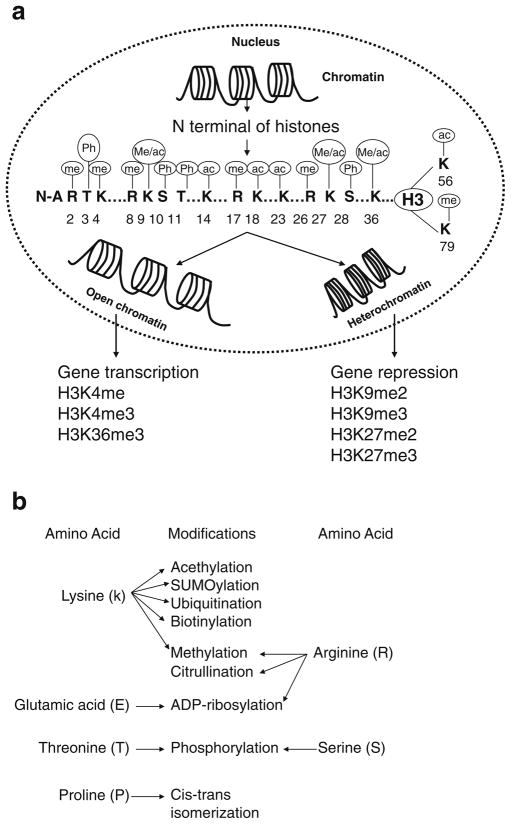
Different histone tail modifications and their effects on gene transcription. a The different H3 histone tail modifications at the amino acid resolution level (aa 1-79) and their modifications, ac acetylation, me methylation, ph phosphorylation. Below is the most common histone modification and the effect on gene transcription i.e. repression and/or active transcription. b The different post-translational modifications of the different histone amino-acids
References
-
- Knoll JH, Nicholls RD, Magenis RE, Graham JM, Jr, Lalande M, Latt SA. Angelman and Prader-Willi syndromes share a common chromosome 15 deletion but differ in parental origin of the deletion. Am J Med Genet. 1989;32:285–290. - PubMed
-
- Yamanaka S. Elite and stochastic models for induced pluripotent stem cell generation. Nature. 2009;460:49–52. - PubMed
Publication types
MeSH terms
Grants and funding
LinkOut - more resources
Full Text Sources
Medical
