. 2010 Dec;70(6):854-69.
doi: 10.1111/j.1365-2125.2010.03791.x.

In vitro and in vivo oxidative metabolism and glucuronidation of anastrozole

Affiliations

In vitro and in vivo oxidative metabolism and glucuronidation of anastrozole

Landry K Kamdem et al. Br J Clin Pharmacol. 2010 Dec.

Abstract

Aims: Little information is available regarding the metabolic routes of anastrozole and the specific enzymes involved. We characterized anastrozole oxidative and conjugation metabolism in vitro and in vivo.

Methods: A sensitive LC-MS/MS method was developed to measure anastrozole and its metabolites in vitro and in vivo. Anastrozole metabolism was characterized using human liver microsomes (HLMs), expressed cytochrome P450s (CYPs) and UDP-glucuronosyltransferases (UGTs).

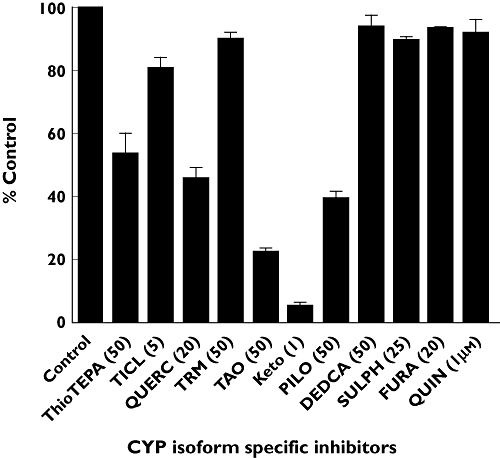
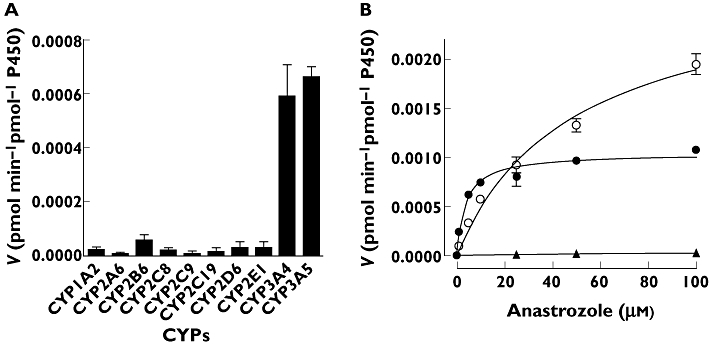
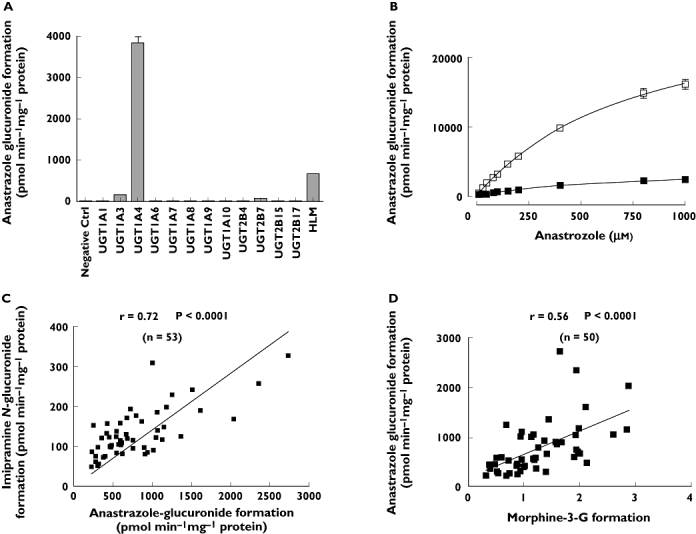
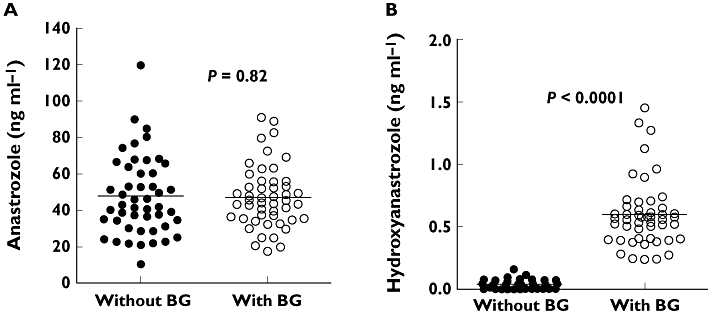
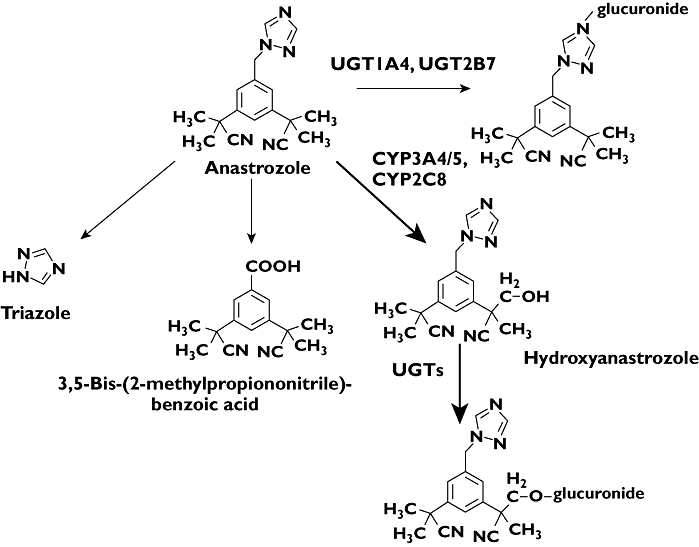
Results: Hydroxyanastrozole and anastrozole glucuronide were identified as the main oxidative and conjugated metabolites of anastrozole in vitro, respectively. Formation of hydroxyanastrozole from anastrozole was markedly inhibited by CYP3A selective chemical inhibitors (by >90%) and significantly correlated with CYP3A activity in a panel of HLMs (r= 0.96, P= 0.0005) and mainly catalyzed by expressed CYP3A4 and CYP3A5. The K(m) values obtained from HLMs were also close to those from CYP3A4 and CYP3A5. Formation of anastrozole glucuronide in a bank of HLMs was correlated strongly with imipramine N-glucuronide, a marker of UGT1A4 (r= 0.72, P < 0.0001), while expressed UGT1A4 catalyzed its formation at the highest rate. Hydroxyanastrozole (mainly as a glucuronide) and anastrozole were quantified in plasma of breast cancer patients taking anastrozole (1 mg day⁻¹); anastrozole glucuronide was less apparent.

Conclusion: Anastrozole is oxidized to hydroxyanastrozole mainly by CYP3A4 (and to some extent by CYP3A5 and CYP2C8). Once formed, this metabolite undergoes glucuronidation. Variable activity of CYP3A4 (and probably UGT1A4), possibly due to genetic polymorphisms and drug interactions, may alter anastrozole disposition and its effects in vivo.


Figures

Figure 1
Figure 1
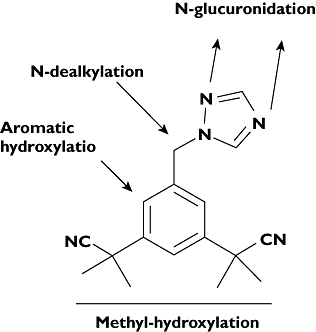
Anastrozole chemical structure and potential sites of metabolism
Figure 2
Figure 2
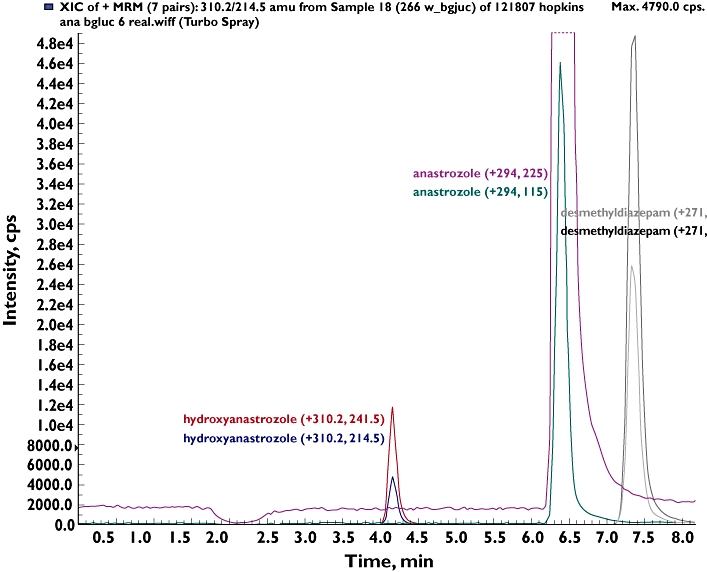
Representative Multiple Reaction Monitoring (MRM) trace chromatograms of anastrozole and its mono-hydroxylated metabolite after incubation of anastrozole (20 µm) in human liver microsomal incubations. Quantifier and qualifier MRMs are shown. The internal stand was desmethyldiazepam
Figure 3
Figure 3
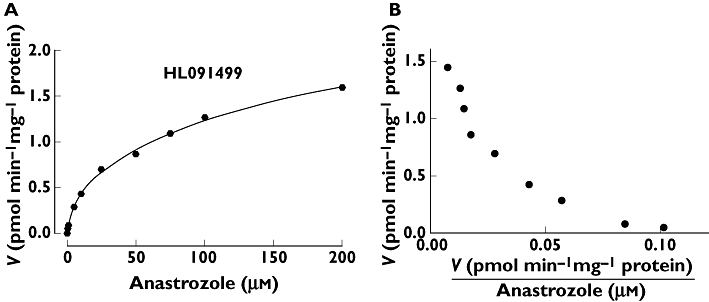
Representative enzyme kinetic plots for the formation of hydroxyanastrozole in three human liver microsomes (HL091499). Anastrozole (0–200 µm) was incubated for 30 min at 37°C with HLMs (0.5 mg ml−1). Each microsomal incubation experiment was carried out in duplicate
Figure 4
Figure 4
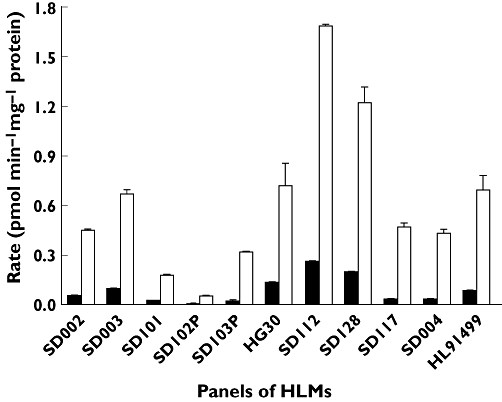
Formation rate of hydroxyanastrozole in a panel of characterized HLMs. Anastrozole (1 µm or 20 µm) was incubated for 30 min at 37°C with HLMs (0.5 mg ml−1). Each microsomal incubation experiment was carried out in duplicate. 1 µm (formula image); 20 µm (□)
Figure 5
Figure 5
Inhibition of hydroxyanastrozole formation from anastrozole by a panel of CYP enzyme specific inhibitors. The final concentrations of the inhibitors used are indicated in parentheses. Anastrozole (10 µm) was incubated for 30 min at 37°C with HLMs (0.5 mg ml−1) in the presence or absence of chemical inhibitors. Each microsomal incubation experiment was carried out in duplicate. Abbreviations: TICL ticlopidine (CYP2B6 and CYP2C19), QUERC quercetin (CYP2C8), TMP trimethoprim (CYP2C8), TAO troleandomycin (CYP3A), Keto ketoconazole (CYP3A), PILO pilocarpine (CYP2A6), DEDCA diethyldiothicarbamate (CYP2E1), SULPH sulfaphenazole (CYP2C9), FURA furafylline (CYP1A2), QUIN quinidine
Figure 6
Figure 6
Metabolism of anastrozole to hydroxyanastrozole by expressed human CYP enzymes. (A) Formation rate of hydroxyanastrozole from anastrozole in a panel of expressed human CYPs. Anastrozole (20 µm) was incubated for 30 min at 37°C with each isoform (52 pmol ml−1). Each microsomal incubation experiment was carried out in duplicate. (B) Representative enzyme kinetic plots for hydroxyanastrozole formation by CYP3A4, CYP3A5 and CYP2C8 in the absence of cytochrome b5 (b). Anastrozole (0–100 µm) was incubated for 30 min at 37°C with each isoform (52 pmol ml−1). Each microsomal incubation experiment was carried out in duplicate. (B) CYP3A4 (formula image); CYP3A5 (formula image); CYP2C8 (formula image)
Figure 7
Figure 7
Anastrozole glucuronidation in HLMs and UGTs enzymes. (A) Formation rate of anastrozole glucuronide from anastrozole single concentration in a panel of purified human UGTs. Incubations were performed with 0.5 mg ml−1 microsomal protein and 500 µm anastrozole for 90 min at 37°C. Data represent means of duplicate determinations from a single experiment. (B) Kinetics of anastrozole glucuronidation by recombinant human UGT1A4 and pooled HLMs. Anastrozole (10–1000 µm) was incubated with pooled HLMs and UGT1A4 at 37°C for 90 min. Data represent the mean of duplicate determinations. (C) Pearson correlation between anastrozole glucuronide formation rate and imipramine glucuronidation (UGT1A4 probe substrate) formation rate in a bank of human liver samples (n = 53). (D) Pearson correlation between anastrozole glucuronide formation rate and morphine 3-glucuronidation (UGT2B7 probe substrate) formation rate in a bank of human liver samples (n = 50). (B) recombinant UGT1A4 (□); pooled HLM (formula image)
Figure 8
Figure 8
Plasma concentrations of anastrozole (A) and hydroxyanastrozole (B) in postmenopausal women with breast cancer taking 1 mg day−1 anastrozole orally. Six or 12 month plasma samples were analyzed without β-glucuronidase (BG) and after incubation with β-glucuronidase (BG). (A) Without BG (•); With BG (○); (B) Without BG (•); With BG (○)
Figure 9
Figure 9
In vitro biotransformation pathways of anastrozole to its primary and secondary metabolites and the specific CYP and UGT enzymes involved. The principal enzymes responsible for each eliminating pathway are indicated. The relative contribution of each pathway to the overall metabolism of anastrozole is shown by the thickness of the arrow, and the principal CYP enzymes responsible are highlighted in bold

References

    1. Parkin DM, Bray F, Ferlay J, Pisani P. Global cancer statistics, 2002. CA Cancer J Clin. 2005;55:74–108. - PubMed
    1. American Cancer Society. Breast cancer facts and figures 2009–2010. 2010:1–36.
    1. Osborne CK. Tamoxifen in the treatment of breast cancer. N Engl J Med. 1998;339:1609–18. - PubMed
    1. Smith IE, Dowsett M. Aromatase inhibitors in breast cancer. N Engl J Med. 2003;348:2431–42. - PubMed
    1. Forbes JF, Cuzick J, Buzdar A, Howell A, Tobias JS, Baum M. Effect of anastrozole and tamoxifen as adjuvant treatment for early-stage breast cancer: 100-month analysis of the ATAC trial. Lancet Oncol. 2008;9:45–53. - PubMed

Publication types

MeSH terms