. 2011 Mar;23(3):269-81.
doi: 10.1111/j.1365-2826.2010.02105.x.

Hyperphagia and leptin resistance in tissue inhibitor of metalloproteinase-2 deficient mice

Affiliations

Hyperphagia and leptin resistance in tissue inhibitor of metalloproteinase-2 deficient mice

H M Stradecki et al. J Neuroendocrinol. 2011 Mar.

Abstract

Obesity is a complex genetic and behavioural disorder arising from the improper integration of peripheral signals at central autonomic centres. For the hypothalamus to respond to dynamic physiological alterations, it must retain a degree of plasticity throughout life. Evidence is mounting that an intricate balance between matrix metalloproteinase (MMP)-mediated extracellular matrix proteolysis and tissue inhibitor of metalloproteinase (TIMP)-mediated proteolysis inhibition contributes to tissue remodelling. However, few studies have examined the role of MMPs/TIMPs in hypothalamic remodelling and energy homeostasis. To determine the contribution of TIMP-2 to the hypothalamic regulation of feeding, body mass and food consumption were monitored in TIMP-2 knockout (KO) mice fed a standard chow or high-fat diet (HFD). TIMP-2 KO mice of both sexes gained more weight than wild-type (WT) mice, even when fed the chow diet. Before the onset of obesity, TIMP-2 KO mice were hyperphagic, without increased orexigenic or decreased anorexigenic neuropeptide expression, but leptin resistant (i.e. reduced leptin-induced anorexigenic response and signal transducer and activator of transcription 3 activation). HFD exacerbated weight gain and hyperleptinaemia. In addition, proteolysis was increased in the arcuate nucleus of TIMP-2 KO mice. These data suggest a role for TIMP-2 in hypothalamic control of feeding and energy homeostasis.


Conflict of interest statement

Disclosures

No con icts of interest, nancial or otherwise, are declared by the author(s).

Figures
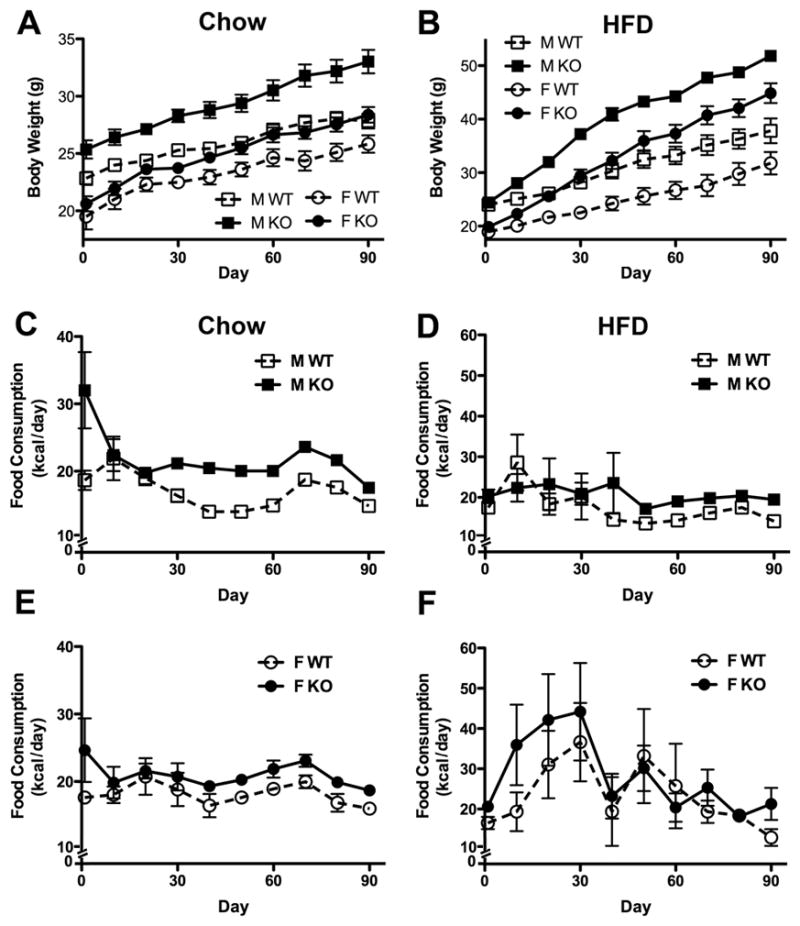
Fig. 1
Fig. 1
TIMP-2 KO mice gain more weight than WT mice regardless of diet. Both sexes of two-month-old TIMP-2 KO mice fed a chow (A) or HFD (B) for 3 months gained significantly more weight than WT mice (as determined by weight slope; chow: M p = 0.03, F p = 0.04; HFD: M p = 0.0001, F p = 0.0003). (C-F) Examination of average daily food consumption revealed that chow- (C, E) and HFD-fed (D, F) TIMP-2 KO mice failed to modify food intake despite increased body weight. Decreased food consumption in chow-fed mice after day 68 was due to overnight starvation and insulin tolerance testing (data not shown). Data are mean ± SEM. n = 8 per sex, genotype, and diet.
Fig. 2
Fig. 2
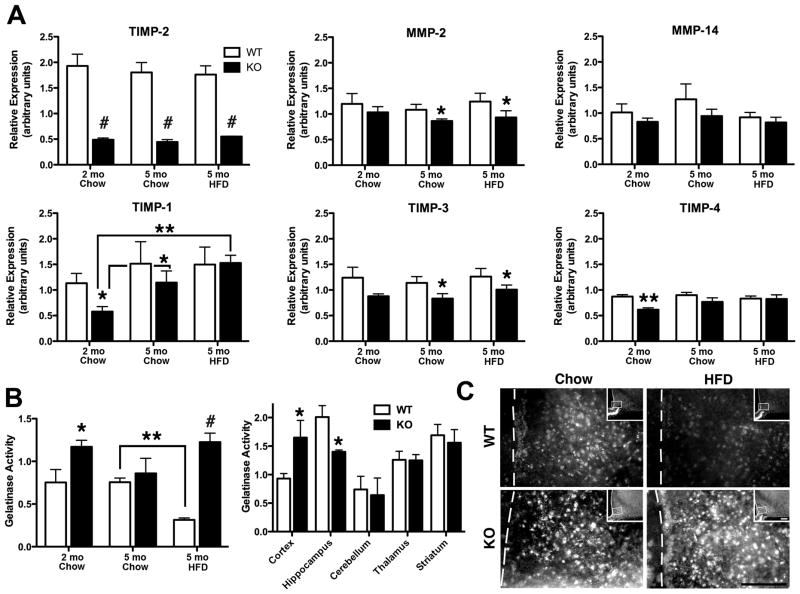
Net proteolytic activity is increased in male TIMP-2 KO hypothalamus. (A) qPCR revealed that, at least at the mRNA level, there is no overall compensation by other TIMPs in response to TIMP-2 absence. There was no effect of diet at the study termination, but when compared to the study start TIMP-1 mRNA expression was increased in chow-fed (p = 0.03) and HFD-fed (p = 0.002) TIMP-2 KO mice while no increase was observed in WT mice. (B) Using a caged substrate that emits fluorescence when cleaved by proteases, it was revealed that net proteolytic activity was increased in TIMP-2 KO hypothalamus, but not globally increased throughout the entire TIMP-2 KO brain. Interestingly, while WT mice decreased proteolytic activity on the HFD, proteolysis remained elevated in HFD-fed TIMP-2 KO mice, suggesting that the inability to effectively inhibit proteolysis may contribute to defective energy homeostasis and obesity. (C) In situ zymography confirmed the results of the gelatinase assay and specifically revealed increased proteolysis within the arcuate nucleus of TIMP-2 KO mice. Data are mean ± SEM. n = 4 – 5 per genotype and diet. *p < 0.05, **p ≤ 0.01, #p≤0.001 relative to WT mice on the same diet, unless otherwise indicated.
Fig. 3
Fig. 3
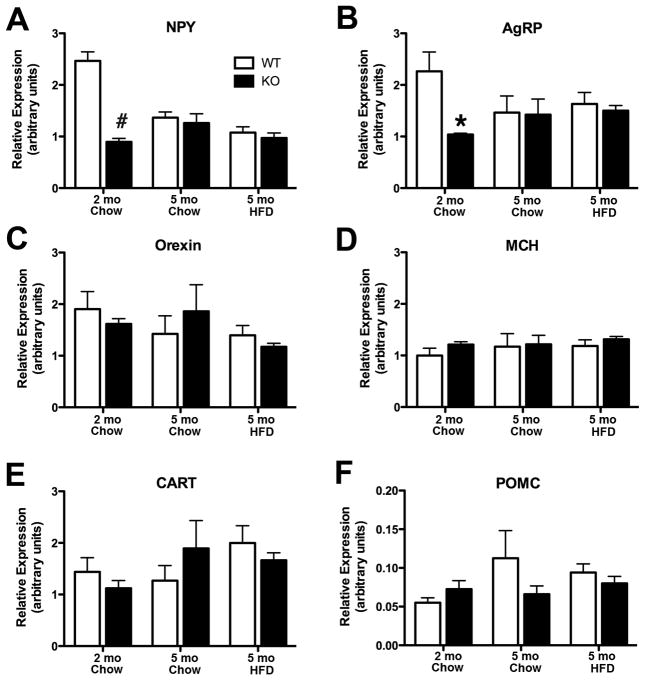
Alterations in hypothalamic neuropeptide mRNA expression are not the basis for increased TIMP-2 KO food consumption. Orexigenic (i.e., NPY, AgRP, orexin, MCH) and anorexigenic (i.e., CART, POMC) neuropeptide mRNA expression in micro-dissected male hypothalami was determined by qPCR. Both arcuate-derived NPY (A) and AgRP (B) mRNA expression was reduced in TIMP-2 KO mice at the study start, but not termination. No differences, either in genotype or diet, were observed for transcript levels of orexin (C) and MCH (D), most prevalent in the lateral hypothalamus, or arcuate-derived CART (D) and POMC (E). Data are mean ± SEM. n = 4 – 5 per genotype and diet. *p < 0.05, #p ≤ 0.001 relative to WT mice on the same diet.
Fig. 4
Fig. 4
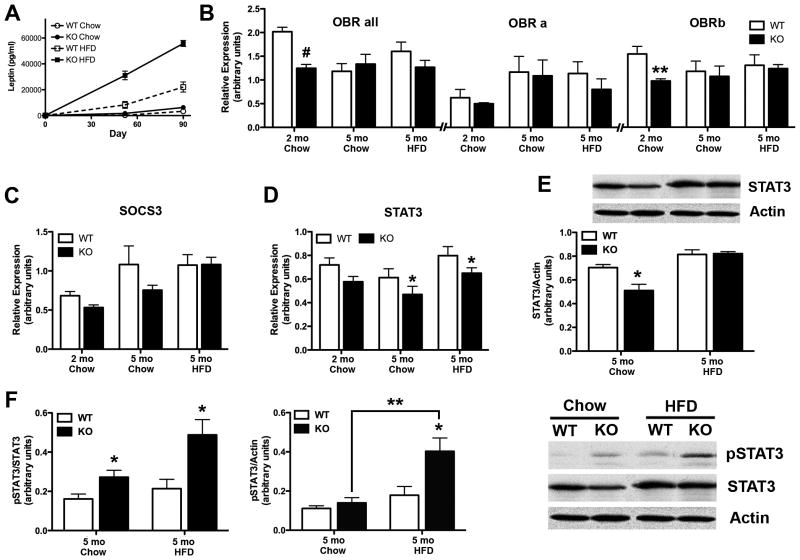
TIMP-2 KO mice exhibit leptin-signalling deficiencies. (A) EIA of serum leptin revealed comparable leptin levels in weight-matched male WT and TIMP-2 KO mice at the study start (WT = 86.97 ± 33.47 pg/ml, KO = 131.1 ± 35.28 pg/ml, p = 0.39). While leptin levels increased greater in TIMP-2 KO mice than WT mice throughout the study, this increase was proportional to their body weight (R2 = 0.85). n = 6 per genotype and diet. (B-D) qPCR was used to analyze mRNA expression of components of the leptin signalling cascade in male hypothalami. n = 4 – 5 per genotype and diet. (E) Western blot analysis confirmed PCR findings of decreased STAT3 mRNA expression in chow-fed TIMP-2 KO mice. (F) Basal STAT3 activation was examined at the study termination. Since total STAT3 expression was decreased in chow-fed mice (E), pSTAT3 expression was normalized both to total STAT3 (left graph) and to actin (right graph). HFD increased STAT3 activation in TIMP-2 KO mice to a greater extent than in WT mice. n = 6 - 7 per genotype and diet. Data are mean ± SEM. *p < 0.05, **p ≤ 0.01, #p≤0.001 relative to WT mice on the same diet, unless otherwise indicated.
Fig. 5
Fig. 5
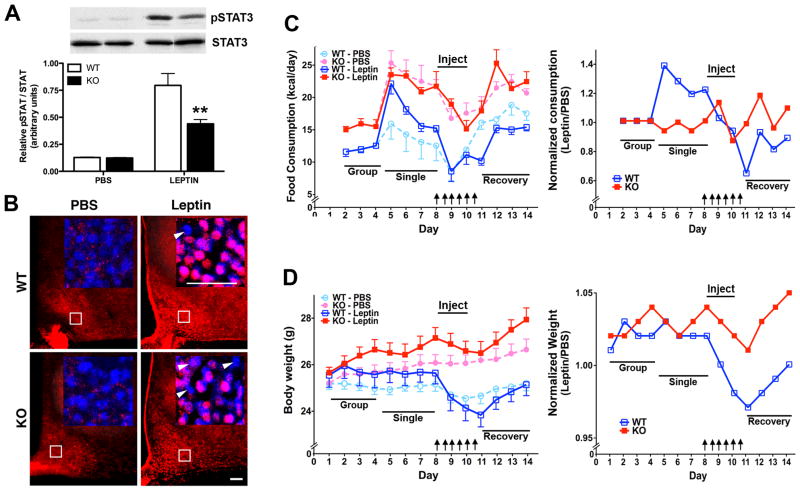
Attenuated leptin-mediated anorectic responses in TIMP-2 KO mice. (A-B) STAT3 activation was assessed in weight-matched (WT = 24.06 ± 0.39 g, KO = 23.49 ± 0.41 g, p = 0.33) 8-week-old mice 30 minutes after a single injection of PBS or leptin (5 μg/g). (A) Western blot analysis showed decreased leptin-mediated STAT3 activation in TIMP-2 KO mice. n = 5. (B) Immunohistochemistry revealed fewer pSTAT3-labelled cells (red, pink in inset) in the arcuate nucleus of TIMP-2 KO mice (arrowheads indicate non-leptin responsive cells). Cell nuclei are counterstained with Hoechst (blue). Images representative of n = 4. Scale bars = 50 μm. (C) The effect of leptin (1 μg/g) administration (indicated by arrows) on food consumption. TIMP-2 KO mice exhibited an attenuated leptin-mediated anorectic response (p = 0.015, intake at day 11 relative to 2 days prior to leptin administration; p < 0.0001, 2-way ANOVA over entire study). Similar results are obtained when normalized to PBS injected mice. (D) Leptin-mediated weight loss was similarly attenuated in TIMP-2 KO mice (p < 0.0001, percent weight loss at day 11 relative to 2 days prior to leptin administration; p < 0.0001, 2-way ANOVA over entire study). Similar results are obtained when normalized to PBS injected mice. Data are mean ± SEM. **p≤0.01 relative to WT mice on the same diet, unless otherwise indicated.

References

    1. Frederich RC, Lollmann B, Hamann A, Napolitano-Rosen A, Kahn BB, Lowell BB, Flier JS. Expression of ob mRNA and its encoded protein in rodents. Impact of nutrition and obesity. J Clin Invest. 1995;96:1658–63. - PMC - PubMed
    1. Zhang Y, Proenca R, Maffei M, Barone M, Leopold L, Friedman JM. Positional cloning of the mouse obese gene and its human homologue. Nature. 1994;372:425–32. - PubMed
    1. Hegyi K, Fülöp K, Kovács K, Tóth S, Falus A. Leptin-induced signal transduction pathways. Cell Biol Int. 2004;28:159–69. - PubMed
    1. Valassi E, Scacchi M, Cavagnini F. Neuroendocrine control of food intake. Nutr Metab Cardiovasc Dis. 2008;18:158–68. - PubMed
    1. Farooqi IS, O’Rahilly S. Monogenic obesity in humans. Annu Rev Med. 2005;56:443–58. - PubMed

Publication types

MeSH terms

Substances