


A primary care level algorithm for identifying HIV-infected adolescents in populations at high risk through mother-to-child transmission
- PMID: 21176006
- PMCID: PMC3132444
- DOI: 10.1111/j.1365-3156.2010.02708.x
A primary care level algorithm for identifying HIV-infected adolescents in populations at high risk through mother-to-child transmission
Abstract
Objective: To present an algorithm for primary-care health workers for identifying HIV-infected adolescents in populations at high risk through mother-to-child transmission.
Methods: Five hundred and six adolescent (10-18 years) attendees to two primary care clinics in Harare, Zimbabwe, were recruited. A randomly extracted 'training' data set (n = 251) was used to generate an algorithm using variables identified as associated with HIV through multivariable logistic regression. Performance characteristics of the algorithm were evaluated in the remaining ('test') records (n = 255) at different HIV prevalence rates.
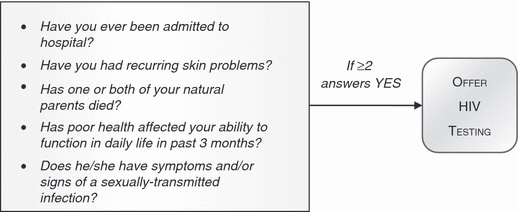
Results: HIV prevalence was 17%, and infection was independently associated with client-reported orphanhood, past hospitalization, skin problems, presenting with sexually transmitted infection and poor functional ability. Classifying adolescents as requiring HIV testing if they reported >1 of these five criteria had 74% sensitivity and 80% specificity for HIV, with the algorithm correctly predicting the HIV status of 79% of participants. In low-HIV-prevalence settings (<2%), the algorithm would have a high negative predictive value (≥ 99.5%) and result in an estimated 60% decrease in the number of people needing to test to identify one HIV-infected individual, compared with universal testing.
Conclusions: Our simple algorithm can identify which individuals are likely to be HIV infected with sufficient accuracy to provide a screening tool for use in settings not already implementing universal testing policies among this age-group, for example immigrants to low-HIV-prevalence countries.
© 2010 Blackwell Publishing Ltd.
Figures
References
-
- AIAU, NSHPC & CHIVA. Perinatal Transmission of HIV in England, 2002–2005. London: AIAU, NSHPC & CHIVA; 2007.
-
- AIDS Epidemic Update. Geneva, Switzerland: UNAIDS and WHO; 2009.
-
- Arpadi SM. Growth failure in children with HIV infection. Journal of Acquired Immune Deficiency Syndromes. 2000;25(Suppl. 1):S37–S42. - PubMed
-
- Buchacz K, Rogol AD, Lindsey JC, et al. Delayed onset of pubertal development in children and adolescents with perinatally acquired HIV infection. Journal of Acquired Immune Deficiency Syndromes. 2003;33:56–65. - PubMed
Publication types
MeSH terms
Grants and funding
LinkOut - more resources
Full Text Sources
Medical
Miscellaneous
