


Green tea polyphenol EGCG blunts androgen receptor function in prostate cancer
- PMID: 21177307
- PMCID: PMC3058706
- DOI: 10.1096/fj.10-167924
Green tea polyphenol EGCG blunts androgen receptor function in prostate cancer
Abstract
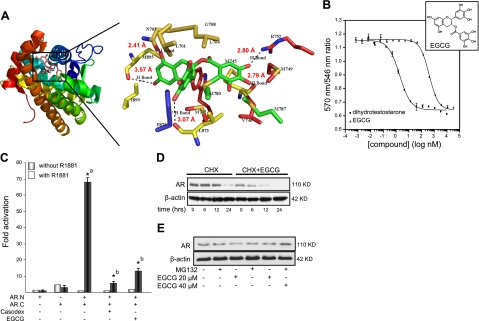
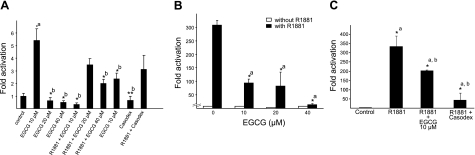
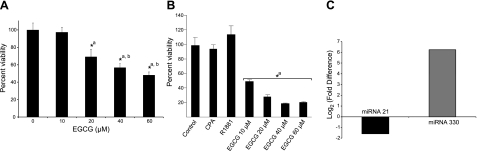
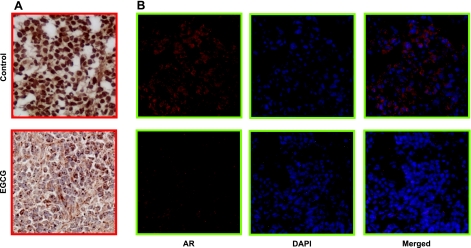
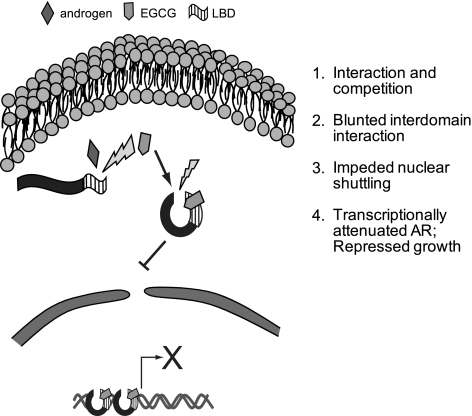
Androgen deprivation therapy is the major treatment for advanced prostate cancer (PCa). However, it is a temporary remission, and the patients almost inevitably develop hormone refractory prostate cancer (HRPC). HRPC is almost incurable, although most HRPC cells still express androgen receptor (AR) and depend on the AR for growth, making AR a prime drug target. Here, we provide evidence that epigallocatechin-3-gallate (EGCG), the major polyphenol in green tea, is a direct antagonist of androgen action. In silico modeling and FRET-based competition assay showed that EGCG physically interacts with the ligand-binding domain of AR by replacing a high-affinity labeled ligand (IC(50) 0.4 μM). The functional consequence of this interaction was a decrease in AR-mediated transcriptional activation, which was due to EGCG mediated inhibition of interdomain N-C termini interaction of AR. Treatment with EGCG also repressed the transcriptional activation by a hotspot mutant AR (T877A) expressed ectopically as well as the endogenous AR mutant. As the physiological consequence of AR antagonism, EGCG repressed R1881-induced PCa cell growth. In a xenograft model, EGCG was found to inhibit AR nuclear translocation and protein expression. We also observed a significant down-regulation of androgen-regulated miRNA-21 and up-regulation of a tumor suppressor, miRNA-330, in tumors of mice treated with EGCG. Taken together, we provide evidence that EGCG functionally antagonizes androgen action at multiple levels, resulting in inhibition of PCa growth.
Figures
References
-
- Weir H. K., Thun M. J., Hankey B. F., Ries L. A., Howe H. L., Wingo P. A., Jemal A., Ward E., Anderson R. N., Edwards B. K. (2003) Annual report to the nation on the status of cancer, 1975–2000, featuring the uses of surveillance data for cancer prevention and control. J. Natl. Cancer Inst. 95, 1276–1299 - PubMed
-
- Jemal A., Siegel R., Ward E., Hao Y., Xu J., Thun M. J. (2009) Cancer statistics, 2009. CA Cancer J. Clin. 59, 225–249 - PubMed
-
- Chmelar R., Buchanan G., Need E. F., Tilley W., Greenberg N. M. (2007) Androgen receptor coregulators and their involvement in the development and progression of prostate cancer. Int. J. Cancer 120, 719–733 - PubMed
-
- Chodak G. W., Kranc D. M., Puy L. A., Takeda H., Johnson K., Chang C. (1992) Nuclear localization of androgen receptor in heterogeneous samples of normal, hyperplastic and neoplastic human prostate. J. Urol. 147, 798–803 - PubMed
-
- Ruizeveld de Winter J. A., Janssen P. J., Sleddens H. M., Verleun-Mooijman M. C., Trapman J., Brinkmann A. O., Santerse A. B., Schroder F. H., van der Kwast T. H. (1994) Androgen receptor status in localized and locally progressive hormone refractory human prostate cancer. Am. J. Pathol. 144, 735–746 - PMC - PubMed
Publication types
MeSH terms
Substances
Grants and funding
LinkOut - more resources
Full Text Sources
Medical
Research Materials
