


Do smokers of menthol cigarettes find it harder to quit smoking?
- PMID: 21177366
- PMCID: PMC3145377
- DOI: 10.1093/ntr/ntq166
Do smokers of menthol cigarettes find it harder to quit smoking?
Abstract
Introduction: Menthol cigarette smokers may find it harder to quit smoking than smokers of nonmenthol cigarettes.
Methods: We conducted a systematic review of published studies examining the association between menthol cigarette smoking and cessation. Electronic databases and reference lists were searched to identify studies published through May 2010, and results were tabulated.
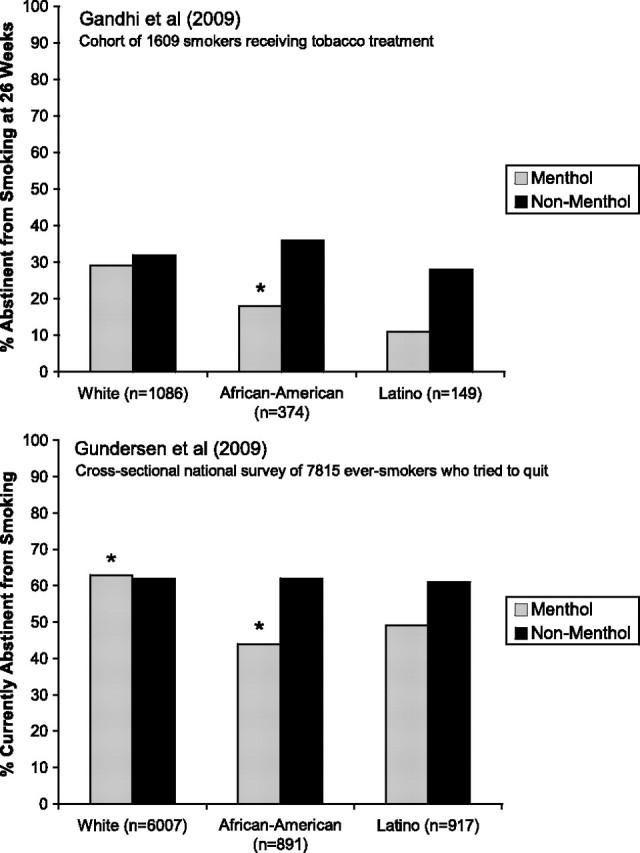
Results: Ten studies were located that reported cessation outcomes for menthol and nonmenthol smokers. Half of the studies found evidence that menthol smoking is associated with lower odds of cessation, while the other half found no such effects. The pattern of results in these studies suggest that the association between smoking menthol cigarettes and difficulty quitting is stronger in (a) racial/ethnic minority populations, (b) younger smokers, and (c) studies carried out after 1999. This pattern is consistent with an effect that relies on menthol to facilitate increased nicotine intake from fewer cigarettes where economic pressure restricts the number of cigarettes smokers can afford to purchase.
Conclusions: There is growing evidence that certain subgroups of smokers find it harder to quit menthol versus nonmenthol cigarettes. There is a need for additional research, and particularly for studies including adequately powered and diverse samples of menthol and nonmenthol smokers, with reliable measurement of cigarette brands, socioeconomic status, and biomarkers of nicotine intake.
Figures
References
-
- Ahijevych K, Garrett BE. Menthol pharmacology and its potential impact on smoking behavior. Nicotine & Tobacco Research. 2004;6(Suppl_1):S17–S28. doi:10.1080/14622200310001649469. - PubMed
-
- Ahijevych K, Parsley LA. Smoke constituent exposure and stage of change in Black and White women cigarette smokers. Addictive Behaviors. 1999;24:115–120. doi:10.1016/S0306-4603(98)00031-8. - PubMed
-
- Ahijevych K, Weed H, Clarke J. Levels of cigarette availability and exposure in Black and White women and efficient smokers. Pharmacology, Biochemistry and Behavior. 2004;77:685–693. doi:10.1016/j.pbb.2004.01.016. - PubMed
-
- Benowitz NL, Herrera B, Jacob P., III Mentholated cigarette smoking inhibits nicotine metabolism. The Journal of Pharmacology and Experimental Therapeutics. 2004;310:1208–1215. doi:10.1124/jpet.104.066902. - PubMed
-
- Clark PI, Gautam S, Gerson LW. Effect of menthol cigarettes on biochemical markers of smoke exposure among black and white smokers. Chest. 1996;110:1194–1198. doi:10.1378/chest.110.5.1194. - PubMed
Publication types
MeSH terms
Substances
Grants and funding
LinkOut - more resources
Full Text Sources
Medical
