


Nucleosome accessibility governed by the dimer/tetramer interface
- PMID: 21177647
- PMCID: PMC3082900
- DOI: 10.1093/nar/gkq1279
Nucleosome accessibility governed by the dimer/tetramer interface
Abstract
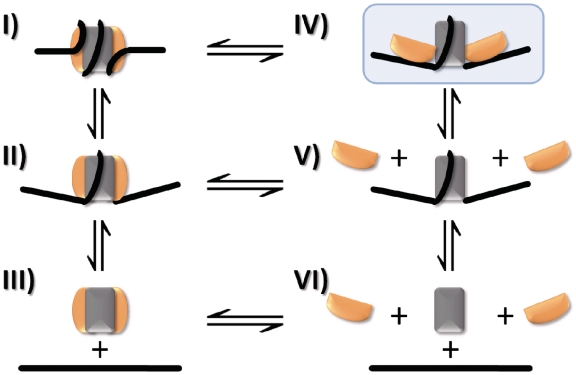
Nucleosomes are multi-component macromolecular assemblies which present a formidable obstacle to enzymatic activities that require access to the DNA, e.g. DNA and RNA polymerases. The mechanism and pathway(s) by which nucleosomes disassemble to allow DNA access are not well understood. Here we present evidence from single molecule FRET experiments for a previously uncharacterized intermediate structural state before H2A-H2B dimer release, which is characterized by an increased distance between H2B and the nucleosomal dyad. This suggests that the first step in nucleosome disassembly is the opening of the (H3-H4)(2) tetramer/(H2A-H2B) dimer interface, followed by H2A-H2B dimer release from the DNA and, lastly, (H3-H4)(2) tetramer removal. We estimate that the open intermediate state is populated at 0.2-3% under physiological conditions. This finding could have significant in vivo implications for factor-mediated histone removal and exchange, as well as for regulating DNA accessibility to the transcription and replication machinery.
Figures
References
-
- Luger K, Mäder AW, Richmond RK, Sargent DF, Richmond TJ. Crystal structure of the nucleosome core particle at 2.8 A resolution. Nature. 1997;389:251–260. - PubMed
-
- Van Holde KE. Chromatin. New York: Springer; 1988.
-
- Akey CW, Luger K. Histone chaperones and nucleosome assembly. Curr. Opin. Struct. Biol. 2003;13:6–14. - PubMed
-
- Lusser A, Kadonaga JT. Strategies for the reconstitution of chromatin. Nat. Methods. 2004;1:19–26. - PubMed
Publication types
MeSH terms
Substances
Grants and funding
LinkOut - more resources
Full Text Sources
Molecular Biology Databases
