


Survival and long-term health and cognitive outcomes after low-grade glioma
- PMID: 21177781
- PMCID: PMC3064628
- DOI: 10.1093/neuonc/noq178
Survival and long-term health and cognitive outcomes after low-grade glioma
Abstract
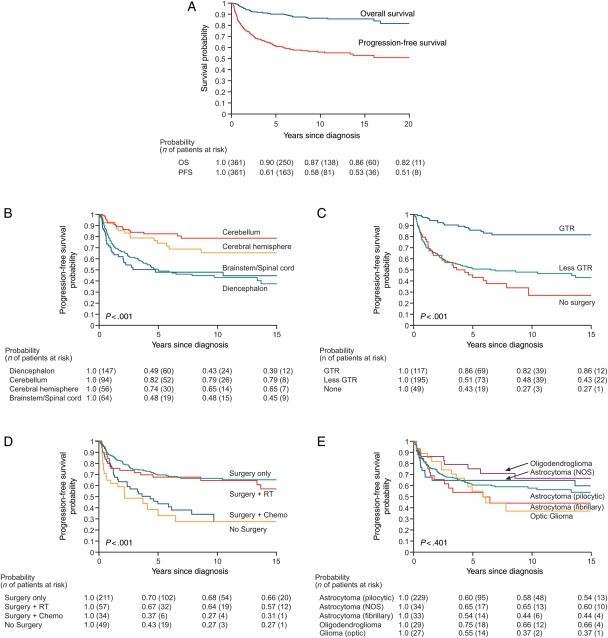
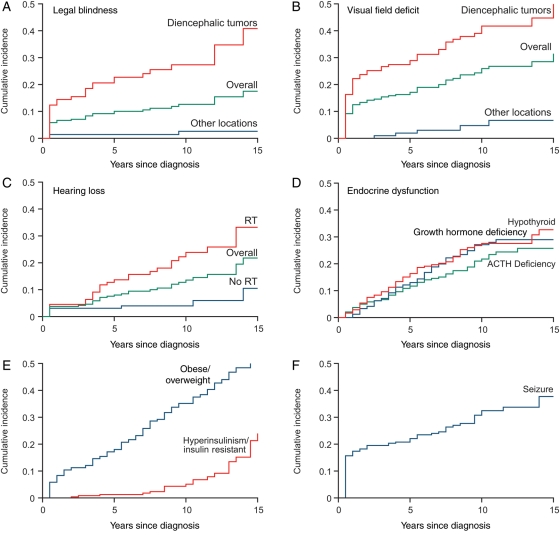
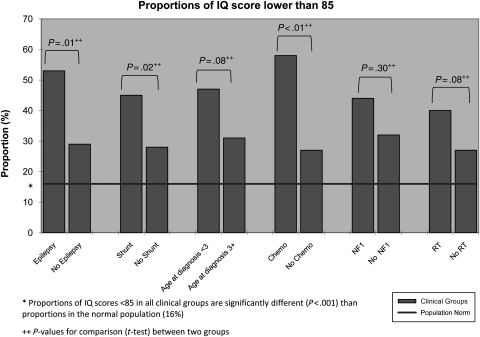
Long-term morbidity for children with low-grade glioma (LGG) requires exposure-specific characterization. Overall survival (OS) and progression-free survival (PFS) were estimated for 361 children diagnosed with LGG between 1985 and 2007 at a single institution. Five-year survivors (n = 240) received risk-based clinical assessment. Cumulative incidence of late effects 15 years from diagnosis were estimated. Risk factors for adverse health were identified using Fine and Gray's approach to Cox's proportional hazards model, accounting for death as a competing risk. OS at 15 years was 86% (95% confidence interval [CI] 82%-90%), and PFS was 55% (95% CI 51%-58%). Among the 240 5-year survivors, the 5-, 10-, and 15-year cumulative incidence of adverse outcomes included blindness: 10%, 13%, and 18%, respectively; hearing loss: 8%, 14%, and 22%; obesity/overweight: 18%, 35%, and 53%; hyperinsulinism: 1%, 5%, and 24%; growth hormone deficiency: 13%, 27%, and 29%;thyroid hormone deficiency: 16%, 28%, and 33%; and adrenocorticotropic hormone (ACTH) deficiency: 12%, 22%, and 26%. Multivariable models demonstrated radiation therapy to be a significant independent predictor of hearing loss, growth hormone deficiency, abnormal thyroid function, and ACTH deficiency. Diencephalic location was a statistically significant independent risk factor for blindness, growth hormone deficiency, abnormal thyroid function, and ACTH deficiency. Among the 182 5-year survivors assessed for intellectual function, 34% had an intelligence quotient (IQ) below average (<85), associated with younger age at diagnosis, epilepsy, and shunt placement. Survivors of childhood LGG experience substantial long-term adverse effects that continue to increase well beyond the 5-year survival time point.
Figures
References
-
- 2008. C. Statistical Report: Primary Brain Tumors in the United States, 2000–2004. Published by the Central Brain Tumor Registry of the United States.
-
- Duffner PK, Cohen ME, Myers MH, Heise HW. Survival of children with brain tumors: SEER Program, 1973–1980. Neurology. 1986;36(5):597–601. - PubMed
-
- Rashidi M, DaSilva VR, Minagar A, Rutka JT. Nonmalignant pediatric brain tumors. Curr Neurol Neurosci Rep. 2003;3(3):200–205. doi:10.1007/s11910-003-0079-9. - DOI - PubMed
-
- Fisher PG, Tihan T, Goldthwaite PT, et al. Outcome analysis of childhood low-grade astrocytomas. Pediatr Blood Cancer. 2008;51(2):245–250. doi:10.1002/pbc.21563. - DOI - PubMed
-
- Watson GA, Kadota RP, Wisoff JH. Multidisciplinary management of pediatric low-grade gliomas. Semin Radiat Oncol. 2001;11(2):152–162. doi:10.1053/srao.2001.21421. - DOI - PubMed
Publication types
MeSH terms
Grants and funding
LinkOut - more resources
Full Text Sources
Medical
