


Clinical outcomes of a 2-y soy isoflavone supplementation in menopausal women
- PMID: 21177797
- PMCID: PMC3021428
- DOI: 10.3945/ajcn.110.008359
Clinical outcomes of a 2-y soy isoflavone supplementation in menopausal women
Abstract
Background: Soy isoflavones are naturally occurring phytochemicals with weak estrogenic cellular effects. Despite numerous clinical trials of short-term isoflavone supplementation, there is a paucity of data regarding longer-term outcomes and safety.
Objective: Our aim was to evaluate the clinical outcomes of soy hypocotyl isoflavone supplementation in healthy menopausal women as a secondary outcome of a trial on bone health.
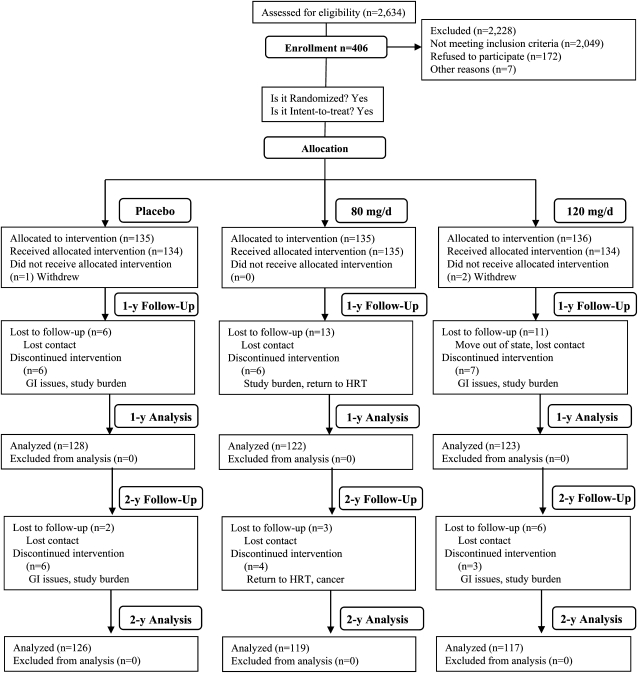
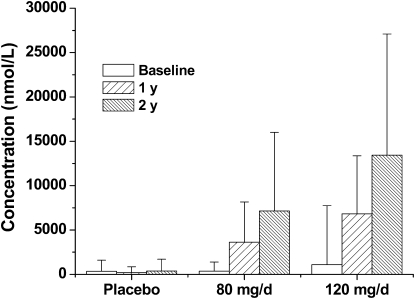
Design: A multicenter, randomized, double-blind, placebo-controlled 24-mo trial was conducted to assess the effects of daily supplementation with 80 or 120 mg aglycone equivalent soy hypocotyl isoflavones plus calcium and vitamin D on the health of 403 postmenopausal women. At baseline and after 1 and 2 y, clinical blood chemistry values were measured and a well-woman examination was conducted, which included a mammogram and a Papanicolaou test. A cohort also underwent transvaginal ultrasound measurements to assess endometrial thickness and fibroids.
Results: The baseline characteristics of the groups were similar. After 2 y of daily isoflavone exposure, all clinical chemistry values remained within the normal range. The only variable that changed significantly was blood urea nitrogen, which increased significantly after 2 y (P = 0.048) but not after 1 y (P = 0.343) in the supplementation groups. Isoflavone supplementation did not affect blood lymphocyte or serum free thyroxine concentrations. No significant differences in endometrial thickness or fibroids were observed between the groups. Two serious adverse events were detected (one case of breast cancer and one case of estrogen receptor-negative endometrial cancer), which was less than the expected population rate for these cancers.
Conclusion: Daily supplementation for 2 y with 80-120 mg soy hypocotyl isoflavones has minimal risk in healthy menopausal women. This trial was registered at clinicaltrials.gov as NCT00665860.
Figures
References
-
- The Writing Group for the PEPI Trial Effects of hormone replacement therapy on endometrial histology in postmenopausal women. The Postmenopausal Estrogen/Progestin Interventions (PEPI) Trial. JAMA 1996;275:370–5 - PubMed
-
- Rossouw JE, Anderson GL, Prentice R, et al. Risks and benefits of estrogen plus progestin in healthy postmenopausal women: principal results from the Women's Health Initiative randomized controlled trial. JAMA 2002;288:321–33 - PubMed
-
- Woodruff JD, Pickar JH. Incidence of endometrial hyperplasia in postmenopausal women taking conjugated estrogens (Premarin) with medroxyprogesterone acetate or conjugated estrogens alone. The Menopause Study Group. Am J Obstet Gynecol 1994;170:1213–23 - PubMed
-
- Haimov-Kochman R, Brezinski A, Hochner-Celnikier D. Herbal remedies for menopausal symptoms: are we cautious enough? Eur J Contracept Reprod Health Care 2008;13:133–7 - PubMed
-
- Eisenbrand G. Isoflavones as phytoestrogens in food supplements and dietary foods for special medical purposes. Opinion of the Senate Commission on Food Safety (SKLM) of the German Research Foundation (DFG)-(shortened version). Mol Nutr Food Res 2007;51:1305–12 - PubMed
Publication types
MeSH terms
Substances
Associated data
Grants and funding
LinkOut - more resources
Full Text Sources
Medical
