


Low-fat dietary pattern and change in body-composition traits in the Women's Health Initiative Dietary Modification Trial
- PMID: 21177798
- PMCID: PMC3041598
- DOI: 10.3945/ajcn.110.006395
Low-fat dietary pattern and change in body-composition traits in the Women's Health Initiative Dietary Modification Trial
Abstract
Background: The Women's Health Initiative Dietary Modification (DM) Trial was a randomized controlled trial that compared the effects of a low-fat (≤20% of total energy) or a usual diet in relation to chronic disease risk in postmenopausal women.
Objective: We characterized long-term body-composition changes associated with the DM trial and potential modifiers of these associations.
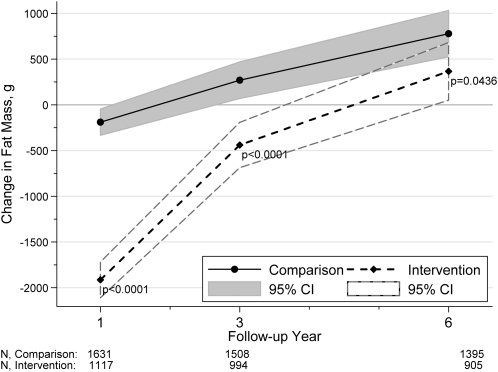
Design: In the DM trial, 48,835 women aged 50-79 y were randomly assigned to intervention (40%) or comparison (60%) groups. We studied a subset with whole-body dual-energy X-ray absorptiometry scans at baseline and during follow-up. Changes in fat mass (FM), lean mass (LM), and percentage body fat between the intervention (n = 1580) and comparison (n = 2731) groups at years 1, 3, and 6 were compared. By using generalized estimating equations, we calculated overall differences between groups and tested for interactions with age, diabetes, race-ethnicity (white, black, and Hispanic), body mass index (BMI), and hormone therapy (HT).
Results: The intervention women experienced significantly greater reductions in percentage body fat, FM, and LM at years 1 and 3 than did women in the comparison group (all P < 0.05). At year 6, only the FM change was significantly different between groups. Overall, the intervention was associated with reductions in percentage body fat (-0.8%; 95% CI: -1.0%, -0.6%), FM (-1.1 kg; 95% CI: -1.3, -0.8 kg), and LM (-0.17 kg; 95% CI: -0.28, -0.06 kg) during follow-up (all P < 0.003). Intervention associations varied by race-ethnicity, BMI, diabetes, and HT and remained significant after adjustment for physical activity.
Conclusion: This intervention was associated with modest long-term body-composition changes; the findings were more robust in years 1 and 3. This trial was registered at clinicaltrials.gov as NCT00000611.
Figures


Comment in
-
Is dietary fat important?Am J Clin Nutr. 2011 Mar;93(3):481-2. doi: 10.3945/ajcn.110.011114. Epub 2011 Jan 26. Am J Clin Nutr. 2011. PMID: 21270373 No abstract available.
-
WHI dietary modification trial – disappointing results?Climacteric. 2011 Jun;14(3):402. Climacteric. 2011. PMID: 21721172 No abstract available.
References
-
- Ritenbaugh C, Patterson RE, Chlebowski RT, et al. The Women's Health Initiative Dietary Modification trial: overview and baseline characteristics of participants. Ann Epidemiol 2003;13(suppl):S87–97 - PubMed
-
- Prentice RL, Caan B, Chlebowski RT, et al. Low-fat dietary pattern and risk of invasive breast cancer: the Women's Health Initiative Randomized Controlled Dietary Modification Trial. JAMA 2006;295:629–42 - PubMed
-
- Beresford SA, Johnson KC, Ritenbaugh C, et al. Low-fat dietary pattern and risk of colorectal cancer: the Women's Health Initiative Randomized Controlled Dietary Modification Trial. JAMA 2006;295:643–54 - PubMed
-
- Tinker LF, Bonds DE, Margolis KL, et al. Low-fat dietary pattern and risk of treated diabetes mellitus in postmenopausal women: the Women's Health Initiative randomized controlled dietary modification trial. Arch Intern Med 2008;168:1500–11 - PubMed
Publication types
MeSH terms
Associated data
Grants and funding
LinkOut - more resources
Full Text Sources
Other Literature Sources
Medical
