. 2011 Feb;18(2):210-6.
doi: 10.1128/CVI.00296-10. Epub 2010 Dec 22.

Internalization of IgG-coated targets results in activation and secretion of soluble CD40 ligand and RANTES by human platelets

Affiliations

Internalization of IgG-coated targets results in activation and secretion of soluble CD40 ligand and RANTES by human platelets

Adam J Antczak et al. Clin Vaccine Immunol. 2011 Feb.

Abstract

Platelets are crucial elements for maintenance of hemostasis. Other functions attributable to platelets are now being appreciated, such as their role in inflammatory reactions and host defense. Platelets have been reported to bind immunological stimuli like IgG complexes, and for nearly 50 years it has been speculated that platelets may participate in immunological reactions. Platelets have been reported to bind and internalize various substances, similar to other leukocytes, such as macrophages and dendritic cells. In the present study, we tested the hypothesis that human platelets can bind and internalize IgG-coated particles, similar to leukocytes. To this end, we observed that interaction with IgG-coated beads resulted in platelet activation (as measured by CD62P expression), internalization of targets, and significant soluble CD40 ligand (sCD40L) and RANTES (regulated upon activation, normal T cell expresses and secreted) secretion. Blocking FcγRIIA with monoclonal antibody (MAb) IV.3 or inhibiting actin remodeling with cytochalasin D inhibited platelet activation, internalization, and cytokine production. These data suggest that platelets are capable of mediating internalization of IgG-coated particles, resulting in platelet activation and release of both sCD40L and RANTES.


Figures
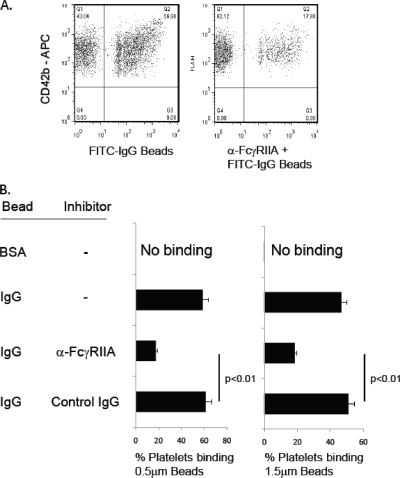
FIG. 1.
FIG. 1.
Platelet FcγRIIA mediates binding of IgG-coated targets. (A) The 1.5-μm polystyrene beads coated with FITC-IgG were added to platelets for 30 min at 4°C in the absence (left) or presence (right) of 5 μg/ml anti-FcγRIIA monoclonal antibody IV.3. The platelets were then labeled with anti-CD42b-APC, and CD42+ events were measured for the presence of FITC-labeled beads. (B) Platelets incubated with 0.5- or 1.5-μm polystyrene beads coated with BSA or IgG. In some samples, 5 μg/ml anti-FcγRIIA MAb or an isotype-matched control IgG (5 μg/ml) was added to inhibit interaction. Data are means ± standard deviations (SD) representative of one experiment performed in triplicate. Experiments were repeated on 3 different days with platelets from three healthy volunteers with similar results.
FIG. 2.
FIG. 2.
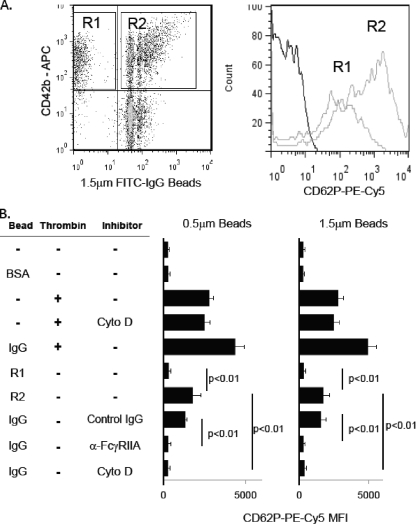
IgG-coated targets activate platelets. (A) Platelets were exposed to IgG-coated 1.5-μm polystyrene beads, and CD42b-expressing platelets were assessed for activation by measuring CD62P surface expression (gray lines) or isotype-matched control IgG (black line) on platelets not in contact with beads (region R1) or in contact with beads (region R2). (B) Quantitative analysis of CD62P expression of CD42b-expressing platelets incubated with 0.5- or 1.5-μm polystyrene beads coated with BSA or IgG. Platelets incubated with 2 U/ml thrombin served as a positive control for platelet activation. Some samples were pretreated with either 5 μg/ml anti-FcγRIIA MAb IV.3 or 5 μg/ml isotype-matched control IgG to assess the dependence on FcγRIIA. Other samples were allowed to bind beads and then incubated with 20 μM cytochalasin D (Cyto D) to determine the role of actin rearrangement on activation. Data are means ± SD representative of one experiment performed in triplicate. Experiments were repeated on 3 different days with platelets from three healthy volunteers with similar results. MFI, mean fluorescence intensity.
FIG. 3.
FIG. 3.
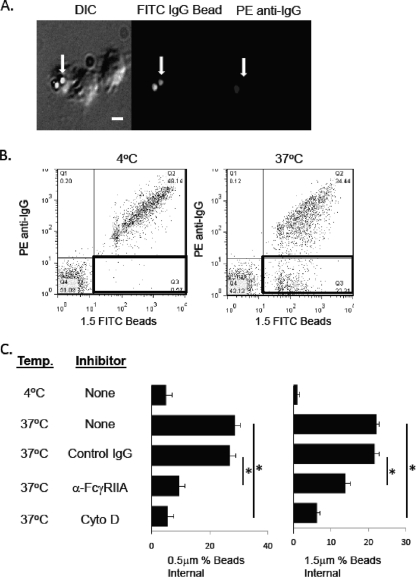
Platelet internalization of IgG-coated beads. (A) Platelets were incubated with FITC-IgG-coated polystyrene beads (0.5 μm) at 4°C for 30 min and then warmed to 37°C for 30 min. Samples were then cooled to 4°C, fixed with 2% paraformaldehyde, stained with PE-conjugated anti-human IgG, and viewed by fluorescence microscopy for double-positive (external) or single-positive (internal) beads (arrows point to single-positive beads). (B) Flow cytometric analysis of internalization of IgG-coated 1.5-μm beads by platelets. Platelets were incubated with beads as described in panel A and then stained with APC-conjugated anti-CD42b MAb and PE-conjugated anti-human IgG. CD42b+ platelets were assessed for FITC and PE fluorescence by flow cytometry. Double-positive (external) and single-positive (internal) beads are shown in the upper right and lower right quadrants, respectively. (C) Internalization of IgG-coated beads by platelets. Samples treated as described in panel A were assessed for internalization by dividing the number of PE-negative beads (lower right quadrant) by the total number of beads (upper and lower right quadrants). Some samples were treated with 20 μM cytochalasin D (Cyto D) to inhibit actin rearrangement. Data are means ± SD representative of one experiment performed in triplicate. Experiments were repeated on 3 different days with platelets from three healthy volunteers with similar results. *, P < 0.01.
FIG. 4.
FIG. 4.
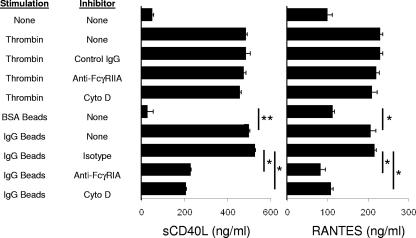
Platelet cytokine secretion in response to IgG-coated targets. Platelets were stimulated with thrombin (20 U/ml) or 1.5-μm polystyrene beads (10 beads per platelet) coated with BSA or IgG and assessed for secretion of sCD40L and RANTES by ELISA. Other samples were pretreated with 5 μg/ml anti-FcγRIIA MAb or 5 μg/ml isotype-matched control IgG to assess the role of FcγRIIA. Other samples were pretreated with 20 μM cytochalasin D (Cyto D) to determine the role of actin rearrangement in cytokine secretion. Data are means ± SD representative of one experiment performed in triplicate. Experiments were repeated on 5 different days with platelets from five healthy volunteers with similar results. *, P < 0.01; **, P < 0.001.

References

    1. Antczak, A. J., N. Singh, S. R. Gay, and R. G. Worth. 2010. IgG-complex stimulated platelets: a source of sCD40L and RANTES in initiation of inflammatory cascade. Cell. Immunol. 263:129-133. - PubMed
    1. Boehlen, F., and K. J. Clemetson. 2001. Platelet chemokines and their receptors: what is their relevance to platelet storage and transfusion practice? Transfus. Med. 11:403-417. - PubMed
    1. Booth, J. W., M. K. Kim, A. Jankowski, A. D. Schreiber, and S. Grinstein. 2002. Contrasting requirements for ubiquitylation during Fc receptor-mediated endocytosis and phagocytosis. EMBO J. 21:251-258. - PMC - PubMed
    1. Brandt, E., A. Ludwig, F. Petersen, and H. D. Flad. 2000. Platelet-derived CXC chemokines: old players in new games. Immunol. Rev. 177:204-216. - PubMed
    1. Bubel, S., D. Wilhelm, M. Entelmann, H. Kirchner, and H. Kluter. 1996. Chemokines in stored platelet concentrates. Transfusion 36:445-449. - PubMed

Publication types