Review
. 2011 Jan 15;214(Pt 2):206-29.
doi: 10.1242/jeb.048397.

The biological control of voluntary exercise, spontaneous physical activity and daily energy expenditure in relation to obesity: human and rodent perspectives

Affiliations
Review

The biological control of voluntary exercise, spontaneous physical activity and daily energy expenditure in relation to obesity: human and rodent perspectives

Theodore Garland Jr et al. J Exp Biol. .

Abstract

Mammals expend energy in many ways, including basic cellular maintenance and repair, digestion, thermoregulation, locomotion, growth and reproduction. These processes can vary tremendously among species and individuals, potentially leading to large variation in daily energy expenditure (DEE). Locomotor energy costs can be substantial for large-bodied species and those with high-activity lifestyles. For humans in industrialized societies, locomotion necessary for daily activities is often relatively low, so it has been presumed that activity energy expenditure and DEE are lower than in our ancestors. Whether this is true and has contributed to a rise in obesity is controversial. In humans, much attention has centered on spontaneous physical activity (SPA) or non-exercise activity thermogenesis (NEAT), the latter sometimes defined so broadly as to include all energy expended due to activity, exclusive of volitional exercise. Given that most people in Western societies engage in little voluntary exercise, increasing NEAT may be an effective way to maintain DEE and combat overweight and obesity. One way to promote NEAT is to decrease the amount of time spent on sedentary behaviours (e.g. watching television). The effects of voluntary exercise on other components of physical activity are highly variable in humans, partly as a function of age, and have rarely been studied in rodents. However, most rodent studies indicate that food consumption increases in the presence of wheels; therefore, other aspects of physical activity are not reduced enough to compensate for the energetic cost of wheel running. Most rodent studies also show negative effects of wheel access on body fat, especially in males. Sedentary behaviours per se have not been studied in rodents in relation to obesity. Several lines of evidence demonstrate the important role of dopamine, in addition to other neural signaling networks (e.g. the endocannabinoid system), in the control of voluntary exercise. A largely separate literature points to a key role for orexins in SPA and NEAT. Brain reward centers are involved in both types of physical activities and eating behaviours, likely leading to complex interactions. Moreover, voluntary exercise and, possibly, eating can be addictive. A growing body of research considers the relationships between personality traits and physical activity, appetite, obesity and other aspects of physical and mental health. Future studies should explore the neurobiology, endocrinology and genetics of physical activity and sedentary behaviour by examining key brain areas, neurotransmitters and hormones involved in motivation, reward and/or the regulation of energy balance.


Figures
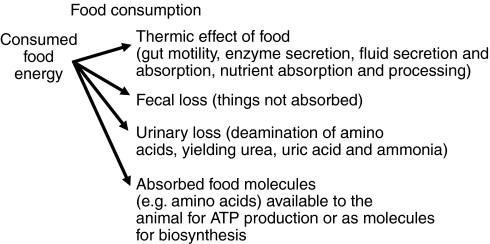
Fig. 1.
Fig. 1.
Partitioning of consumed food energy. Note that energy going to the thermic effect of food is not available for ATP production or biosynthesis, but it can be used for thermoregulation. In addition, a considerable portion of the chemical potential energy in absorbed food molecules is lost as heat during the production of ATP (but again, some of this heat may be used for thermoregulation).
Fig. 2.
Fig. 2.
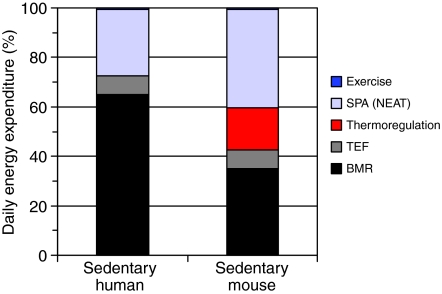
(A,B) Partitioning of daily energy expenditure in a sedentary human and a sedentary laboratory mouse. The human engages in negligible voluntary exercise, and the mouse is housed without a wheel. At room temperature (∼21°C), people wear appropriate clothing and so do not have any extra energy expenditure to maintain body temperature. For mice, however, 21°C is below their thermoneutral zone, so they have a substantial cost of thermoregulation (e.g. see Hart, 1971; Hudson and Scott, 1979; Lacy and Lynch, 1979). The values depicted are approximations, based on the synthesis of a number of sources (e.g. http://www.fao.org/docrep/007/y5686e/y5686e04.htm) [Garland and others (Garland, 1983; Saris et al., 1989; Hammond and Diamond, 1997; Gorman et al., 1998; Girard, 2001; Swallow et al., 2001; Donahoo et al., 2004; Westerterp, 2004; Carbone et al., 2005; Vaanholt et al., 2007a; Vaanholt et al., 2007b; Johanssen and Ravussin, 2008; Rezende et al., 2009; Secor, 2009) and references therein]. BMR, basal metabolic rate; NEAT, non-exercise activity thermogenesis; SPA, spontaneous physical activity; TEF, thermic effect of food.
Fig. 3.
Fig. 3.
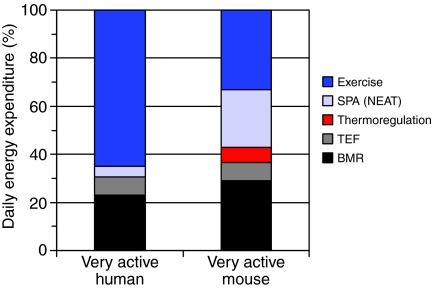
(A,B) Partitioning of daily energy expenditure (DEE) when the amount of voluntary exercise is extraordinarily high. For humans, this occurs during the Tour de France cycling race (Saris et al., 1989) and for mice it represents the High Runner lines housed with wheel access (Swallow et al., 2001; Vaanholt et al., 2007a; Vaanholt et al., 2007b; Rezende et al., 2009). For the mice, some of the heat produced during wheel running is used for thermoregulation, thus reducing costs of thermoregulation per se. SPA is still a substantial part of the energy budget for mice (Rezende et al., 2009). SPA may also appreciable for these human ultra-racers, but it has not been directly measured to our knowledge. In general, larger-bodied mammals are predicted to expend a larger fraction of their DEE on costs of locomotion, based on previous allometric analyses (Garland, 1983; Goszczynski, 1986). For additional literature sources, see Fig. 2 legend.
Fig. 4.
Fig. 4.
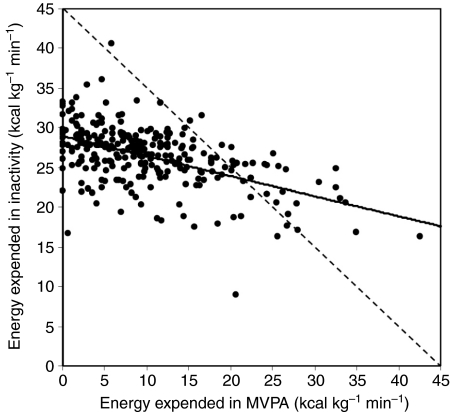
Relationship between estimated energy expenditure during inactivity and during moderate-to-vigorous physical activity (MVPA) in 125 human males and 152 females aged 18–24 years [data from Wickel and Eisenmann (Wickel and Eisenmann, 2006)]. On days when MVPA was relatively high, DEE was also relatively high [see fig. 3 in Wickel and Eisenmann (Wickel and Eisenmann, 2006)], but, as shown here, some compensation occurred in that the energy expended during inactive behaviours was reduced. However, the slope (–0.25) is much shallower than –1 (dashed line), indicating that compensation was incomplete.
Fig. 5.
Fig. 5.
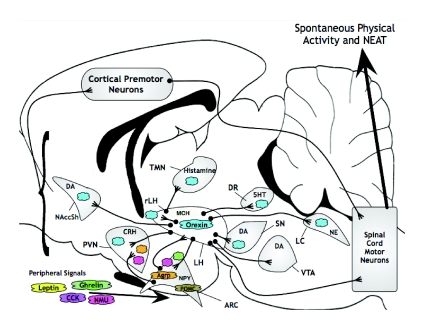
SPA (and resulting NEAT) regulatory brain areas and associated neuropeptides/transmitters [updated from fig. 1 in Kotz (Kotz, 2008)]. Colors correspond to specific neuropeptides/hormones as follows: blue, orexin; purple, CCK; pink, NMU; orange, Agrp; brown, POMC; green, ghrelin; yellow, leptin. Areas with these colors indicate site of synthesis (e.g. AgRP, POMC and ARC; orexin, LH), peripheral source (NMU, ghrelin, leptin and CCK), areas in which the neuropeptide/hormone has been injected and effects on SPA reported, or proposed site(s) of action (see text). Signals from all of these areas have the potential to influence cortical premotor neurons. Brain areas are not to scale, and connections and neuropeptides/transmitters indicated are not all-inclusive. Outline of rat brain was modified from Paxinos and Watson (Paxinos and Watson, 1990). For an alternative depiction, see fig. 2 in Castaneda et al. (Castaneda et al., 2005). 5HT, serotonin; Agrp, Agouti-related protein; ARC, hypothalamic arcuate nucleus; CCK, cholecystokinin; CRH, corticotrophin releasing hormone; DA, dopamine; LC, locus coeruleus; LH, lateral hypothalamus; MCH, melanin concentrating hormone; NAccSH, shell of nucleus accumbens; NE, norepinephrine; NMU, neuromedin U; NPY, neuropeptide Y; POMC, proopiomelanocortin; PVN, hypothalamic paraventricular nucleus; VTA, ventral tegmental area; rLH, rostral LH; SN, substantia nigra; TMN, tuberomammillary nucleus.
Fig. 6.
Fig. 6.
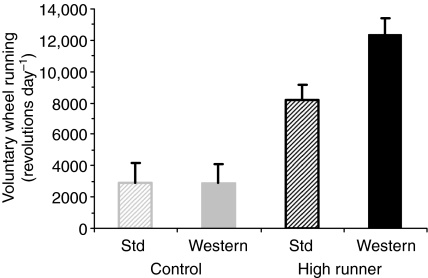
Western diet increased voluntary wheel running of mice from High Runner (HR) lines by ∼52% (+36% duration of running, +18% average speed of running) during days 17–30 of wheel access, whereas it had no effect on control lines [standard diet (Std)] [data from Meek et al. (Meek et al., 2010)]. This stimulation of voluntary exercise is remarkable in particular because the lines have been at an apparent selection limit for ∼35 generations (see Kolb et al., 2010). Data are adjusted means + s.e.m.

References

    1. Ahlenius S., Hillegaart V., Thorell G., Magnusson O., Fowler C. J. (1987). Suppression of exploratory locomotor activity and increase in dopamine turnover following the local application of cis-flupenthixol into limbic projection areas of the rat striatum. Brain Res. 402, 131-138 - PubMed
    1. Aidman E. V., Woollard S. (2003). The influence of self-reported exercise addiction on acute emotional and physiological responses to brief exercise deprivation. Psychol. Sport Exerc. 4, 225-226
    1. Ainsworth B. E., Haskell W. L., Whitt M. C., Irwin M. L., Swartz A. M., Strath S. J., O’Brien W. L., Bassett D. R., Jr, Schmitz K. H., Emplaincourt P. O., et al. (2000). Compendium of physical activities: an update of activity codes and MET intensities. Med. Sci. Sports Exerc. 32, S498-S504 - PubMed
    1. Albert F. W., Carlborg O., Plyusnina I., Besnier F., Hedwig D., Lautenschlager S., Lorenz D., McIntosh J., Neumann C., Richter H., et al. (2009). Genetic architecture of tameness in a rat model of animal domestication. Genetics 182, 541-554 - PMC - PubMed
    1. Allegre B., Souville M., Therma P., Griffiths M. (2006). Definitions and measures of exercise dependance. Addict. Res. Theory. 14, 631-646

Publication types