. 2011 Apr 5;52(5):2160-4.
doi: 10.1167/iovs.10-6518.

Significance of outer blood-retina barrier breakdown in diabetes and ischemia

Affiliations

Significance of outer blood-retina barrier breakdown in diabetes and ischemia

Hui-Zhuo Xu et al. Invest Ophthalmol Vis Sci. .

Abstract

Purpose: The outer blood-retina barrier (BRB) separates the neural retina from the choroidal vasculature, which is responsible for approximately 80% of blood supplies in the eye. To determine the significance of outer BRB breakdown in diabetic retinopathy, the outer BRB-specific leakage of macromolecules in diabetic and ischemic rodents was investigated.

Methods: Diabetes and ischemia were induced in rodents by streptozotocin and oxygen-induced retinopathy, respectively. Diabetic and ischemic rodents were injected intravenously with fluorescein isothiocyanate (FITC)-dextran. The outer BRB-specific leakage in diabetic and ischemic rodents was visualized by fluorescent microscopy.

Results: A microscopic imaging assay was developed to examine outer BRB breakdown. The outer BRB-specific leakage of fluorescent macromolecules was visualized in diabetic and ischemic rodents. Substantial leakages of macromolecules through the outer BRB in diabetic and ischemic rodents were detected with this assay. The number of severe outer BRB leakage sites is inversely proportional to the size of macromolecules. Significant depletion of occludin in the RPE of ischemic and diabetic rodents was also observed.

Conclusions: For the first time, a microscopic imaging assay for directly visualizing macromolecules leaked through the outer BRB in rodents was developed. Using this assay, the authors demonstrated the significance of outer BRB breakdown in diabetes and ischemia, which will have implications to the understanding, diagnosis, and treatment of diabetic macular edema and other ocular diseases with outer BRB defects. The microscopic imaging assay established in this study will likely be very useful to the development of drugs for macular edema.


Figures
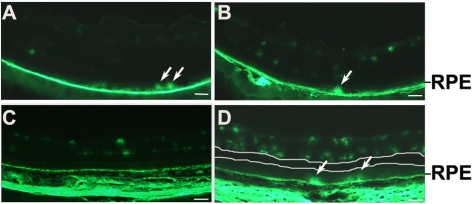
Figure 1.
Figure 1.
Detection of diabetes-induced outer BRB breakdown in rodents. (A, B) Fluorescent microscopic images of retinal sections from 12-month-old diabetic mice injected with 10 kDa (A) and 40 kDa (B) FITC-dextran. (C, D) Fluorescent microscopic images of retinal sections from 9-month-old non-diabetic controls (C) and diabetic rats (D) injected with 10 kDa FITC-dextran. All images were obtained from animals killed 1 minute after injecting FITC-dextran. Upper white line in (D): a board for inner BRB–specific leakage. Lower white line in (D): a board for outer BRB–specific leakage. Outer BRB leakage was visible in diabetic rodents. Arrows: severe leakage sites. Scale bar, 50 μm.
Figure 2.
Figure 2.
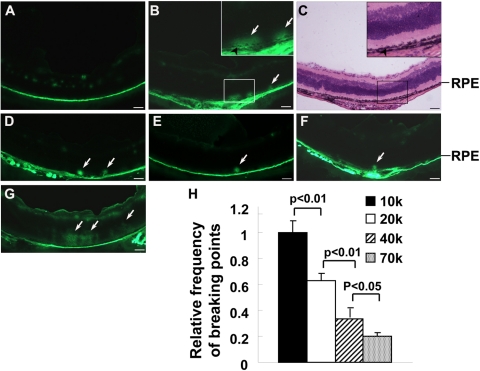
Detection of ischemia-induced outer BRB breakdown in mice. All images were obtained from animals killed 1 minute after injecting FITC-dextran, except that in (G). (A, B) Fluorescent microscopic images of retinal sections from P17 room air controls (A) and OIR mice (B) injected with 10 kDa FITC-dextran. (C) Light microscopic image of H&E-stained identical retinal section as shown in (B). (DF) Fluorescent microscopic images of retinal sections from P17 OIR mice injected with 20 (D), 40 (E), or 70 kDa (F) FITC-dextran. (G) Fluorescent microscopic image of retinal sections from P17 OIR mice killed 20 minutes after injection of 10 kDa FITC-dextran. Arrows: severe leakage sites. Scale bar, 50 μm. (H) Statistical analysis for relative frequency of severe outer BRB leakage sites in P17 OIR mice injected with FITC-dextran of various molecular weights. Error bar: SEM. Frequencies of severe outer BRB leakage sites were inversely proportional to the size of FITC-dextran.
Figure 3.
Figure 3.
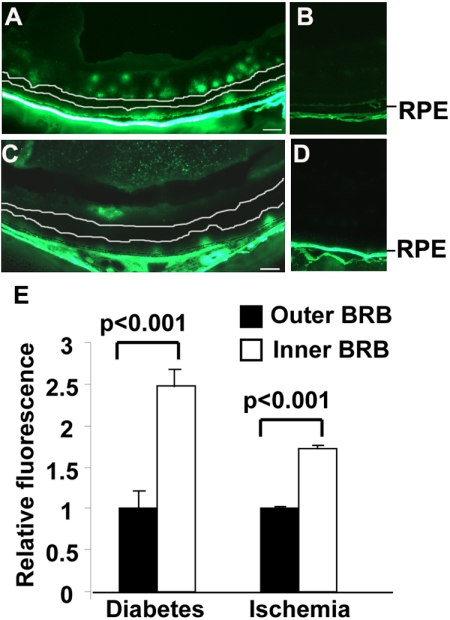
Significance of outer BRB–specific leakage in diabetic and ischemic mice. All images were obtained in animals killed 1 minute after injecting 10 kDa FITC-dextran. (A, B) Fluorescent images of retinal sections from 12-month-old diabetic mice and age-matched non-diabetic controls. (C, D) Fluorescent images of retinal sections from P17 OIR mice and age-matched room air controls. (E) Relative ratios of FITC-dextran leaked through each BRB. Scale bar, 50 μm. Inner BRB–specific leakage: fluorescence between the upper white line and the inner limiting membrane in (A, C). Outer BRB–specific leakage: fluorescence between the lower white line and the RPE in (A, C). Substantial outer BRB–specific leakages were detected in diabetic and ischemic mice.
Figure 4.
Figure 4.
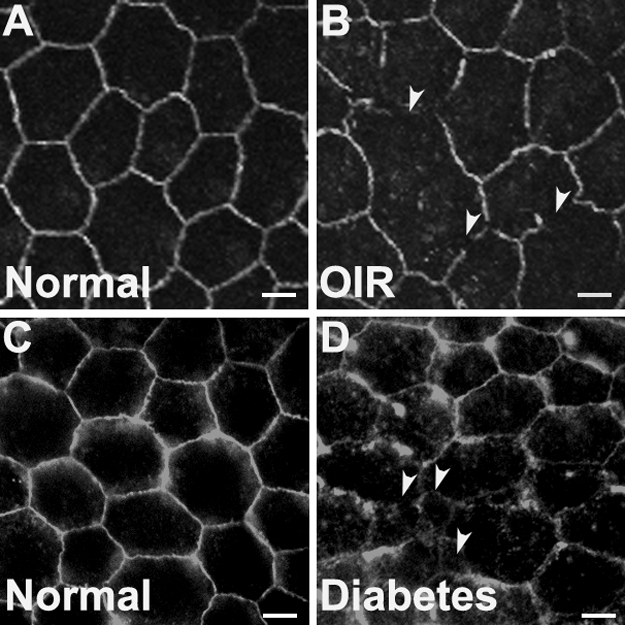
Integrity of tight junctions in the RPE of ischemic and diabetic mice. (A, B) Immunostaining for occludin in P17 normal and OIR mice. (C, D) Immunostaining for occludin in 1-year-old non-diabetic and diabetic mice. Scale bars, 10 μm. Arrowheads: depletion of occludin in the outer BRB. Ischemia and diabetes induced significant depletion of occludin in the RPE.

References

    1. Simo R, Villarroel M, Corraliza L, Hernandez C, Garcia-Ramirez M. The retinal pigment epithelium: something more than a constituent of the blood-retinal barrier–implications for the pathogenesis of diabetic retinopathy. J Biomed Biotechnol. 2010;190724. - PMC - PubMed
    1. Young RW, Bok D. Participation of the retinal pigment epithelium in the rod outer segment renewal process. J Cell Biol. 1969;42:392–403 - PMC - PubMed
    1. Gordon WC, Rodriguez de Turco EB, Bazan NG. Retinal pigment epithelial cells play a central role in the conservation of docosahexaenoic acid by photoreceptor cells after shedding and phagocytosis. Curr Eye Res. 1992;11:73–83 - PubMed
    1. Benolken RM, Anderson RE, Wheeler TG. Membrane fatty acids associated with the electrical response in visual excitation. Science. 1973;182:1253–1254 - PubMed
    1. Philp NJ, Ochrietor JD, Rudoy C, Muramatsu T, Linser PJ. Loss of MCT1, MCT3, and MCT4 expression in the retinal pigment epithelium and neural retina of the 5A11/basigin-null mouse. Invest Ophthalmol Vis Sci. 2003;44:1305–1311 - PubMed

Publication types

MeSH terms

Substances