. 2010 May-Jun;1(3):164-73.
doi: 10.4161/viru.1.3.11750.

Characterization of a 5-azacytidine-induced developmental Aspergillus fumigatus variant

Affiliations

Characterization of a 5-azacytidine-induced developmental Aspergillus fumigatus variant

Ronen Ben-Ami et al. Virulence. 2010 May-Jun.

Abstract

The hypomethylating agent 5-azacytidine (5AC) is widely used in patients at risk of invasive mycoses. We sought to determine whether 5AC affects the developmental competence and virulence of Aspergillus fumigatus. Incubation of A. fumigatus strain 293 with 5AC induced high-frequency conversion to a fluffy-variant (Af293 (FL) ). The conidiation defect was bypassed by exposing Af293 (FL) to light during the initial 18 hours of growth on solid media. Transcriptional profiling revealed differential expression of multiple genes involved in G-protein signaling, including a putative G-protein coupled photoreceptor (opsin), suggesting that impaired signaling through a light-responsive pathway upstream of brlA is responsible for this phenotype. Af293 (FL) was fully virulent in fruit fly and murine models of invasive aspergillosis. Moreover, Af293 (FL) overexpressed aspergillopepsin F, had increased elastase activity and was more angioinvasive than the parental wild-type strain. The 5AC-induced A. fumigatus fluffy variant illustrates the potential effects of chemotherapeutic agents on the developmental and pathobiologic characteristics of opportunistic fungi.


Figures
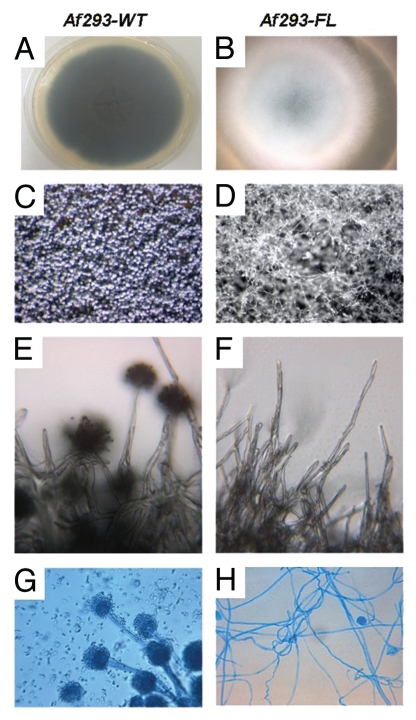
Figure 1
Figure 1
Morphologic characteristics of Af293FL. Af293FL (B, D, F and H) was compared with its parental wild-type strain (A, C, E and G). It demonstrated a lack of conidiophore formation and extensive proliferation of undifferentiated hyphae after 72 hours of incubation in the dark. Macroscopic colony appearance is shown in (A and B); appearance on dissecting microscopy (x40) is shown in (C and D); colony surface by light microscopy (x250) is shown in (E and F); and light microscopy (x250) of lactophenol cotton blue-stained tease slides is shown in (G and H).
Figure 2
Figure 2
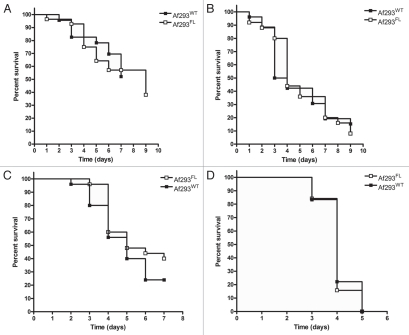
Assessment of Af293FL virulence in fly and mouse models of invasive aspergillosis. The virulence of Af293FL relative to that of its parental wild-type strain was assessed in Toll-deficient flies using an inoculum suspension of 106 conidia/ml (A) or 107 conidia/ml (B), and in BALB/c mice immunosuppressed with a neutropenia-inducing drug regimen (cyclophosphamide plus cortisone acetate) (C) or a non-neutropenic regimen (cortisone acetate) (D). In each model system, survival rates were similar between animals infected with Af293FL and those infected with Af293WT (p = NS by the log-rank test).
Figure 3
Figure 3
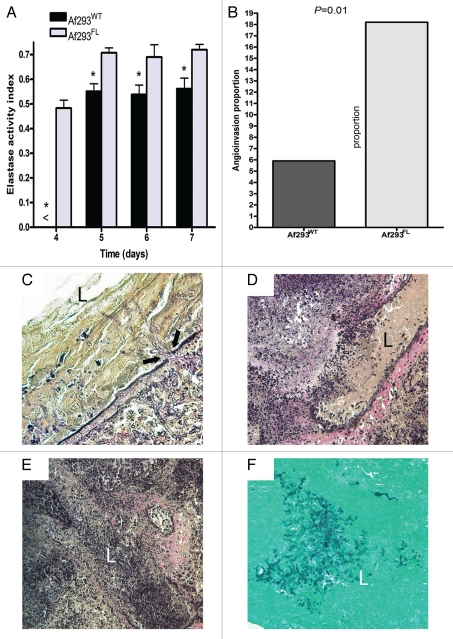
Elastase activity and angioinvasiveness. (A) The elastase activity indices (EAIs) of Af293FL and its parental wild-type strain were evaluated on elastin-Congo red agar according to the method described by Blanco et al. Values represent the means of experiments with five different Af293FL strains. No elastase activity was detected prior to day 4. *p < 0.01. (B) The proportion of blood vessels invaded by fungal hyphae was evaluated in tissue sections from mouse lungs stained with the EVG stain. Proportions were compared with Fisher's exact test. (C–E) Representative tissue sections from Af293FL-infected lungs: (C) penetration of the vascular lumen by hyphae is associated with thinning and disruption of elastin fibers (arrows mark site of penetration) (EVG x400 magnification), (D) complete disruption of vessel wall by a penetrating fungal mass (EVG x200), (E) vessel lumen packed with proliferating hyphae (EVG, x200), (F) same vessel as (E) observed in a GMS-stained specimen (x200). L, vascular lumen.
Figure 4
Figure 4
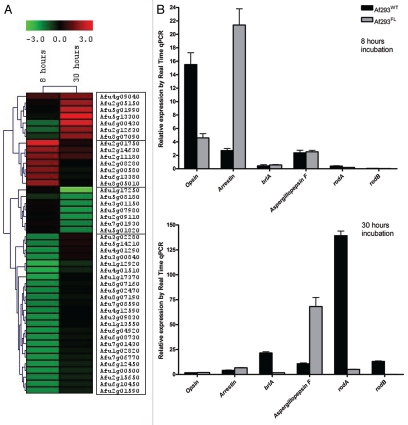
Whole-genome expression studies in Af293FL. Transcriptional analysis of Af293FL using cDNA microarrays revealed differential expression of four gene clusters (A); the expression of selected genes was confirmed by RT-PCR (B). After 8 hours of growth in submerged culture, Af293FL underexpressed the gene encoding opsin-related-protein as well as several developmentally regulated genes (HSP 9/12, HSP Awh11, and NAD-dependent formate dehydrogenase AciA/Fdh). The genes encoding arrestin and the RGS protein flbA were concurrently overexpressed. At the 30-hour time point, Af293FL underexpressed the key developmental regulator brlA and conidia-specific genes rodA and rodB, whereas aspergillopepsin F was overexpressed.

References

    1. Tamame M, Antequera F, Santos E. Developmental characterization and chromosomal mapping of the 5-azacytidine-sensitive fluF locus of Aspergillus nidulans. Mol Cell Biol. 1988;8:3043–3050. - PMC - PubMed
    1. Tamame M, Antequera F, Villanueva JR, Santos T. High-frequency conversion to a “fluffy” developmental phenotype in Aspergillus spp. by 5-azacytidine treatment: evidence for involvement of a single nuclear gene. Mol Cell Biol. 1983;3:2287–2297. - PMC - PubMed
    1. Segal BH. Aspergillosis. N Engl J Med. 2009;360:1870–1884. - PubMed
    1. Garcia-Manero G. Demethylating agents in myeloid malignancies. Curr Opin Oncol. 2008;20:705–710. - PMC - PubMed
    1. Paris S, Wysong D, Debeaupuis JP, et al. Catalases of Aspergillus fumigatus. Infect Immun. 2003;71:3551–3562. - PMC - PubMed

Publication types

MeSH terms

LinkOut - more resources