


Ebolavirus VP35 is a multifunctional virulence factor
- PMID: 21178490
- PMCID: PMC3061251
- DOI: 10.4161/viru.1.6.12984
Ebolavirus VP35 is a multifunctional virulence factor
Abstract
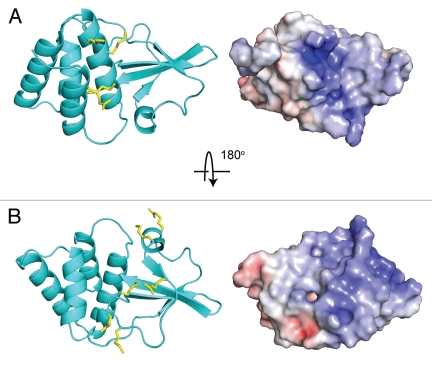
Ebola virus (EBOV) is a member of the filoviridae family that causes severe hemorrhagic fever during sporadic outbreaks, and no approved treatments are currently available. The multifunctional EBOV VP35 protein facilitates immune evasion by antagonizing antiviral signaling pathways and is important for viral RNA synthesis. In order to elucidate regulatory mechanisms and to develop countermeasures, we recently solved the structures of the Zaire and Reston EBOV VP35 interferon inhibitory domain (IID) in the free form and of the Zaire EBOV VP35 IID bound to dsRNA. Together with biochemical, cell biological, and virological studies, our structural work revealed that distinct regions within EBOV VP35 IID contribute to virulence through host immune evasion and viral RNA synthesis. Here we summarize our recent structural and functional studies and discuss the potential of multifunctional Ebola VP35 as a therapeutic target.
Figures


Comment on
-
Structural basis for dsRNA recognition and interferon antagonism by Ebola VP35.Nat Struct Mol Biol. 2010 Feb;17(2):165-72. doi: 10.1038/nsmb.1765. Epub 2010 Jan 17. Nat Struct Mol Biol. 2010. PMID: 20081868 Free PMC article.
References
-
- Geisbert TW, Hensley LE. Ebola virus: New insights into disease aetiopathology and possible therapeutic interventions. Expert Rev Mol Med. 2004;6:1–24. - PubMed
-
- Sanchez A, Geisbert TW, Feldmann H. Filoviridae: Marburg, Ebola Viruses. In: Knipe DM, Howley PM, Griffin RA, Martin MA, Roizman B, Straus SE, editors. Fields Virology. Philadenphia, PA: Lippincott Williams & Wilkins; 2006. pp. 1409–1448.
-
- Mohamadzadeh M, Chen L, Schmaljohn AL. How Ebola and Marburg viruses battle the immune system. Nat Rev Immunol. 2007;7:556–567. - PubMed
-
- Bray M, Geisbert TW. Ebola virus: the role of macrophages and dendritic cells in the pathogenesis of Ebola hemorrhagic fever. Int J Biochem Cell Biol. 2005;37:1560–1566. - PubMed
-
- Bray M, Murphy FA. Filovirus research: knowledge expands to meet a growing threat. J Infect Dis. 2007;196:438–443. - PubMed
Publication types
MeSH terms
Substances
Grants and funding
- R01 AI081914/AI/NIAID NIH HHS/United States
- R01AI059536/AI/NIAID NIH HHS/United States
- R56AI089547/AI/NIAID NIH HHS/United States
- U54 AI057160/AI/NIAID NIH HHS/United States
- R56 AI089547/AI/NIAID NIH HHS/United States
- F32 AI084324/AI/NIAID NIH HHS/United States
- R01AI081914/AI/NIAID NIH HHS/United States
- U54AI057160/AI/NIAID NIH HHS/United States
- R01 AI059536/AI/NIAID NIH HHS/United States
- U54 AI057158/AI/NIAID NIH HHS/United States
- AI057158/AI/NIAID NIH HHS/United States
- 1F32AI084324/AI/NIAID NIH HHS/United States
LinkOut - more resources
Full Text Sources
Medical
