


Common nonsynonymous substitutions in SLCO1B1 predispose to statin intolerance in routinely treated individuals with type 2 diabetes: a go-DARTS study
- PMID: 21178985
- PMCID: PMC3353487
- DOI: 10.1038/clpt.2010.255
Common nonsynonymous substitutions in SLCO1B1 predispose to statin intolerance in routinely treated individuals with type 2 diabetes: a go-DARTS study
Abstract
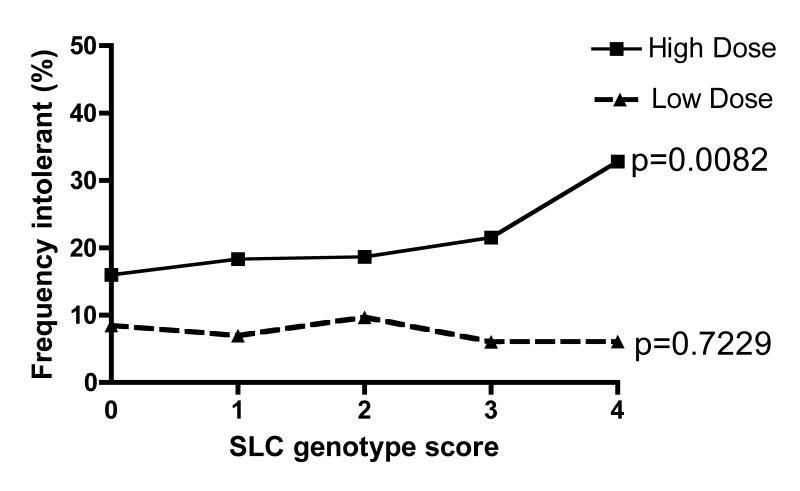
SLCO1B1 gene variants are associated with severe statin-induced myopathy. We examined whether these variants are also associated with general statin intolerance in a large population of patients with type 2 diabetes receiving statins as part of routine clinical care. A total of 4,196 individuals were genotyped for rs4149056 (Val174Ala) and rs2306283 (Asp130Asn). Intolerance was defined by serum biochemistry and also by discontinuation, switching, or reduction in dose of the prescribed statin drug. Ala174 was associated with higher intolerance (odds ratio = 2.05, P = 0.043), whereas Asp130 was associated with lower intolerance (odds ratio = 0.71, P = 0.026). Ala174 was associated with a lower low-density lipoprotein cholesterol (LDLc) response to statins (P = 0.01) whereas 130D was associated with a greater LDLc response to statins (P = 0.048), as previously reported; however, this association was no longer present when data for statin-intolerant individuals were removed from the analysis. This study suggests that common genetic variants selected for an extreme phenotype of statin-induced myopathy also predispose to more common milder statin intolerance and may, for this reason, impact lipid-lowering efficacy.
Figures
Comment in
-
Research highlights. SNPs affecting efficacy and safety of statin therapy.Pharmacogenomics. 2011 Jun;12(6):773-8. doi: 10.2217/pgs.11.57. Pharmacogenomics. 2011. PMID: 21692611 No abstract available.
-
Genetic influence in statin intolerance.Clin Pharmacol Ther. 2011 Sep;90(3):365. doi: 10.1038/clpt.2011.114. Epub 2011 Jul 13. Clin Pharmacol Ther. 2011. PMID: 21753748 No abstract available.
References
-
- Baigent C, Keech A, Kearney PM, Blackwell L, Buck G, Pollicino C, et al. Efficacy and safety of cholesterol-lowering treatment: prospective meta-analysis of data from 90,056 participants in 14 randomised trials of statins. Lancet. 2005;366:1267–78. - PubMed
-
- Armitage J. The safety of statins in clinical practice. Lancet. 2007;370:1781–90. - PubMed
-
- Lansberg PJ, Mitchel YB, Shapiro D, Kastelein JJ, Altman R, Jerums G, et al. Long-term efficacy and tolerability of simvastatin in a large cohort of elderly hypercholesterolemic patients. Atherosclerosis. 1995;116:153–62. - PubMed
-
- Simons LA, Levis G, Simons J. Apparent discontinuation rates in patients prescribed lipid-lowering drugs. Med J Aust. 1996;164:208–11. - PubMed
Publication types
MeSH terms
Substances
Grants and funding
LinkOut - more resources
Full Text Sources
Medical
Molecular Biology Databases
