Association of the superoxide dismutase (V16A) and catalase (C262T) genetic polymorphisms with the clinical outcome of patients with acute paraquat intoxication
- PMID: 21179281
- PMCID: PMC2997972
- DOI: 10.3904/kjim.2010.25.4.422
Association of the superoxide dismutase (V16A) and catalase (C262T) genetic polymorphisms with the clinical outcome of patients with acute paraquat intoxication
Abstract
Background/aims: Many patients with acute paraquat (PQ) intoxication die even at low PQ concentrations, whereas others with similar concentrations recover. Therefore, it is possible that individual differences in antioxidant capacity are responsible for the variable clinical outcome in patients with acute PQ intoxication.
Methods: We investigated whether there was a relationship between the genetic polymorphisms of SOD (V16A), catalase (C262T), and GPX1 (C593T) in 62 patients with acute PQ intoxication and the clinical outcomes of these patients.
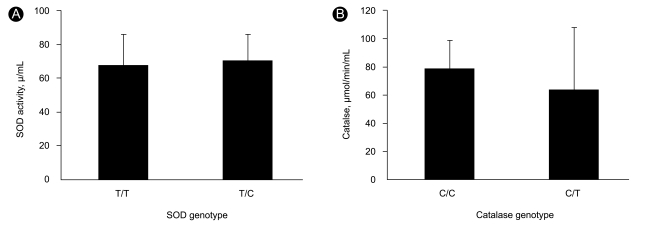
Results: The frequency of the Mn-SOD V/V, V/A, and A/A genotypes were 56.3, 43.5, and 0% in survivors and 86.9, 13.1, and 0% in non-survivors (p > 0.05). The GPX1 C/C, C/T, and T/T genotypes were present in 100, 0, and 0% of all subjects. The catalase C/C, C/T, and T/T genotypes were present in 100, 0, and 0% of survivors, and in 82.6, 17.4, and 0% of non-survivors. Neither erythrocyte SOD activity nor catalase activity were significantly different between survivors and non-survivors.
Conclusions: No association was found between clinical outcome of acute PQ intoxication and the genetic polymorphism of GPX1 (C593T) or the genetic polymorphisms or enzyme activity of superoxide dismutase (V16A) or catalase (C262T).
Keywords: Catalase; Glutathione peroxidase GPX1; Paraquat; Polymorphism, genetic; Superoxide dismutase.
Conflict of interest statement
No potential conflict of interest relevant to this article was reported.
Figures
References
-
- Battin EE, Brumaghim JL. Antioxidant activity of sulfur and selenium: a review of reactive oxygen species scavenging, glutathione peroxidase, and metal-binding antioxidant mechanisms. Cell Biochem Biophys. 2009;55:1–23. - PubMed
-
- Foth H. Role of the lung in accumulation and metabolism of xenobiotic compounds: implications for chemically induced toxicity. Crit Rev Toxicol. 1995;25:165–205. - PubMed
-
- Doelman CJ, Bast A. Oxygen radicals in lung pathology. Free Radic Biol Med. 1990;9:381–400. - PubMed
MeSH terms
Substances
LinkOut - more resources
Full Text Sources
Miscellaneous