Antibiotic selection pressure and macrolide resistance in nasopharyngeal Streptococcus pneumoniae: a cluster-randomized clinical trial
- PMID: 21179434
- PMCID: PMC3001893
- DOI: 10.1371/journal.pmed.1000377
Antibiotic selection pressure and macrolide resistance in nasopharyngeal Streptococcus pneumoniae: a cluster-randomized clinical trial
Abstract
Background: It is widely thought that widespread antibiotic use selects for community antibiotic resistance, though this has been difficult to prove in the setting of a community-randomized clinical trial. In this study, we used a randomized clinical trial design to assess whether macrolide resistance was higher in communities treated with mass azithromycin for trachoma, compared to untreated control communities.
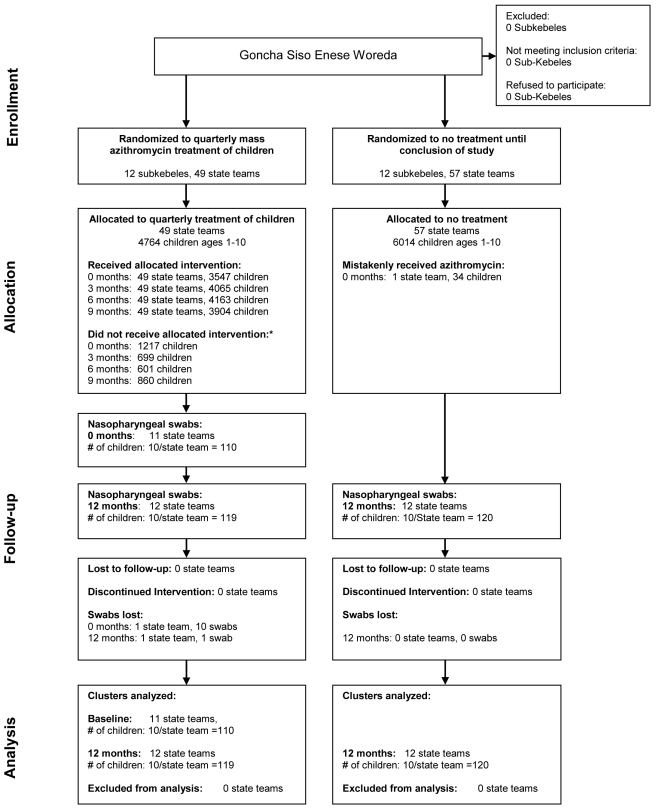
Methods and findings: In a cluster-randomized trial for trachoma control in Ethiopia, 12 communities were randomized to receive mass azithromycin treatment of children aged 1-10 years at months 0, 3, 6, and 9. Twelve control communities were randomized to receive no antibiotic treatments until the conclusion of the study. Nasopharyngeal swabs were collected from randomly selected children in the treated group at baseline and month 12, and in the control group at month 12. Antibiotic susceptibility testing was performed on Streptococcus pneumoniae isolated from the swabs using Etest strips. In the treated group, the mean prevalence of azithromycin resistance among all monitored children increased from 3.6% (95% confidence interval [CI] 0.8%-8.9%) at baseline, to 46.9% (37.5%-57.5%) at month 12 (p = 0.003). In control communities, azithromycin resistance was 9.2% (95% CI 6.7%-13.3%) at month 12, significantly lower than the treated group (p < 0.0001). Penicillin resistance was identified in 0.8% (95% CI 0%-4.2%) of isolates in the control group at 1 year, and in no isolates in the children-treated group at baseline or 1 year.
Conclusions: This cluster-randomized clinical trial demonstrated that compared to untreated control communities, nasopharyngeal pneumococcal resistance to macrolides was significantly higher in communities randomized to intensive azithromycin treatment. Mass azithromycin distributions were given more frequently than currently recommended by the World Health Organization's trachoma program. Azithromycin use in this setting did not select for resistance to penicillins, which remain the drug of choice for pneumococcal infections.
Trial registration: www.ClinicalTrials.gov NCT00322972. Please see later in the article for the Editors' Summary.
Conflict of interest statement
JHJ was an Advisory board member for BD Diagnostics; and has received research support from BD Diagnostics, bioMerieux, Merck and Pfizer.
Figures
References
-
- Goossens H, Ferech M, Vander Stichele R, Elseviers M. Outpatient antibiotic use in Europe and association with resistance: a cross-national database study. Lancet. 2005;365:579–587. - PubMed
-
- Van Eldere J, Mera RM, Miller LA, Poupard JA, Amrine-Madsen H. Risk factors for development of multiple-class resistance to Streptococcus pneumoniae Strains in Belgium over a 10-year period: antimicrobial consumption, population density, and geographic location. Antimicrob Agents Chemother. 2007;51:3491–3497. - PMC - PubMed
-
- Mera RM, Miller LA, White A. Antibacterial use and Streptococcus pneumoniae penicillin resistance: a temporal relationship model. Microb Drug Resist. 2006;12:158–163. - PubMed
Publication types
MeSH terms
Substances
Associated data
Grants and funding
LinkOut - more resources
Full Text Sources
Other Literature Sources
Medical
Molecular Biology Databases