doi: 10.4103/0972-6748.62273.
Hallucinations: Etiology and clinical implications
Affiliations
- PMID: 21180490
- PMCID: PMC2996210
- DOI: 10.4103/0972-6748.62273
Item in Clipboard
Hallucinations: Etiology and clinical implications
Ind Psychiatry J.
2009 Jul.
Abstract
The literature on hallucinations is reviewed, including history; theoretical background from physiological, biochemical and psychological points of view; classification; causation; presentation in different psychiatric and neurological disorders and in normal persons. The available evidence suggests that hallucinations result from a failure of the metacognitive skills involved in discriminating between self-generated and external sources of information. Management of hallucinations is briefly discussed.
Keywords: Etiology; Hallucinations; Psychopathology.
Conflict of interest statement
Figures
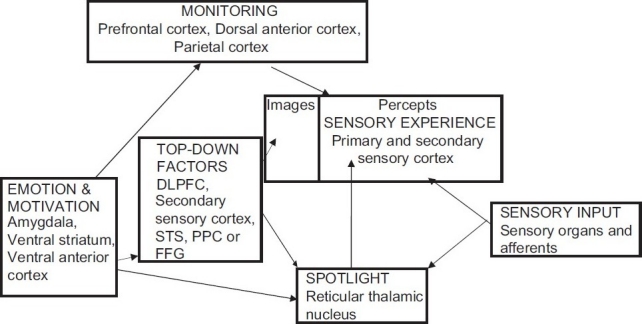
The role of emotion and motivation in cognitive processes. DLPFC - Dorsolateral prefrontal cortex; STS - Superior temporal sulcus; PPS - Posterior parietal sulcus; FFG - Fusiform gyrus
References
-
- Aleman A, Laroi F. The science of idiosyncratic perception. Washington DC: American Psychological Association; 2008. Halluciantions.
-
- Behrendt R.P, Young C. Hallucinations in schizophrenia, sensory impairment and brain disease. A unifying model. Behavioral and Brain sciences. 2004;27:771–787. - PubMed
-
- Bental R.P. The illusion of reality: A review and integration of psychological research on hallucinations. Psychological Bulletin. 107;82:95. - PubMed
-
- Collerton D, Perry E, McKeith I. Why people see things that are not there: A novel perception and attention deficit model for recurrent complex visual hallucinations. Behavioral and Brain Sciences. 2005;28:737–794. - PubMed
-
- David A.S. The neuropsychological origin of auditory hallucinations. In: David AS, Cutting JC, Hove UK, Earlbaum, editors. the Neuropsychology of schizophrenia. 1994. pp. 269–313.