


Gait adaptations in low back pain patients with lumbar disc herniation: trunk coordination and arm swing
- PMID: 21181483
- PMCID: PMC3048239
- DOI: 10.1007/s00586-010-1639-8
Gait adaptations in low back pain patients with lumbar disc herniation: trunk coordination and arm swing
Abstract
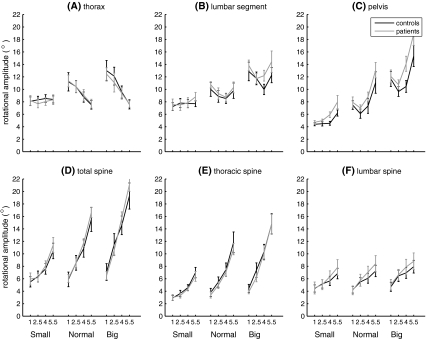
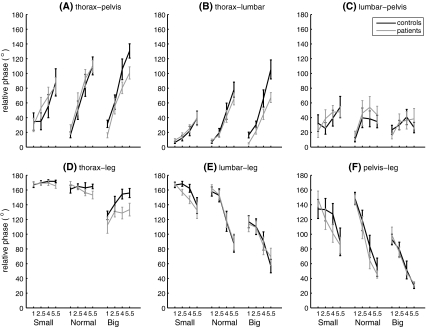
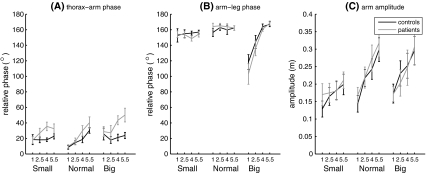
Patients with chronic non-specific low back pain (LBP) walk with more synchronous (in-phase) horizontal pelvis and thorax rotations than controls. Low thorax-pelvis relative phase in these patients appears to result from in-phase motion of the thorax with the legs, which was hypothesized to affect arm swing. In the present study, gait kinematics were compared between LBP patients with lumbar disc herniation and healthy controls during treadmill walking at different speeds and with different step lengths. Movements of legs, arms, and trunk were recorded. The patients walked with larger pelvis rotations than healthy controls, and with lower relative phase between pelvis and thorax horizontal rotations, specifically when taking large steps. They did so by rotating the thorax more in-phase with the pendular movements of the legs, thereby limiting the amplitudes of spine rotation. In the patients, arm swing was out-of phase with the leg, as in controls. Consequently, the phase relationship between thorax rotations and arm swing was altered in the patients.
Figures

References
-
- Wu WH, Meijer OG, Jutte PC, Uegaki K, Lamoth CJC, De Wolf GS, Van Dieën JH, Wuisman PIJM, Kwakkel G, De Vries JIP, Beek PJ. Gait in patients with pregnancy-related pain in the pelvis: an emphasis on the coordination of transverse pelvic and thoracic rotations. Clin Biomech. 2002;17:678–686. doi: 10.1016/S0268-0033(02)00109-2. - DOI - PubMed
Publication types
MeSH terms
LinkOut - more resources
Full Text Sources
Other Literature Sources
Medical
Miscellaneous
