. 2011 Jan;41(1):140-50.
doi: 10.1002/eji.201040796. Epub 2010 Dec 9.

Estrogen receptor-β ligand treatment modulates dendritic cells in the target organ during autoimmune demyelinating disease

Affiliations

Estrogen receptor-β ligand treatment modulates dendritic cells in the target organ during autoimmune demyelinating disease

Sienmi Du et al. Eur J Immunol. 2011 Jan.

Abstract

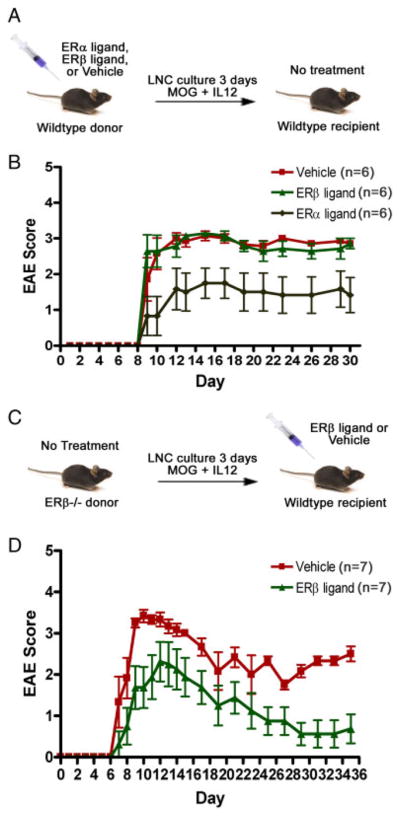
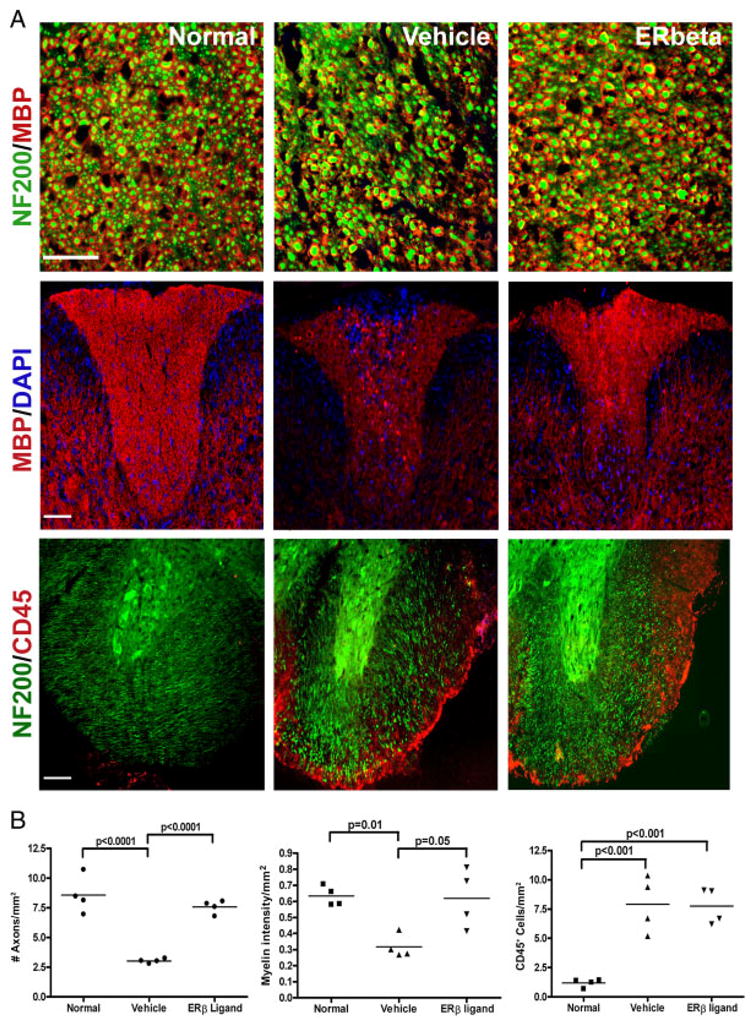
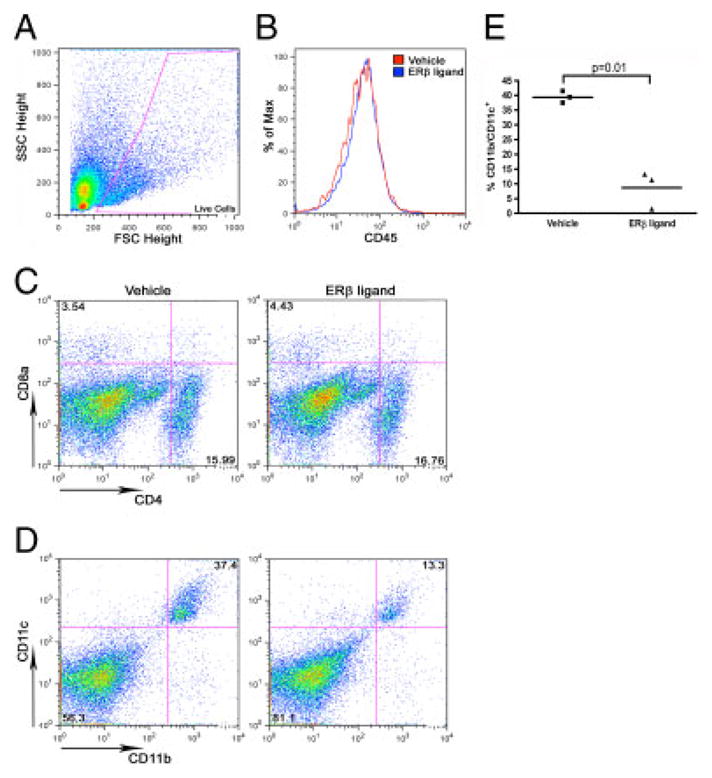
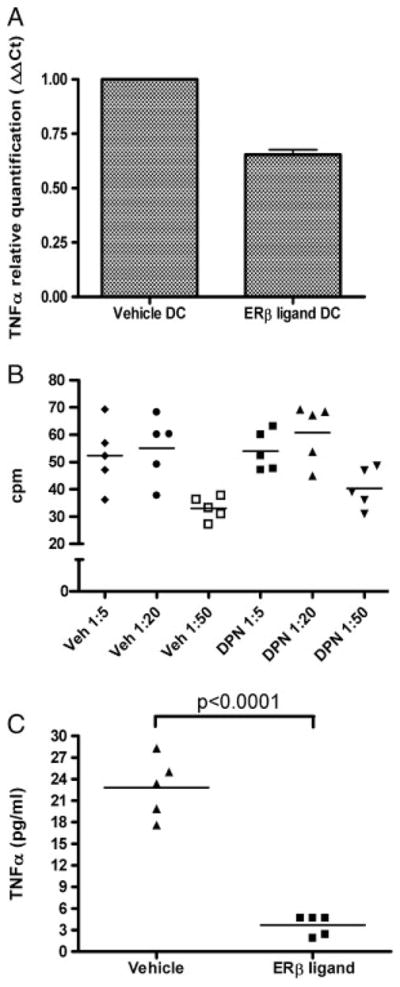
Estrogens act upon nuclear estrogen receptors (ER) to ameliorate cell-mediated autoimmune disease. As most immunomodulatory effects of estrogens in EAE have been attributed to the function of ER-α, we previously demonstrated that ER-β ligand treatment reduced disease severity without affecting peripheral cytokine production or levels of CNS inflammation, suggesting a direct neuroprotective effect; however, the effect of ER-β treatment on the function of immune cells within the target organ remained unknown. Here, we used adoptive transfer studies to show that ER-β ligand treatment was protective in the effector, but not the induction phase of EAE, as shown by decreased clinical disease severity with the preservation of axons and myelin in spinal cords. The analysis of the immune cell infiltrates in the CNS revealed that while ER-β ligand treatment did not reduce overall levels of CNS inflammation, there was a decrease in the DC percentage, and these CNS DC had decreased TNF-α production. Finally, experiments using DC deficient in ER-β revealed that the expression of ER-β on DC was essential for protective effects of ER-β ligand treatment in EAE. Our results demonstrate for the first time an effect of ER-β ligand treatment in vivo on DC in the target organ of a prototypic cell-mediated autoimmune disease.


Conflict of interest statement

Conflict of Interest: The authors declare no financial or commercial conflict of interest.

Figures

Figure 1
Figure 1
ER-β ligand treatment effects in the induction versus the effector phase of adoptive EAE. (A) Induction phase treatment. WT C57BL/6 mice were adoptively transferred with LNC from ER-β ligand-or vehicle-treated WT donor mice immunized with myelin oligodendrocyte glycoprotein (MOG) 35–55 peptide. (B) EAE score of mice treated as described in (A). ER-α ligand treatment was used as the positive control (p = 0.05, repeated one-way ANOVA). (C) Effector phase treatment. Thy1-YFP tg mice treated with ER-β ligand were adoptively transferred with LNC from untreated ER-β−/− mice immunized with autoantigen. (D) EAE score of mice treated as described in (C) (p = 0.04, days 25–35, repeated one-way ANOVA). Each group consisted of 6–7 mice in each experiment. Data are representative of three independent experiments.
Figure 2
Figure 2
ER-β ligand treatment during the effector phase of EAE: effects on axonal densities. (A, top row) Representative 40 × captures of spinal cord sections at the thoracic lateral funiculus of control (left), vehicle-treated (middle), and ER-β ligand-treated (right) EAE mice sacrificed at day 35 post-adoptive transfer. Myelin and axons were stained with MBP (red) and NF200 (green), respectively. Scale bar, 50 μm. (A, middle row) Representative 10 × captures of the dorsal column of spinal cord sections stained with MBP (red) and DAPI (blue) for cell nuclei. Scale bar, 100 μm. (A, bottom row) Representative 10 × confocal images of spinal cord lateral funiculus cross-sections at the thoracic level were stained with NF200 (green) and pan-leukocyte marker CD45 (red). Scale bar, 100 μm. (B) Quantification of axonal densities (left), myelin staining intensity (middle), and CD45 immunoreactivity (right) as shown in (A). Four mice in each treatment group were examined with three sections per mouse for a total of 12 sections analyzed for each treatment group. p-values were determined by one-way ANOVA. Data are representative of three independent experiments.
Figure 3
Figure 3
ER-β ligand treatment effects on DC in the CNS of EAE mice. Thy1-YFP transgenic mice treated with vehicle or ER-β ligand were adoptively transferred with autoantigen-stimulated ER-β−/− LNC (3 × 10⁶ cells/mouse). CNS immune cells were pooled from 7–10 animals at disease onset (10 days post-adoptive transfer) and analyzed by flow cytometry. Cells were stained with CD45, and CD4 and CD8α, or CD11b and CD11c and gated on live cell populations. (A) Forward scatter (FSC) versus side scatter (SSC) dot plot with gate on live cells that were further analyzed in (B)–(D). (B) Histogram of CD45+ infiltrating cells in the CNS of ER-β (blue) and vehicle (red) treated EAE mice. (C) Dot plots of CD4+ or CD8+ T-cell populations in the CNS of ER-β ligand (right) versus vehicle-treated (left) EAE mice. (D) Dot plots of CD11b/CD11c+ DC in the CNS of ER-β ligand (right) versus vehicle-treated (left) EAE mice. (E) Statistical analysis of the percentage of CD11b/CD11c+ DC in the CNS of ER-β ligand (right) versus vehicle-treated (left) EAE mice (p = 0.01, paired t-test). In all experiments, three samples were examined for each treatment group. Dot plots and histograms are representative of results of three independent experiments.
Figure 4
Figure 4
ER-β ligand treatment effects on the production of TNF-α by CNS dendritic cells. (A) Relative quantification of TNF-α mRNA levels in CD11b/CD11c+ DC (left) isolated from the CNS of EAE mice treated with vehicle or ER-β ligand at disease onset (10 days post-adoptive transfer). GAPDH served as an internal control. The results are presented with the vehicle-treated group normalized to a level of one, and ER-β ligand-treated group as a fraction thereof. Data show mean+SD pooled from three independent experiments. (B) Proliferation of DC/TC co-culture. DC were sorted from the CNS of ER-β ligand or vehicle-treated EAE mice, whereas TC were sorted from lymph nodes of a separate group of untreated immunized mice ten days post-immunization. CNS DC and LN TC were re-stimulated with autoantigen at ratios of 1:5, 1:20, and 1:50, with 1 × 10⁵ T-cells/well. (C) TNF-α levels from DC/TC co-culture. TNF-α levels were measured from supernatants of cultures of DC/TC at the 1:5 ratio (p<0.0001, Student’s t-test). CNS DC were pooled from two mice for one sample for a total of five samples from ten mice in each treatment group. LN TC were collected and pooled from ten untreated mice.
Figure 5
Figure 5
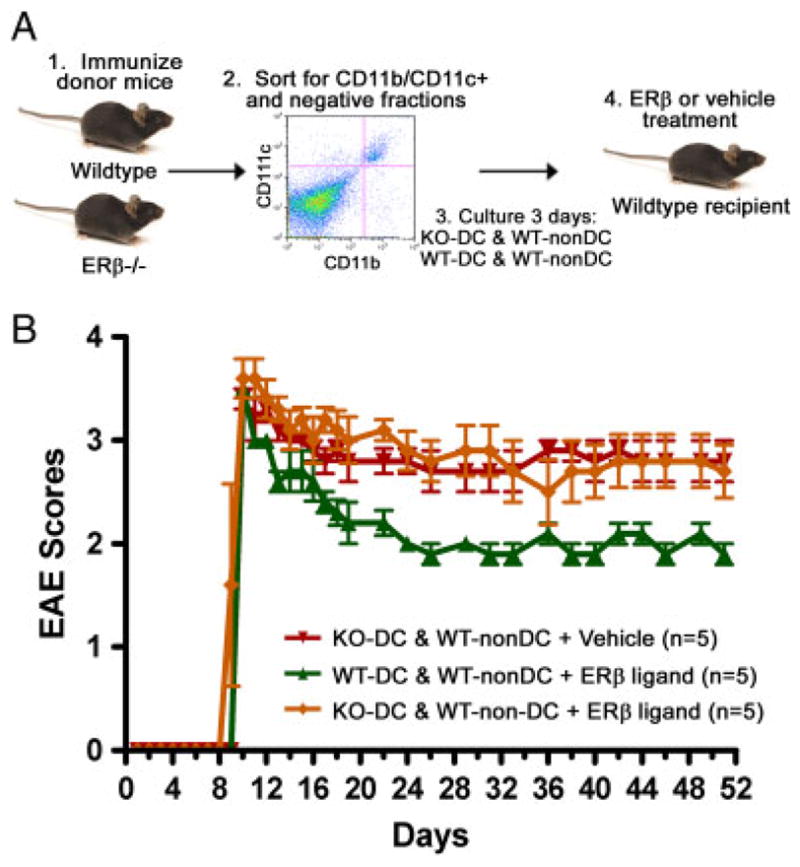
The role of ER-β expression on DC in the protective effect of ER-β ligand treatment in EAE. (A) LNC from immunized WT and ER-β−/− donor mice were sorted for CD11b/CD11c+ DC and CD11b/CD11c (non-DC) populations, then various DC and non-DC were mixed as indicated, restimulated with autoantigen for 3 days, and adoptively transferred to ER-β ligand or vehicle-treated recipient mice. (B) EAE score of mice treated as described in (A) (p<0.0001, repeated one-way ANOVA).

References

    1. Murase JE, Chan KK, Garite TJ, Cooper DM, Weinstein GD. Hormonal effect on psoriasis in pregnancy and post partum. Arch Dermatol. 2005;141:601–606. - PubMed
    1. Djelmis J, Sostarko M, Mayer D, Ivanisevic M. Myasthenia gravis in pregnancy: report on 69 cases. Eur J Obstet Gynecol Reprod Biol. 2002;104:21–25. - PubMed
    1. LeBeau SO, Mandel SJ. Thyroid disorders during pregnancy. Endocrinol Metab Clin North Am. 2006;35:117–136. vii. - PubMed
    1. Russell AS, Johnston C, Chew C, Maksymowych WP. Evidence for reduced Th1 function in normal pregnancy: a hypothesis for the remission of rheumatoid arthritis. J Rheumatol. 1997;24:1045–1050. - PubMed
    1. Confavreux C, Hutchinson M, Hours MM, Cortinovis-Tourniaire P, Moreau T, Grp PMS. Rate of pregnancy-related relapse in multiple sclerosis. N Engl J Med. 1998;339:285–291. - PubMed

Publication types

MeSH terms

LinkOut - more resources