. 2011 Jan 26;133(3):462-77.
doi: 10.1021/ja1071916. Epub 2010 Dec 23.

Universal peptidomimetics

Affiliations

Universal peptidomimetics

Eunhwa Ko et al. J Am Chem Soc. .

Abstract

This paper concerns peptidomimetic scaffolds that can present side chains in conformations resembling those of amino acids in secondary structures without incurring excessive entropic or enthalpic penalties. Compounds of this type are referred to here as minimalist mimics. The core hypothesis of this paper is that small sets of such scaffolds can be designed to analogue local pairs of amino acids (including noncontiguous ones) in any secondary structure; i.e., they are universal peptidomimetics. To illustrate this concept, we designed a set of four peptidomimetic scaffolds. Libraries based on them were made bearing side chains corresponding to many of the protein-derived amino acids. Modeling experiments were performed to give an indication of kinetic and thermodynamic accessibilities of conformations that can mimic secondary structures. Together, peptidomimetics based on these four scaffolds can adopt conformations that resemble almost any combination of local amino acid side chains in any secondary structure. Universal peptidomimetics of this kind are likely to be most useful in the design of libraries for high-throughput screening against diverse targets. Consequently, data arising from submission of these molecules to the NIH Molecular Libraries Small Molecule Repository (MLSMR) are outlined.


Figures

Figure 1
Figure 1
a Illustrative examples of minimalist mimics. b Favorable conformations of Hamilton's helical mimic shown in a.
Figure 2
Figure 2
a A β-turn, and a minimalist mimic consisting of a scaffold affording appropriate Cβ-atom separations. b Minimalist mimics A and B prepared in our group.
Figure 2
Figure 2
a A β-turn, and a minimalist mimic consisting of a scaffold affording appropriate Cβ-atom separations. b Minimalist mimics A and B prepared in our group.
Figure 3
Figure 3
a Conformations of the triazole B can display side-chains aligned with Cβ atoms as close, or as far apart as possible, and these conformations are easily interconverted at room temperature. b Definition of the term “extension factor”.
Figure 4
Figure 4
a “Significant degrees of freedom” for mimic 1 (R1 = R2 = Me); rotation about only these bonds in the scaffold alters the βs. b Conformations corresponding to the βsc and βse in an abbreviated structure of compound 1 (piperidine ring omitted).
Figure 4
Figure 4
a “Significant degrees of freedom” for mimic 1 (R1 = R2 = Me); rotation about only these bonds in the scaffold alters the βs. b Conformations corresponding to the βsc and βse in an abbreviated structure of compound 1 (piperidine ring omitted).
Scheme 1
Scheme 1
Two Methods for Preparing Monovalent Mimics 1.
Scheme 1
Scheme 1
Two Methods for Preparing Monovalent Mimics 1.
Figure 5
Figure 5
a Transposition of the global minima of 1 into conformation that mimics the i and i + 3 residues in an α-helix by rotation around one of the significant bonds, then the other (ΔGo values shown in kcal/mol). b Overlay of the latter conformation on an ideal α-helix (shown color-coded on the left and in pink on the right).
Figure 6
Figure 6
QMD data for compound 1 (R1 = R2 = Me). a Data from family 3 illustrating overlay with an inverse γ-turn (overlay with a α-helix is shown in Figure 5b). b Data from family 5 illustrating overlay with a type 1 β-turn.
Scheme 2
Scheme 2
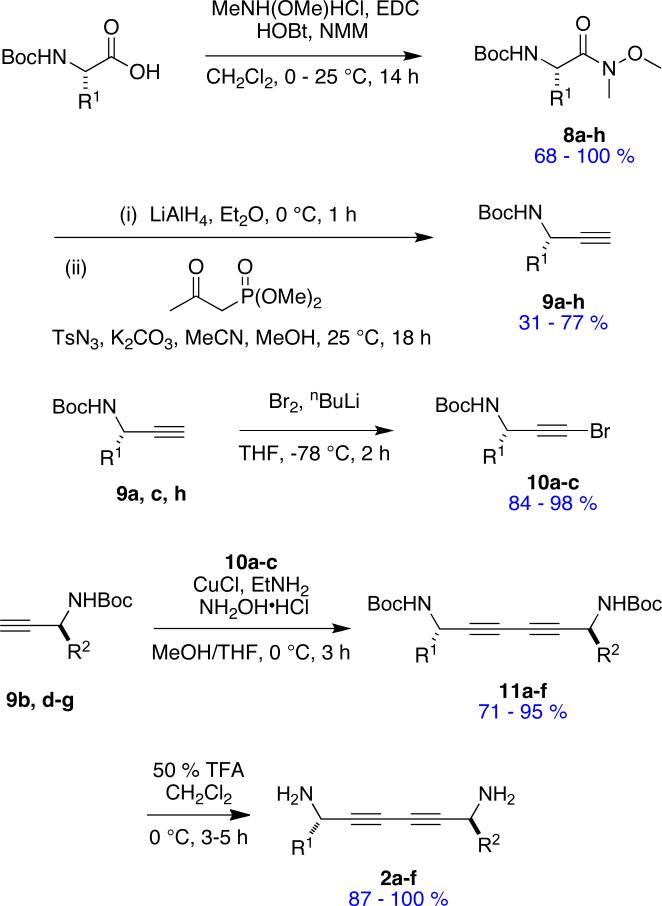
Method for Preparing Diyne-based Mimics 2.
Figure 7
Figure 7
a Peptidomimetics 2 have only one significant degree of freedom (R1 = R2 = Me shown); b conformations corresponding to the βsc and βse; and, c overlay of one conformation of 2 with the i and i + 2 side-chains of a classical γ-turn.
Scheme 3
Scheme 3
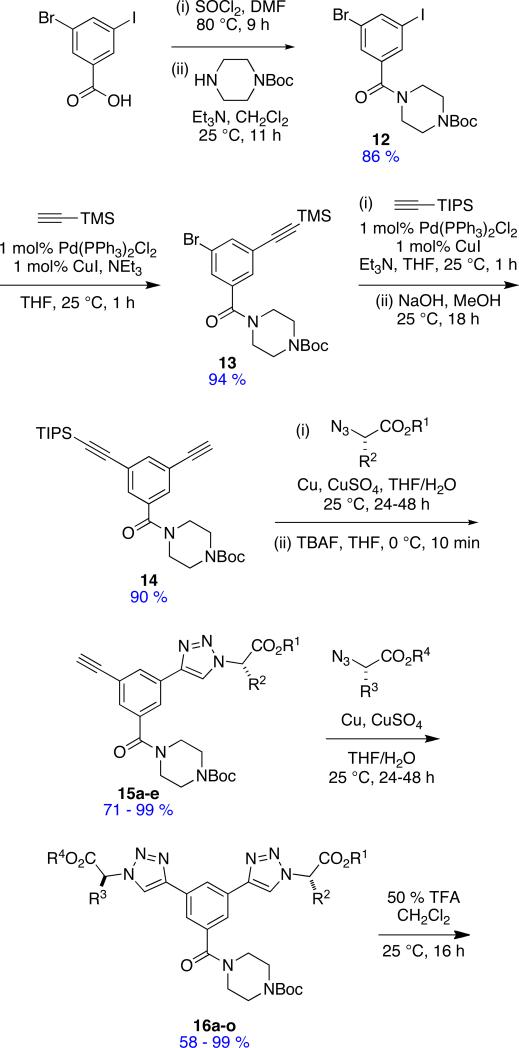
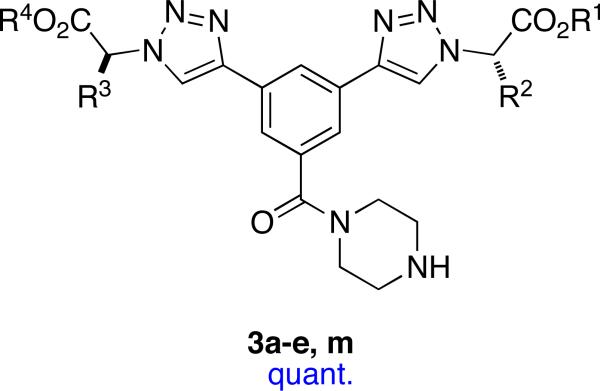
Method for Preparing Extended Mimics 3.
Scheme 3
Scheme 3
Method for Preparing Extended Mimics 3.
Figure 8
Figure 8
a Peptidomimetics 3 have four significant degrees of freedom (R1 = R2 = Me shown); b conformations corresponding to the βsc and βse in an abbreviated model of structure 3 (piperazine ring omitted).
Figure 9
Figure 9
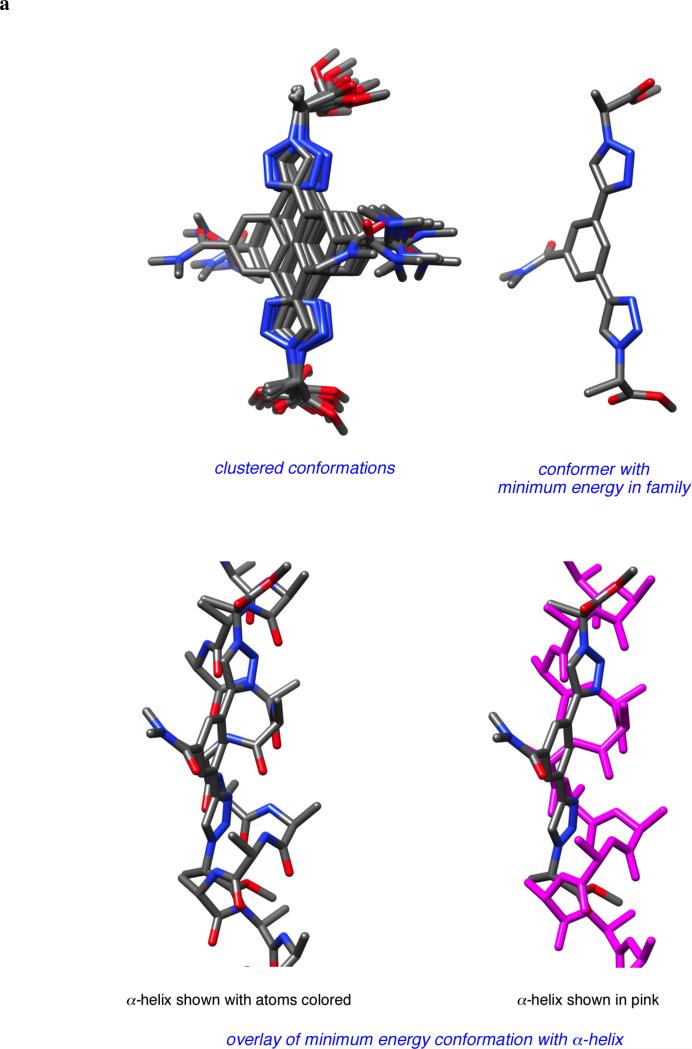
a Transposition of the global minima of 3 into conformation that mimics the i and i' + 3 residues in an anti-parallel β-sheet (ΔGo values shown in kcal/mol). b Overlay of the latter conformation on an anti-parallel β-sheet (shown color coded on the left and in pink on the right).
Figure 10
Figure 10
Conformers from QMD studies on compounds 3 (see Table 7). Family: a 3 overlaid with α-helix; b 4 overlaid with an anti-parallel β-sheet; and, c 7 overlaid onto a parallel β-sheet.
Figure 10
Figure 10
Conformers from QMD studies on compounds 3 (see Table 7). Family: a 3 overlaid with α-helix; b 4 overlaid with an anti-parallel β-sheet; and, c 7 overlaid onto a parallel β-sheet.
Figure 10
Figure 10
Conformers from QMD studies on compounds 3 (see Table 7). Family: a 3 overlaid with α-helix; b 4 overlaid with an anti-parallel β-sheet; and, c 7 overlaid onto a parallel β-sheet.
Figure 11
Figure 11
a Peptidomimetics 4 have four significant degrees of freedom (R1 = R2 = Me shown); b conformations corresponding to the βsc and βse in an abbreviated model of structure 4 (piperazine ring omitted).
Scheme 4
Scheme 4
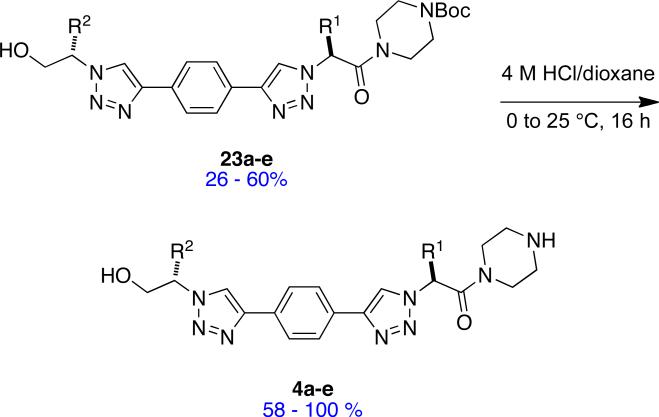
Synthesis of the “Linear” Bistriazole-based Peptidomimetics 4.
Scheme 4
Scheme 4
Synthesis of the “Linear” Bistriazole-based Peptidomimetics 4.
Figure 12
Figure 12
a Global minimum conformation of 4 from the density functional theory method must surmount energy barriers of just over 3 kcal/mol to reach conformations that mimic the i and i + 4 residues in a parallel β-sheet (ΔGo values shown in kcal/mol). b Overlay of the latter conformation on a parallel β-sheet (shown color coded on the left and in pink on the right).
Figure 13
Figure 13
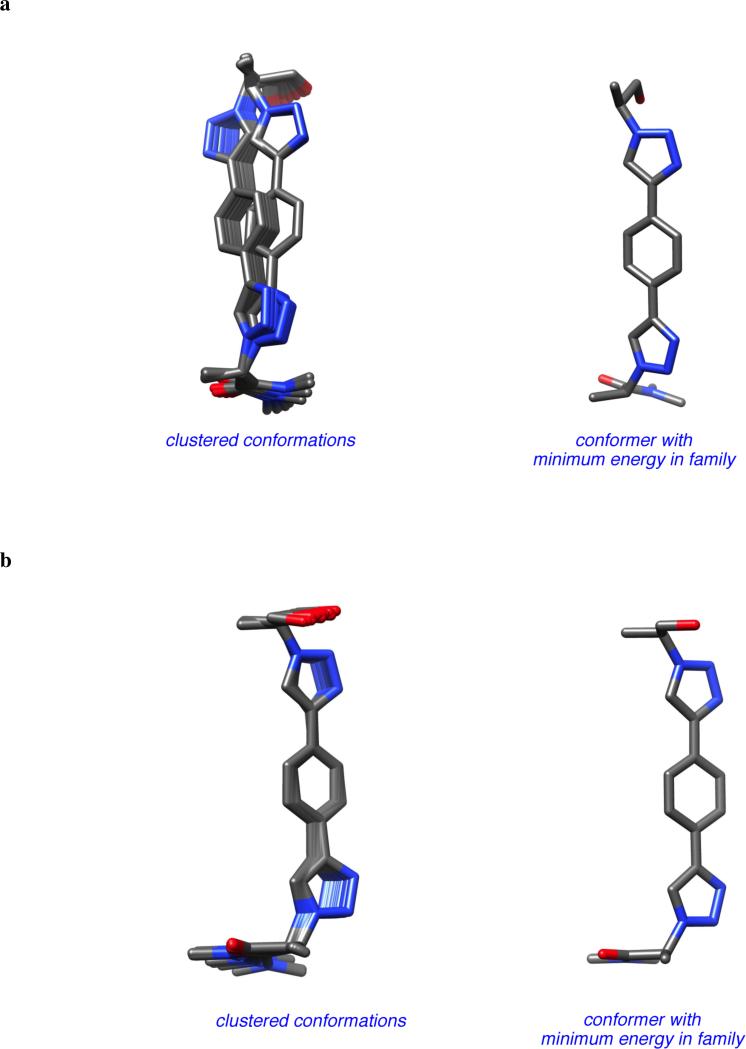
Conformers generated in QMD (see Table 7). a family 2 (overlays with parallel β-sheet as in Figure 12); b family 5 overlays with an α-helix.
Figure 13
Figure 13
Conformers generated in QMD (see Table 7). a family 2 (overlays with parallel β-sheet as in Figure 12); b family 5 overlays with an α-helix.

References

    1. Farmer PS. In: Drug Design. Ariens EJ, editor. Vol. 10. Academic Press; San Diego: 1980. pp. 119–143.
    1. Farmer PS, Ariens EJ. Trends Pharmacol. Sci. 1982;3:362–365.
    1. Spatola AF. In: Chemistry and Biochemistry of Amino Acids, Peptides, and Proteins: A Survey of Recent Developments. Weinstein B, editor. Vol. 7. Marcel Dekker; New York: 1983. pp. 267–357.
    1. Hruby VJ, Al-Obeidi F, Kazmierski W. Biochem. J. 1990;268:249–262. - PMC - PubMed
    1. Lam KS, Lebl M, Krchnak V. Chem. Rev. 1997;97:411–448. - PubMed

Publication types

Substances