Review
. 2011 Feb;11(1):11-27.
doi: 10.2174/156652311794520111.

Meganucleases and other tools for targeted genome engineering: perspectives and challenges for gene therapy

Affiliations
Free PMC article
Review

Meganucleases and other tools for targeted genome engineering: perspectives and challenges for gene therapy

George Silva et al. Curr Gene Ther. 2011 Feb.
Free PMC article

Abstract

The importance of safer approaches for gene therapy has been underscored by a series of severe adverse events (SAEs) observed in patients involved in clinical trials for Severe Combined Immune Deficiency Disease (SCID) and Chromic Granulomatous Disease (CGD). While a new generation of viral vectors is in the process of replacing the classical gamma-retrovirus-based approach, a number of strategies have emerged based on non-viral vectorization and/or targeted insertion aimed at achieving safer gene transfer. Currently, these methods display lower efficacies than viral transduction although many of them can yield more than 1% of engineered cells in vitro. Nuclease-based approaches, wherein an endonuclease is used to trigger site-specific genome editing, can significantly increase the percentage of targeted cells. These methods therefore provide a real alternative to classical gene transfer as well as gene editing. However, the first endonuclease to be in clinic today is not used for gene transfer, but to inactivate a gene (CCR5) required for HIV infection. Here, we review these alternative approaches, with a special emphasis on meganucleases, a family of naturally occurring rare-cutting endonucleases, and speculate on their current and future potential.


Figures
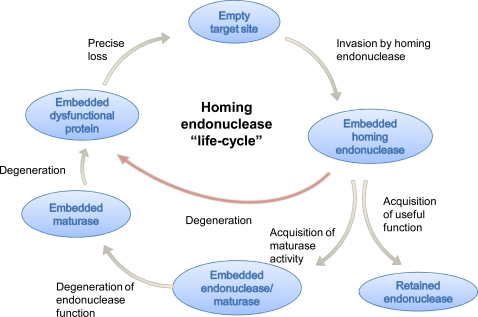
Fig. (1)
Fig. (1)
Proposed life-cycle of a homing endonuclease (see text for details). Adapted from [145].
Fig. (2)
Fig. (2)
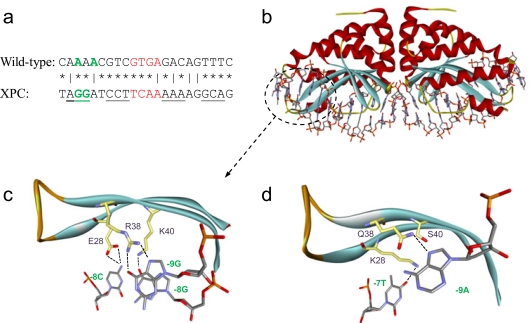
Re-engineering meganuclease specificity: example of a custom meganuclease targeting a sequence from the human XPC gene. (a) Comparison of the starting and final targets. (b) Crystal structure of the engineered I-CreI variant in complex with target DNA. Details of protein-DNA contacts from the encircled region are highlighted (c) to demonstrate how a clustered approach leads to significant changes in specificity contacts. The native protein-DNA contacts for I-CreI (d) are shown for reference. Adapted from [161].
Fig. (3)
Fig. (3)
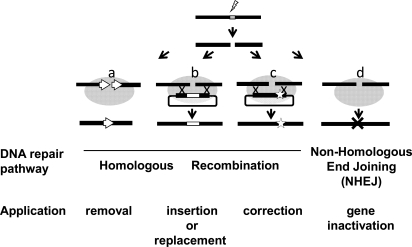
Endonuclease-induced gene targeting approaches. Upon cleavage, DNA repair mechanisms may result in one of several outcomes. When a double-strand break is targeted between two direct repeats (a), homologous recombination can result in the deletion of one repeat together with the intervening sequence. Gene insertion (b) or correction (c) can be achieved by the introduction of a DNA repair matrix containing sequences homologous to the endogenous sequence surrounding the DNA break. Mutations can be corrected either at or distal to the break, with the frequency of correction decreasing with increasing distance. The misrepair of DNA ends by error-prone non-homologous end joining (d) can result in insertions or deletions of various sizes, leading to gene inactivation.
Fig. (4)
Fig. (4)
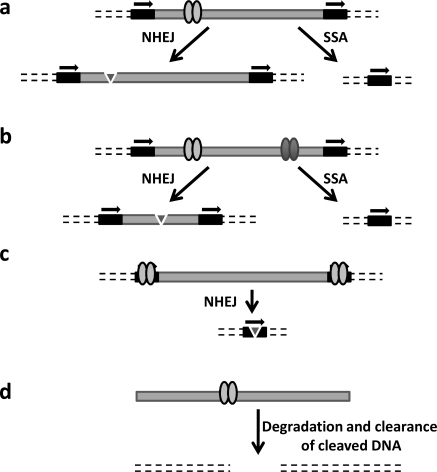
Meganucleases as antiviral agents. Pathways by which viral sequences belonging either to essential genes or regulatory regions can be inactivated are shown. Gene inactivation can result from small insertions/deletions that introduce lethal mutations in the viral genome by error-prone non-homologous recombination (panel a). Large deletions can be introduced by DNA cleavage and repair when using two different meganucleases targeting the same viral genome at different positions (panel b), or by rejoining DNA ends when cleavage occurs in a repeated region of the viral genome (panel c). Alternatively, when cleavage occurs between two direct repeats (e.g.: the LTR retroviral sequences), deletion of the intervening sequences can be generated by tandem repeat recombination (SSA, panels a and b). While the pathways depicted in panels a-c are valid for integrated as well as episomal viruses, the latter can also be targeted via the degradation and clearance of the viral genome upon DNA cleavage (panel d).

References

    1. Cavazzana-Calvo M, Hacein-Bey S, de Saint Basile G, et al. Gene therapy of human severe combined immunodeficiency (SCID)-X1 disease. Science. 2000;288:669–72. - PubMed
    1. Gaspar HB, Parsley KL, Howe S, et al. Gene therapy of X-linked severe combined immunodeficiency by use of a pseudotyped gammaretroviral vector. Lancet. 2004;364:2181–7. - PubMed
    1. Hacein-Bey-Abina S, Garrigue A, Wang GP, et al. Insertional oncogenesis in 4 patients after retrovirus-mediated gene therapy of SCID-X1. J Clin Invest. 2008;118:3132–42. - PMC - PubMed
    1. Hacein-Bey-Abina S, Von Kalle C, Schmidt M, et al. LMO2-associated clonal T cell proliferation in two patients after gene therapy for SCID-X1. Science. 2003;302:415–9. - PubMed
    1. Howe SJ, Mansour MR, Schwarzwaelder K, et al. Insertional mutagenesis combined with acquired somatic mutations causes leukemogenesis following gene therapy of SCID-X1 patients. J Clin Invest. 2008;118:3143–50. - PMC - PubMed