. 2011 Apr;16(2):261-72.
doi: 10.1111/j.1369-1600.2010.00281.x. Epub 2010 Dec 23.

Endogenous GDNF in ventral tegmental area and nucleus accumbens does not play a role in the incubation of heroin craving

Affiliations

Endogenous GDNF in ventral tegmental area and nucleus accumbens does not play a role in the incubation of heroin craving

Mikko Airavaara et al. Addict Biol. 2011 Apr.

Abstract

Glial cell line-derived neurotrophic factor (GDNF) activity in ventral tegmental area (VTA) mediates the time-dependent increases in cue-induced cocaine-seeking after withdrawal (incubation of cocaine craving). Here, we studied the generality of these findings to incubation of heroin craving. Rats were trained to self-administer heroin for 10 days (6 hours/day; 0.075 mg/kg/infusion; infusions were paired with a tone-light cue) and tested for cue-induced heroin-seeking in extinction tests after 1, 11 or 30 withdrawal days. Cue-induced heroin seeking was higher after 11 or 30 days than after 1 day (incubation of heroin craving), and the time-dependent increases in extinction responding were associated with time-dependent changes in GDNF mRNA expression in VTA and nucleus accumbens. Additionally, acute accumbens (but not VTA) GDNF injections (12.5 µg/side) administered 1-3 hours after the last heroin self-administration training session enhanced the time-dependent increases in extinction responding after withdrawal. However, the time-dependent increases in extinction responding after withdrawal were not associated with changes in GDNF protein expression in VTA and accumbens. Additionally, interfering with endogenous GDNF function by chronic delivery of anti-GDNF monoclonal neutralizing antibodies (600 ng/side/day) into VTA or accumbens had no effect on the time-dependent increases in extinction responding. In summary, heroin self-administration and withdrawal regulate VTA and accumbens GDNF mRNA expression in a time-dependent manner, and exogenous GDNF administration into accumbens but not VTA potentiates cue-induced heroin seeking. However, based on the GDNF protein expression and the anti-GDNF monoclonal neutralizing antibodies manipulation data, we conclude that neither accumbens nor VTA endogenous GDNF mediates the incubation of heroin craving.


Figures

Figure 1
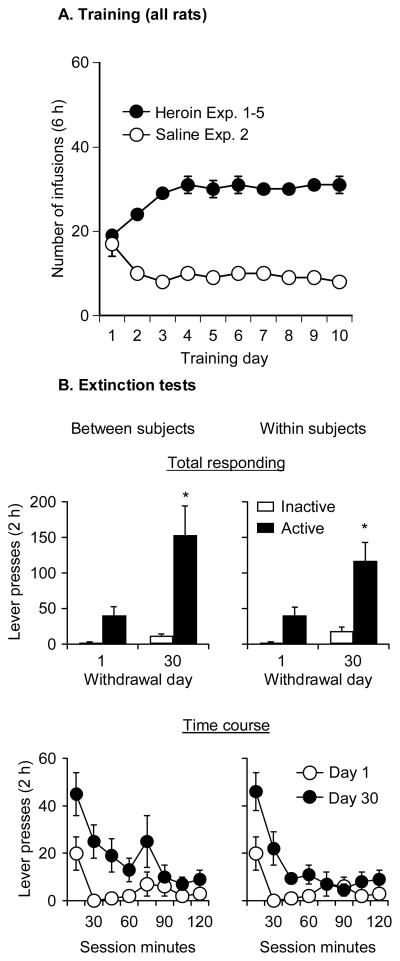
Figure 1. Heroin self-administration training and time-dependent increases in cue-induced heroin seeking in extinction tests (incubation of heroin craving)
(A) Training days 1–10. Data are mean±SEM number of heroin (0.075 mg/kg/injection) and saline infusions over the ten 6-h daily self-administration sessions. During training, lever presses were reinforced under a fixed-ratio-1 40-sec timeout reinforcement schedule; heroin injections were paired with a 5-sec tone-light cue. Data are from 167 heroin-trained rats from Exp. 1-4 and 28 saline-trained rats from Exp. 2. (B) Within- and between-subjects comparison of cue-induced heroin seeking. Upper panels: Mean±SEM responses per 2 h (sum of two 1-h sessions that were separated by 5 min) during the extinction tests in two groups of rats; one group was tested repeatedly on withdrawal days 1 and 30 (n=11) and the other group was tested on day 30 only (n=10). Lower panels: active lever responding during the extinction tests at 15 min intervals. During the extinction tests, heroin was not available and lever presses resulted in the presentation of a tone-light cue previously paired with heroin injections. * Different from withdrawal day 1, p< 0.05.
Figure 2
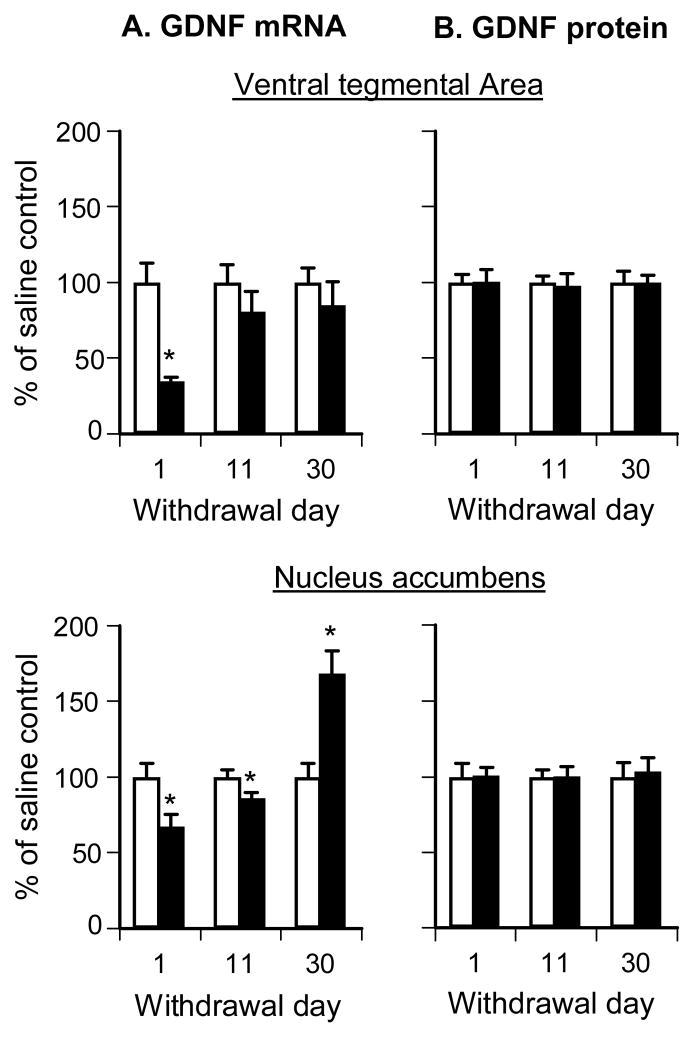
Figure 2. Time-dependent changes in GDNF mRNA but protein expression after withdrawal from heroin
Rats self-administered heroin (0.075 mg/kg/injection, n=7-9 per group) or saline (n=8-10 per group) over ten 6-h daily sessions and brains were dissected on withdrawal days 1, 11 or 30. Real-time quantitative PCR and western blots were conducted from samples derived from VTA or nucleus accumbens. Data are presented as percent of the saline control (mean±SEM) within each withdrawal day. GDNF protein levels were normalized to tubulin. * Different from the corresponding saline group within each withdrawal day, p< 0.05.
Figure 3
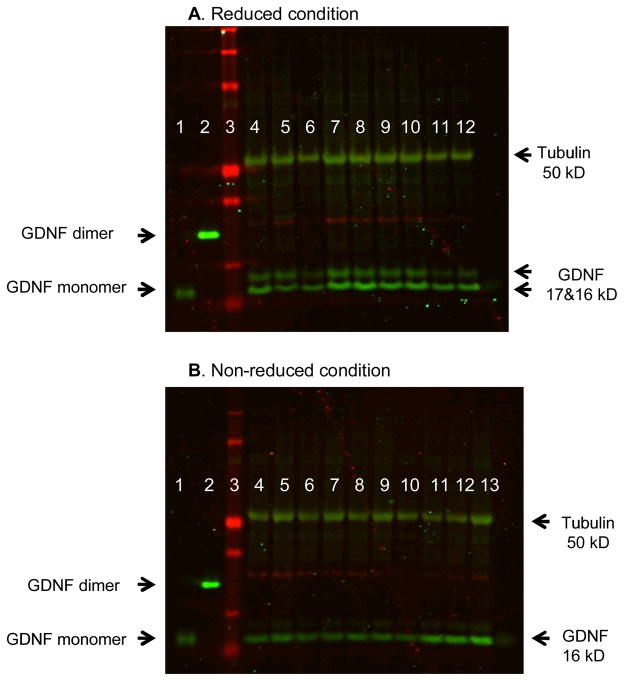
Figure 3. GDNF Western blot under reduced (A) and non-reduced conditions (B)
The Western blots are of nucleus accumbens of 10 saline-trained and 9 heroin-trained rats from the withdrawal day 11 groups; assays were performed under two different conditions: reduced and non-reduced. In the reduced condition (A), DTT was added to the final concentration of 20 mM in the lysis buffer before incubation at 45°C for 90 min. In the non-reduced condition (B), the lyses were without the DTT. A doublet band at the GDNF monomer region was observed in the reduced condition, possibly due to reduction of intramolecular disulfide bonds, and a single band was observed in the non-reduced condition. In the Western blot assays of the experimental rats (Fig. 3) we used the reduced condition to dissociate all potential GDNF dimers for accurate quantification of the GDNF monomer. Column numbers 1 to 12 in A refers to: 1: rhGDNF dimer under the non-reduced condition; 2: rhGDNF monomer under the reduced condition; 3: BioRad precision molecular weight marker; 4, 6, 8, 10: heroin-trained rats; 5, 7, 9, 11, 12: saline-trained rats. Column numbers 1 to 13 in B refer to: 1: rhGDNF dimer under the non-reduced condition; 2: rhGDNF monomer under reduced condition; 3: BioRad precision molecular weight marker; 4, 6, 8, 10, 12: heroin-trained rats; 5, 7, 9, 11, 13: saline-trained rats. Abbreviations: rhGDNF: recombinant human GDNF protein.
Figure 4
Figure 4. Accumbens but not ventral tegmental area (VTA) injections of GDNF potentiate cue-induced heroin-seeking
Data are mean±SEM responses per 1 h on the previously active lever (upper panels) and on the inactive lever (lower panels) during the extinction tests for cue-induced heroin seeking performed on withdrawal days 1, 11, and 30. During the extinction tests, heroin was not available and lever-presses resulted in the delivery of the tone-light cue previously paired with heroin injections. GDNF (12.5 μg/0.5μl/side) or vehicle (PBS) was injected bilaterally into VTA or accumbens 1-3 h after the last training session. (A) Timeline of the experiment, (B) VTA injections (n=10–12), (C) accumbens injections (n=14–16) * Different from vehicle, p< 0.05. SA, self-administration.

References

    1. Airavaara M, Tuomainen H, Piepponen TP, Saarma M, Ahtee L. Effects of repeated morphine on locomotion, place preference and dopamine in heterozygous glial cell line-derived neurotrophic factor knockout mice. Genes Brain Behav. 2007;6:287–298. - PubMed
    1. Alvarez-Jaimes L, Polis I, Parsons LH. Attenuation of cue-induced heroin-seeking behavior by cannabinoid CB1 antagonist infusions into the nucleus accumbens core and prefrontal cortex, but not basolateral amygdala. Neuropsychopharmacology. 2008;33:2483–2493. - PubMed
    1. Beninger RJ, Gerdjikov T. The role of signaling molecules in reward-related incentive learning. Neurotox Res. 2004;6:91–104. - PubMed
    1. Boger HA, Middaugh LD, Huang P, Zaman V, Smith AC, Hoffer BJ, Tomac AC, Granholm AC. A partial GDNF depletion leads to earlier age-related deterioration of motor function and tyrosine hydroxylase expression in the substantia nigra. Exp Neurol. 2006;202:336–347. - PubMed
    1. Bossert JM, Gray SM, Lu L, Shaham Y. Activation of group II metabotropic glutamate receptors in the nucleus accumbens shell attenuates context-induced relapse to heroin seeking. Neuropsychopharmacology. 2006;31:2197–2209. - PMC - PubMed

Publication types

MeSH terms