


Malaria transmission and vector behaviour in a forested malaria focus in central Vietnam and the implications for vector control
- PMID: 21182774
- PMCID: PMC3224380
- DOI: 10.1186/1475-2875-9-373
Malaria transmission and vector behaviour in a forested malaria focus in central Vietnam and the implications for vector control
Abstract
Background: In Vietnam, malaria is becoming progressively restricted to specific foci where human and vector characteristics alter the known malaria epidemiology, urging for alternative or adapted control strategies. Long-lasting insecticidal hammocks (LLIH) were designed and introduced in Ninh Thuan province, south-central Vietnam, to control malaria in the specific context of forest malaria. An entomological study in this specific forested environment was conducted to assess the behavioural patterns of forest and village vectors and to assess the spatio-temporal risk factors of malaria transmission in the province.
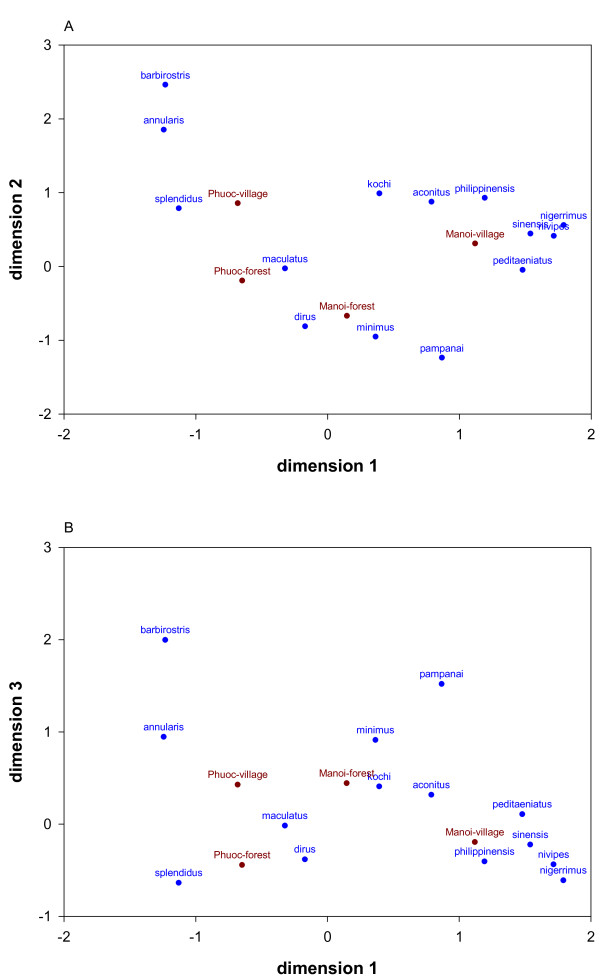
Methods: Five entomological surveys were conducted in three villages in Ma Noi commune and in five villages in Phuoc Binh commune in Ninh Thuan Province, south-central Vietnam. Collections were made inside the village, at the plot near the slash-and-burn fields in the forest and on the way to the forest. All collected mosquito species were subjected to enzyme-linked immunosorbent assay (ELISA) to detect Plasmodium in the head-thoracic portion of individual mosquitoes after morphological identification. Collection data were analysed by use of correspondence and multivariate analyses.
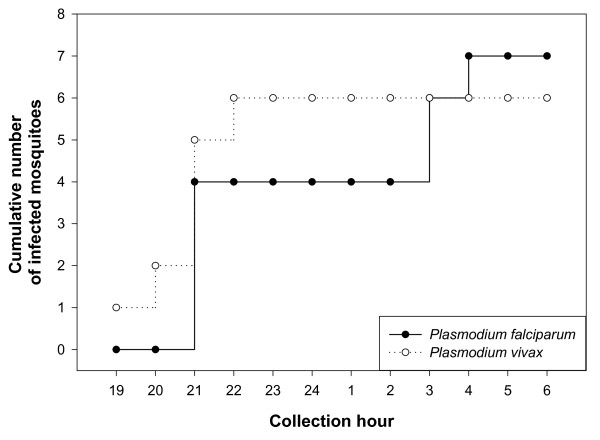
Results: The mosquito density in the study area was low with on average 3.7 anopheline bites per man-night and 17.4 culicine bites per man-night. Plasmodium-infected mosquitoes were only found in the forest and on the way to the forest. Malaria transmission in the forested malaria foci was spread over the entire night, from dusk to dawn, but was most intense in the early evening as nine of the 13 Plasmodium positive bites occurred before 21H. The annual entomological inoculation rate of Plasmodium falciparum was 2.2 infective bites per person-year to which Anopheles dirus s.s. and Anopheles minimus s.s. contributed. The Plasmodium vivax annual entomological inoculation rate was 2.5 infective bites per person-year with Anopheles sawadwongporni, Anopheles dirus s.s. and Anopheles pampanai as vectors.
Conclusion: The vector behaviour and spatio-temporal patterns of malaria transmission in Southeast Asia impose new challenges when changing objectives from control to elimination of malaria and make it necessary to focus not only on the known main vector species. Moreover, effective tools to prevent malaria transmission in the early evening and in the early morning, when the treated bed net cannot be used, need to be developed.
Figures
References
-
- Verlé P, Tuy TQ, Lieu TT, Kongs A, Coosemans M. New challenges for malaria control in northern Vietnam. Res Rev Parasitol. 1998;58:169–174.
-
- Barat LM. Four malaria success stories: How malaria burden was successfully reduced in Brazil, Eritrea, India, and Vietnam. Am J Trop Med Hyg. 2006;74:12–16. - PubMed
-
- Erhart A. Malaria control in Vietnam: successes and challenges. University of Antwerp; 2006.
-
- Erhart A, Thang ND, Hung NQ, Toi LV, Hung LX, Tuy TQ, Cong LD, Speybroeck N, Coosemans M, D'alessandro U. Forest malaria in Vietnam: A challenge for control. Am J Trop Med Hyg. 2004;70:110–118. - PubMed
Publication types
MeSH terms
LinkOut - more resources
Full Text Sources
