


Nutrition-responsive glia control exit of neural stem cells from quiescence
- PMID: 21183078
- PMCID: PMC3087489
- DOI: 10.1016/j.cell.2010.12.007
Nutrition-responsive glia control exit of neural stem cells from quiescence
Abstract
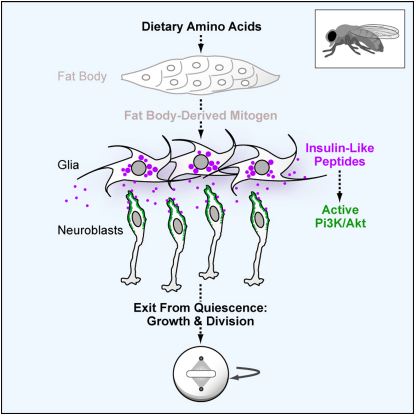
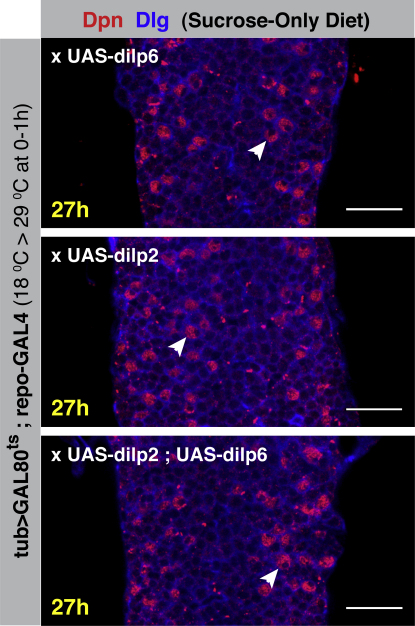
The systemic regulation of stem cells ensures that they meet the needs of the organism during growth and in response to injury. A key point of regulation is the decision between quiescence and proliferation. During development, Drosophila neural stem cells (neuroblasts) transit through a period of quiescence separating distinct embryonic and postembryonic phases of proliferation. It is known that neuroblasts exit quiescence via a hitherto unknown pathway in response to a nutrition-dependent signal from the fat body. We have identified a population of glial cells that produce insulin/IGF-like peptides in response to nutrition, and we show that the insulin/IGF receptor pathway is necessary for neuroblasts to exit quiescence. The forced expression of insulin/IGF-like peptides in glia, or activation of PI3K/Akt signaling in neuroblasts, can drive neuroblast growth and proliferation in the absence of dietary protein and thus uncouple neuroblasts from systemic control.
Copyright © 2010 Elsevier Inc. All rights reserved.
Figures
Comment in
-
Neurogenesis: food signals wake sleeping stem cells.Nat Rev Neurosci. 2011 Feb;12(2):62. doi: 10.1038/nrn2988. Nat Rev Neurosci. 2011. PMID: 21309091 No abstract available.
-
Food for thought: neural stem cells on a diet.Cell Stem Cell. 2011 Apr 8;8(4):352-4. doi: 10.1016/j.stem.2011.03.004. Cell Stem Cell. 2011. PMID: 21474096
References
-
- Aberg M.A., Aberg N.D., Palmer T.D., Alborn A.M., Carlsson-Skwirut C., Bang P., Rosengren L.E., Olsson T., Gage F.H., Eriksson P.S. IGF-I has a direct proliferative effect in adult hippocampal progenitor cells. Mol. Cell. Neurosci. 2003;24:23–40. - PubMed
-
- Ahn S., Joyner A.L. In vivo analysis of quiescent adult neural stem cells responding to Sonic hedgehog. Nature. 2005;437:894–897. - PubMed
-
- Alam S., Sen A., Behie L.A., Kallos M.S. Cell cycle kinetics of expanding populations of neural stem and progenitor cells in vitro. Biotechnol. Bioeng. 2004;88:332–347. - PubMed
-
- Anderson M.F., Aberg M.A., Nilsson M., Eriksson P.S. Insulin-like growth factor-I and neurogenesis in the adult mammalian brain. Brain Res. Dev. Brain Res. 2002;134:115–122. - PubMed
-
- Androutsellis-Theotokis A., Rueger M.A., Mkhikian H., Korb E., McKay R.D. Signaling pathways controlling neural stem cells slow progressive brain disease. Cold Spring Harb. Symp. Quant. Biol. 2008;73:403–410. - PubMed
Supplemental References
-
- Britton, J.S., Lockwood, W.K., Li, L., Cohen, S.M., and Edgar, B.A. (2002). Drosophila's insulin/PI3-kinase pathway coordinates cellular metabolism with nutritional conditions. Dev. Cell 2, 239–249. - PubMed
-
- Huang, H., Potter, C.J., Tao, W., Li, D.M., Brogiolo, W., Hafen, E., Sun, H., and Xu, T. (1999). PTEN affects cell size, cell proliferation and apoptosis during Drosophila eye development. Development 126, 5365–5372. - PubMed
-
- Ikeya, T., Galic, M., Belawat, P., Nairz, K., and Hafen, E. (2002). Nutrient-dependent expression of insulin-like peptides from neuroendocrine cells in the CNS contributes to growth regulation in Drosophila. Curr. Biol. 12, 1293–1300. - PubMed
Publication types
MeSH terms
Substances
Grants and funding
LinkOut - more resources
Full Text Sources
Other Literature Sources
Molecular Biology Databases
