. 2011 Apr;25(4):1254-63.
doi: 10.1096/fj.10-175208. Epub 2010 Dec 23.

Neutrophil responses to staphylococcal pathogens and commensals via the formyl peptide receptor 2 relates to phenol-soluble modulin release and virulence

Affiliations

Neutrophil responses to staphylococcal pathogens and commensals via the formyl peptide receptor 2 relates to phenol-soluble modulin release and virulence

Maren Rautenberg et al. FASEB J. 2011 Apr.

Abstract

The mechanisms used by the immune system to discriminate between pathogenic and commensal bacteria have remained largely unclear. Recently, we have shown that virulence of Staphylococcus aureus depends on secretion of phenol-soluble modulin (PSM) peptides that disrupt neutrophils at micromolar concentrations. Moreover, all S. aureus PSMs stimulate and attract neutrophils at nanomolar concentrations via interaction with the formyl-peptide receptor 2 (FPR2). Here, we demonstrate that FPR2 allows neutrophils to adjust their responses in relation to the aggressiveness of staphylococcal species, which differ largely in their capacity to infect or colonize humans and animals. PSM-related peptides were detected in all human and animal pathogenic staphylococci, but were absent from most commensal species. Three PSMβ-like peptides produced by the serious human pathogen Staphylococcus lugdunensis were identified as the previously described S. lugdunensis-synergistic hemolysins (SLUSHs). SLUSHs attracted and stimulated human leukocytes in a FPR2-dependent manner, indicating that FPR2 is a general receptor for all PSM-like peptide toxins. Remarkably, the release of PSMs correlated closely with the apparent capacity of staphylococcal species to cause invasive infections and with their ability to activate FPR2. These findings suggest that the innate immune system may be able to respond in different ways to pathogenic or innocuous staphylococci by monitoring the presence of PSMs via FPR2.


Figures
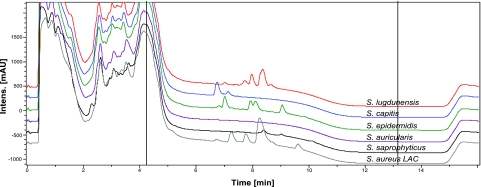
Figure 1.
Figure 1.
HPLC spectra of selected staphylococcal culture supernatants. Peaks between ∼6 and 10 min correspond to PSM peptides, which are known to elute at these positions under the experimental conditions.
Figure 2.
Figure 2.
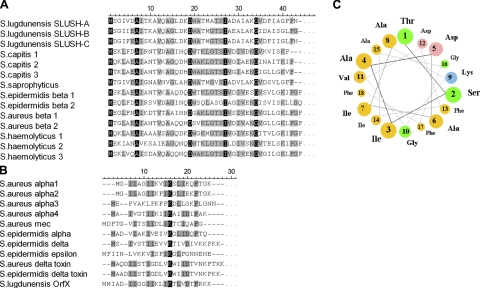
Similarities and secondary structure prediction of SLUSH peptides. Alignment of SLUSH peptides with other staphylococcal PSM-β peptides (A) and staphylococcal PSM-α peptides (B). Partially and completely conserved positions are boxed in gray and black, respectively. A) The following proteins were compared: (SwissProt accession numbers are given in parentheses): S. lugdunensis SLUSH-A (P95769), S. lugdunensis SLUSH-B (P95770), S. lugdunensis SLUSH-C (P95771), S. capitis 1 (B9CTG4), S. capitis 2 (B9CTG7), S. capitis 3 (B9CTG8), S. saprophyticus (Q4A0W3), S. epidermidis PSMβ1 (Q5HQ19), S. epidermidis PSMβ2 (Q5HQ20), S. aureus PSMβ1 (Q2FHR4), S. aureus PSMβ2 (Q2FHR3), S. haemolyticus 1 (P11697), S. haemolyticus 2 (P11698), S. haemolyticus 3 (P116999), S. warneri (C4W8T1). B) S. aureus PSMα1 (A9JX05), S. aureus PSMα2 (A9JX06), S. aureus PSMα3 (A9JX07), S. aureus PSMα4 (A9JX08), S. aureus PSM-mec (D2EBB2), S. epidermidis PSMα (Q5HRV9), S. epidermidis PSMδ (no SwissProt accession number available), S. epidermidis PSMε (no SwissProt accession number available), S. aureus δ-toxin (D1GPU5), S. epidermidis δ-toxin (Q79MA7), S. lugdunensis OrfX (no SwissProt accession number available). C) Helical wheel computation of positions 25 to 42 of SLUSH-A. Colors represent amino acid charges as follows: yellow, nonpolar; green, polar and uncharged; pink, acidic; blue, basic.
Figure 3.
Figure 3.
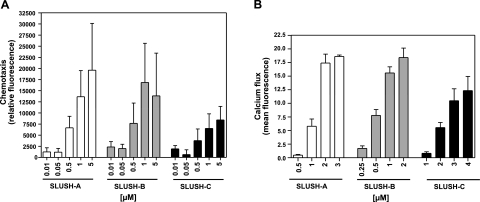
Chemotactic and stimulatory activities of SLUSH peptides toward human neutrophils. A) SLUSH peptides induce chemotaxis in human neutrophils. B) SLUSH peptides induce chemotaxis-associated calcium fluxes in human neutrophils. Data represent means ± se of ≥ independent experiments. Buffer controls were subtracted from all values.
Figure 4.
Figure 4.
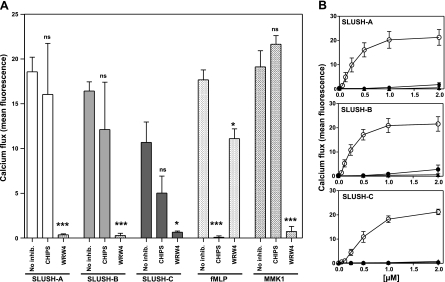
The FPR2 receptor is responsible for stimulation of neutrophils by SLUSH peptides. A) Neutrophil stimulation with or without the FPR1- or FPR2-specific inhibitors CHIPS or WRW4, respectively. fMLP and MMK1 are synthetic control ligands of FPR1 and FPR2, respectively. Data represent means ± se of ≥3 independent experiments. *P < 0.05; ***P < 0.001 vs. no inhibition. B) Stimulation of FPR1, FPR2, and FPR3-transfected HL60 cells by SLUSH peptides. Untransfected HL60 cells exhibited no response (mean fluorescence values <1, data not shown). Open circles denote FPR2-transfected HL60 cells; solid circles denote FPR1-transfected HL60 cells; triangles denote FPR3-transfected HL60 cells. Data represent means ± se of ≥3 independent experiments.
Figure 5.
Figure 5.
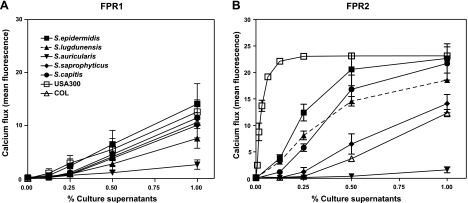
Stimulation of receptor-transfected HL60 by staphylococcal culture supernatants. Activation of FPR1-transfected (left panel) or FPR2-transfected cells (right panel) by culture supernatants of the indicated staphylococcal strains was measured. Supernatants were taken from S. lugdunensis IVK28, S. epidermidis Tü3298, S. auricularis ATCC337535, S. saprophyticus NT219, S. capitis ATCC27840, S. aureus USA300, and S. aureus COL. Data represent means ± se of ≥3 independent experiments.

References

    1. Medzhitov R. (2007) Recognition of microorganisms and activation of the immune response. Nature 449, 819–826 - PubMed
    1. Fu H., Karlsson J., Bylund J., Movitz C., Karlsson A., Dahlgren C. (2006) Ligand recognition and activation of formyl peptide receptors in neutrophils. J. Leukoc. Biol. 79, 247–256 - PubMed
    1. Ye R. D., Boulay F., Wang J. M., Dahlgren C., Gerard C., Parmentier M., Serhan C. N., Murphy P. M. (2009) International Union of Basic and Clinical Pharmacology. LXXIII. Nomenclature for the formyl peptide receptor (FPR) family. Pharmacol. Rev. 61, 119–161 - PMC - PubMed
    1. Le Y., Oppenheim J. J., Wang J. M. (2001) Pleiotropic roles of formyl peptide receptors. Cytokine Growth Factor Rev. 12, 91–105 - PubMed
    1. Migeotte I., Communi D., Parmentier M. (2006) Formyl peptide receptors: a promiscuous subfamily of G protein-coupled receptors controlling immune responses. Cytokine Growth Factor Rev. 17, 501–519 - PubMed

Publication types

LinkOut - more resources