. 2010 Dec 24:5:28.
doi: 10.1186/1748-7161-5-28.

Spinal deformities rehabilitation - state of the art review

Affiliations

Spinal deformities rehabilitation - state of the art review

Hans-Rudolf Weiss. Scoliosis. .

Abstract

Background: Medical rehabilitation aims at an improvement in function, capacity and participation. For the rehabilitation of spinal deformities, the goal is to maintain function and prevent secondary symptoms in the short- and long-term. In patients with scoliosis, predictable signs and symptoms include pain and reduced pulmonary function.

Materials and methods: A Pub Med review was completed in order to reveal substantial evidence for inpatient rehabilitation as performed in Germany. No evidence has been found in general to support claims for actual inpatient rehabilitation programmes as used today. Nevertheless, as there is some evidence that inpatient rehabilitation may be beneficial to patients with spinal deformities complicated by certain additional conditions, the body of evidence there is for conservative treatment of spinal deformities has been reviewed in order to allow suggestions for outpatient conservative treatment and inpatient rehabilitation.

Discussion: Today, for both children and adolescents, we are able to offer intensive rehabilitation programmes lasting three to five days, which enable the patients to acquire the skills necessary to prevent postures fostering scoliosis in everyday life without missing too much of school teaching subjects at home. The secondary functional impairments adult scoliosis patients might have, as in the opinion of the author, still today require the time of 3-4 weeks in the clinical in-patient setting. Time to address psychosocial as well as somatic limitations, namely chronic pains and cardiorespiratory malfunction is needed to preserve the patients working capability in the long-term.

Conclusion: Outpatient treatment/rehabilitation is sufficient for adolescents with spinal deformities.Inpatient rehabilitation is recommended for patients with spinal deformities and pain or severe restrictive ventilation disorder.


Figures
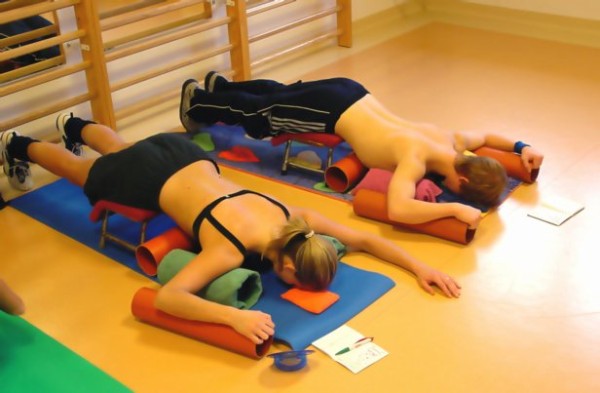
Figure 1
Figure 1
Exercises as performed during inpatient rehabilitation. Many items are needed in order to allow a pattern specific 3 D correction in lying position. Pads, stools, rolls and other items used in lying position are not needed in the new 'Power Schroth' approach used within the 'Best Practice' programme.
Figure 2
Figure 2
Scoliosis is a 'flatback disorder' and therefore thoracic kyphosis has to be restored. As shown in this example, many of the 'old' Schroth exercises increase the flatback. These exercises are still in use today, although this is not beneficial to AIS (Adolescent Idiopathic Scoliosis) patients with thoracic curvatures.
Figure 3
Figure 3
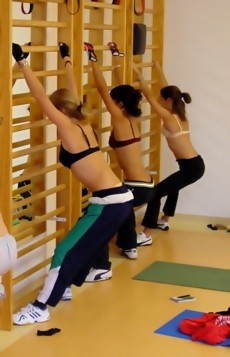
New Power Schroth' exercise using postural synergy effects. Outer rotation of the arm of the thoracic convex side improves derotation and redression of the rib-hump on the same side. Inner rotation of the arm of the thoracic concave side improves kyphosation on the thoracic concave side, which is the 'flatback side' of the curve.
Figure 4
Figure 4
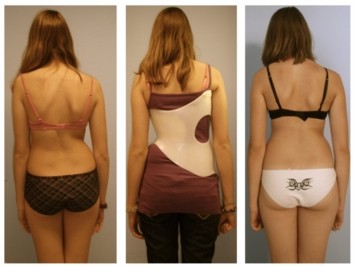
Standard of today's high correction braces. As can be seen on this figure, the deformity of the trunk is mirrored in the Gensingen brace™, one of the braces enabling correction of the spine and the clinical deviation of the trunk. After six weeks of bracing the deformity is largely reduced (right picture compared to left).
Figure 5
Figure 5
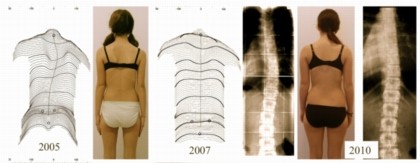
Example of a patient with an initial overcorrection in a Chêneau light brace. Left (2005) at begin with 38°, middle (2007) compensated appearance with 18° and finally right (2010) after weaning off (at 16 years of age) with a balanced clinical appearance the curve was 12° (right). Weiss and Werkmann Scoliosis 2010 5:19 doi: 10.1186/1748-7161-5-1
Figure 6
Figure 6
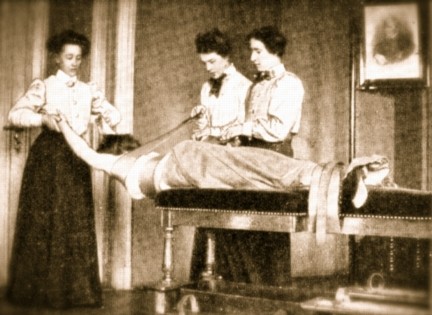
Three therapists treat one patient in the setting proposed by Oldevig at the beginning of the 20th century.
Figure 7
Figure 7
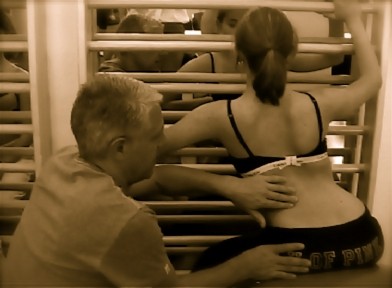
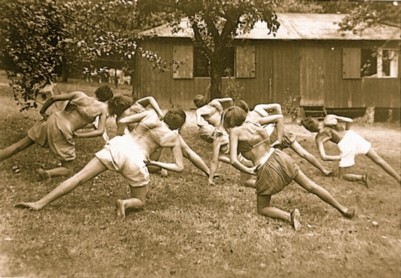
Group rehabilitation therapy as proposed by Katharina Schroth. The pattern specific programme has been taught to the patients so as to enable them to follow the instructions of the therapist during the group setting.
Figure 8
Figure 8
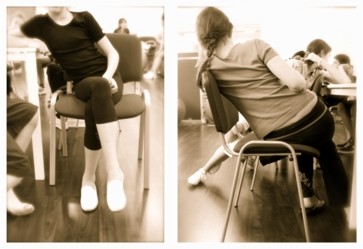
Activities of daily living (ADL) as trained within modern Scoliosis Short-term Rehabilitation (SSTR). Corrected posture in standing, sitting and walking are essential to enable the patients to avoid postures in daily activities fostering curve progression. The SSTR is also taught to professionals regularily. Short impressions of the Scoliosis Short-Term Rehabilitation (SSTR) as described [133] can be found at: [144-146]. Impression of the courses given for professionals can be found here: [147,148].
Figure 9
Figure 9
A 'New Power Schroth' exercise to improve postural control of the patient treated. This exercise, called ' Frog at the pond' enables the patient to achieve the skills necessary to improve postural control during ADL [146].
Figure 10
Figure 10
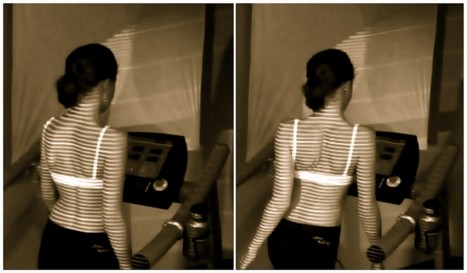
Corrective movements trained during walking. Scoliosis 3 D correction can be performed in sitting and also standing position, however the highest skill is correcting the deformity of the spine and trunk whilst walking. This can be performed using a treadmill, but also by walking plainly on the ground. This is also shown on a video [144].

References

    1. Baron S, Linden M. Analyzing the Effectiveness of Inpatient Psychosomatic Rehabilitation Using the Mini-ICF-APP. Rehabilitation. 2009;48:145–153. doi: 10.1055/s-0029-1220740. - DOI - PubMed
    1. Hüppe A, Raspe H. Die Wirksamkeit stationärer medizinischer Rehabilitation in Deutschland bei chronischen Rückenschmerzen: eine systematische Literaturübersicht 1980 - 2001. Rehabilitation. 2003;42:143–154. doi: 10.1055/s-2003-40099. - DOI - PubMed
    1. Lehmann C, Bergelt C, Welk H, Hagen-Aukamp C, Berger D, Koch U. Unterscheiden sich ambulante und stationäre onkologische Rehabilitationsmaßnahmen im Hinblick auf Leistungserbringung und Erfolg? Eine Analyse der medizinischen Entlassungsberichte. Phys Rehab Kur Med. 2008;18:59–68. doi: 10.1055/s-2007-985176. - DOI
    1. Schönle PW. Ambulante und stationäre neurologische Rehabilitation - ein katamnestischer Vergleich. Rehabilitation. 2002;41:183–188. doi: 10.1055/s-2002-28442. - DOI - PubMed
    1. Bürger W, Dietsche S, Morfeld M, Koch U. Ambulante und stationäre orthopädische Rehabilitation - Ergebnisse einer Studie zum Vergleich der Behandlungsergebnisse und Kosten. Rehabilitation. 2002;41:92–102. doi: 10.1055/s-2002-28437. - DOI - PubMed

LinkOut - more resources