


The combined effect of smoking tobacco and drinking alcohol on cause-specific mortality: a 30 year cohort study
- PMID: 21184680
- PMCID: PMC3022858
- DOI: 10.1186/1471-2458-10-789
The combined effect of smoking tobacco and drinking alcohol on cause-specific mortality: a 30 year cohort study
Abstract
Background: Smoking and consuming alcohol are both related to increased mortality risk. Their combined effects on cause-specific mortality were investigated in a prospective cohort study.
Methods: Participants were 5771 men aged 35-64, recruited during 1970-73 from various workplaces in Scotland. Data were obtained from a questionnaire and a screening examination. Causes of death were all cause, coronary heart disease (CHD), stroke, alcohol-related, respiratory and smoking-related cancer. Participants were divided into nine groups according to their smoking status (never, ex or current) and reported weekly drinking (none, 1-14 units and 15 or more). Cox proportional hazards models were used to obtain relative rates of mortality, adjusted for age and other risk factors.
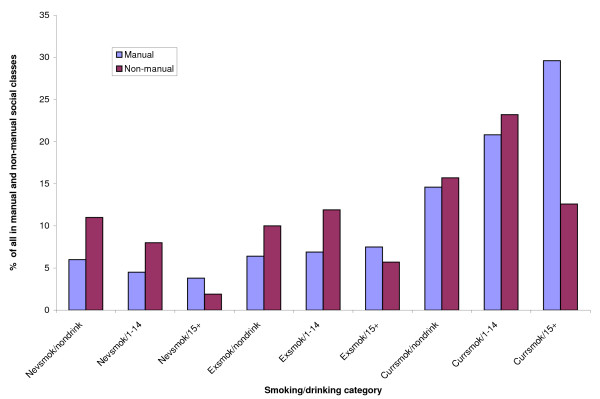
Results: In 30 years of follow-up, 3083 men (53.4%) died. Compared with never smokers who did not drink, men who both smoked and drank 15+ units/week had the highest all-cause mortality (relative rate = 2.71 (95% confidence interval 2.31-3.19)). Relative rates for CHD mortality were high for current smokers, with a possible protective effect of some alcohol consumption in never smokers. Stroke mortality increased with both smoking and alcohol consumption. Smoking affected respiratory mortality with little effect of alcohol. Adjusting for a wide range of confounders attenuated the relative rates but the effects of alcohol and smoking still remained. Premature mortality was particularly high in smokers who drank 15 or more units, with a quarter of the men not surviving to age 65. 30% of men with manual occupations both smoked and drank 15+ units/week compared with only 13% with non-manual ones.
Conclusions: Smoking and drinking 15+ units/week was the riskiest behaviour for all causes of death.
Figures
References
-
- Advisory Council on the Misuse of Drugs. Pathways to Problems: hazardous use of tobacco, alcohol and other drugs by young people. London: Home Office; 2006.
-
- IARC. IARC Handbooks of Cancer Prevention, Tobacco Control, Evaluating the Effectiveness of Smoke-free Policies. Vol. 13. Lyon: IARC; 2009.
-
- Part 1. Smoking: prohibition and control. Edinburgh, Stationery Office; 2005. Smoking Health and Social Care (Scotland) Act 2005.http://www.opsi.gov.uk/legislation/scotland/acts2005/asp_20050013_en_1 29-3-2010.
Publication types
MeSH terms
Grants and funding
LinkOut - more resources
Full Text Sources
Medical
Molecular Biology Databases
