


The BRAFT1799A mutation confers sensitivity of thyroid cancer cells to the BRAFV600E inhibitor PLX4032 (RG7204)
- PMID: 21185263
- PMCID: PMC4596240
- DOI: 10.1016/j.bbrc.2010.12.088
The BRAFT1799A mutation confers sensitivity of thyroid cancer cells to the BRAFV600E inhibitor PLX4032 (RG7204)
Abstract
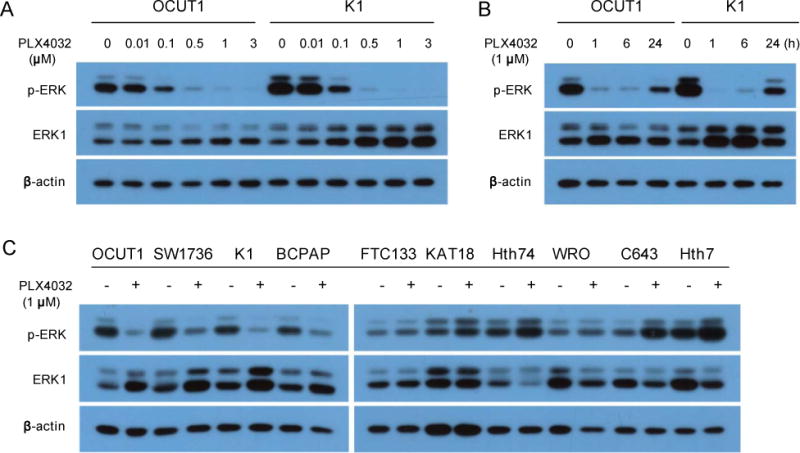
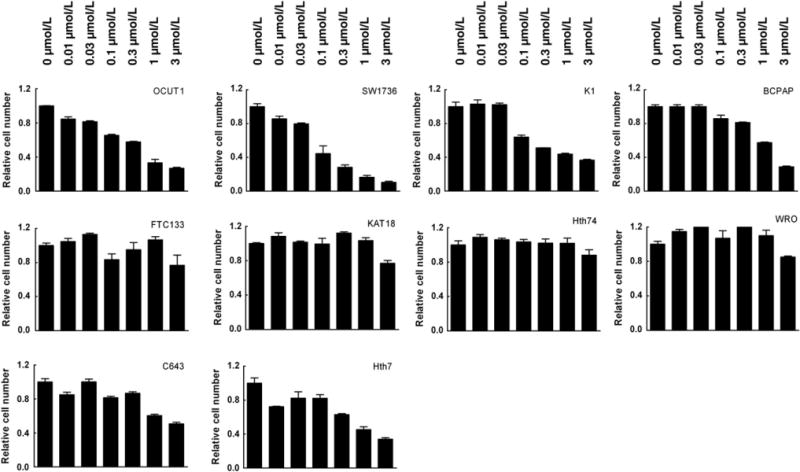
Aberrant signaling of the Ras-Raf-MEK-ERK (MAP kinase) pathway driven by the mutant kinase BRAF(V600E), as a result of the BRAF(T1799A) mutation, plays a fundamental role in thyroid tumorigenesis. This study investigated the therapeutic potential of a BRAF(V600E)-selective inhibitor, PLX4032 (RG7204), for thyroid cancer by examining its effects on the MAP kinase signaling and proliferation of 10 thyroid cancer cell lines with wild-type BRAF or BRAF(T1799A) mutation. We found that PLX4032 could effectively inhibit the MAP kinase signaling, as reflected by the suppression of ERK phosphorylation, in cells harboring the BRAF(T1799A) mutation. PLX4032 also showed a potent and BRAF mutation-selective inhibition of cell proliferation in a concentration-dependent manner. PLX4032 displayed low IC(50) values (0.115-1.156μM) in BRAF(V600E) mutant cells, in contrast with wild-type BRAF cells that showed resistance to the inhibitor with high IC(50) values (56.674-1349.788μM). Interestingly, cells with Ras mutations were also sensitive to PLX4032, albeit moderately. Thus, this study has confirmed that the BRAF(T1799A) mutation confers cancer cells sensitivity to PLX4032 and demonstrated its specific potential as an effective and BRAF(T1799A) mutation-selective therapeutic agent for thyroid cancer.
Copyright © 2010 Elsevier Inc. All rights reserved.
Figures
References
-
- Altekruse SF, Kosary CL, Krapcho M, Neyman N, Aminou R, Waldron W, Ruhl J, Howlader N, Tatalovich Z, Cho H, Mariotto A, Eisner MP, Lewis DR, Cronin K, Chen HS, Feuer EJ, Stinchcomb DG, Edwards BK, editors. SEER Cancer Statistics Review, 1975–2007. National Cancer Institute; Bethesda, MD: 2010. http://seer.cancer.gov/csr/1975_2007/, based on November 2009 SEER data submission, posted to the SEER web site.
-
- Hundahl SA, Fleming ID, Fremgen AM, Menck HR. A National Cancer Data Base report on 53, 856 cases of thyroid carcinoma treated in the U.S., 1985–1995. Cancer. 1998;83:2638–2648. - PubMed
-
- Xing M. BRAF mutation in thyroid cancer. Endocr Relat Cancer. 2005;12:245–262. - PubMed
-
- Xing M. BRAF mutation in papillary thyroid cancer: pathogenic role, molecular bases, and clinical implications. Endocr Rev. 2007:742–762. - PubMed
-
- Tang KT, Lee CH. BRAF mutation in papillary thyroid carcinoma: pathogenic role and clinical implications. J Chin Med Assoc. 2010;73:113–128. - PubMed
Publication types
MeSH terms
Substances
Grants and funding
LinkOut - more resources
Full Text Sources
Medical
Research Materials
Miscellaneous
