


Variation in sexual behaviors in a cohort of adolescent females: the role of personal, perceived peer, and perceived family attitudes
- PMID: 21185529
- PMCID: PMC3052941
- DOI: 10.1016/j.jadohealth.2010.05.004
Variation in sexual behaviors in a cohort of adolescent females: the role of personal, perceived peer, and perceived family attitudes
Abstract
Purpose: Little is known about how adolescent sexual behaviors develop and the influence of personal or perceived social attitudes. We sought to describe how personal, perceived peer, and perceived family attitudes toward adolescent sexual activity influence sexual behaviors of adolescent females' over time.
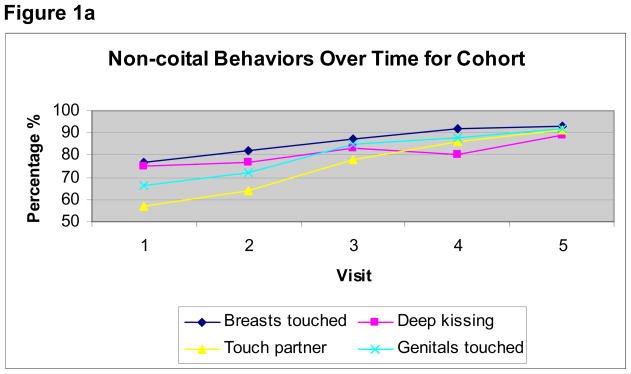
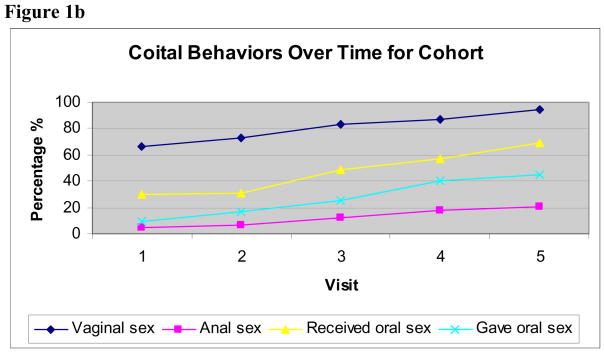
Methods: Between the years of 1999 and 2006, 358 English-speaking female adolescents, aged 14-17 years, were recruited from three urban adolescent clinics. Participants completed quarterly and annual questionnaires over a span of 4 years. Primary outcomes included engagement in any of the following eight sexual behaviors: kissing, having breasts touched, having genitals touched, touching partners' genitals, oral giving, oral receiving, anal, or vaginal sex. Three attitudinal scales assessed personal importance of abstinence, perceived peer beliefs about when to have sex, and perceived family beliefs that adolescent sex is negative. We used generalized estimating equations to identify predictors of each sexual behavior and compared whether personal, perceived peer, or perceived family attitudes predicted sexual behaviors over time.
Results: The odds of reporting each sexual behavior increased with age but were lower among those whose personal or perceived family attitudes were less positive. Participants' personal attitudes toward adolescent sex were the strongest predictor of engagement in all eight sexual behaviors even after controlling for perceived peer and perceived family attitudes.
Conclusions: Female adolescent's personal attitudes toward abstinence appear to be the strongest predictor of engagement in a variety of sexual behaviors. Efforts to influence adolescent attitudes toward abstinence may be an important approach to reducing sexual behaviors that increase the risk of pregnancy and sexually transmitted infections.
Copyright © 2011 Society for Adolescent Health and Medicine. Published by Elsevier Inc. All rights reserved.
Conflict of interest statement
Figures
References
-
- Committee on Adolescent Health Care Services and Models of Care for Treatment P, and Healthy Development. Adolescent Health Services:Missing Opportunities. Washington, D.C: National Research Council; 2009.
-
- Dariotis JK, Sonenstein FL, Gates GJ, et al. Changes in sexual risk behavior as young men transition to adulthood. Perspect Sex Reprod Health. 2008 Dec;40(4):218–225. - PubMed
-
- Brooks-Gunn J, Furstenberg FF., Jr Adolescent sexual behavior. Am Psychol. 1989 Feb;44(2):249–257. - PubMed
-
- Brooks-Gunn J, Paikoff R. Sexuality and developmental transitions during adolescence in Health Ricks and developmental transitions during Adolescence. New York: Cambridge University Press; 1997.
-
- Lindberg LD, Jones R, Santelli JS. Noncoital sexual activities among adolescents. J Adolesc Health. 2008 Sep;43(3):231–238. - PubMed
Publication types
MeSH terms
Grants and funding
LinkOut - more resources
Full Text Sources
Medical
