


PKR-dependent CHOP induction limits hyperoxia-induced lung injury
- PMID: 21186267
- PMCID: PMC3064291
- DOI: 10.1152/ajplung.00166.2010
PKR-dependent CHOP induction limits hyperoxia-induced lung injury
Abstract
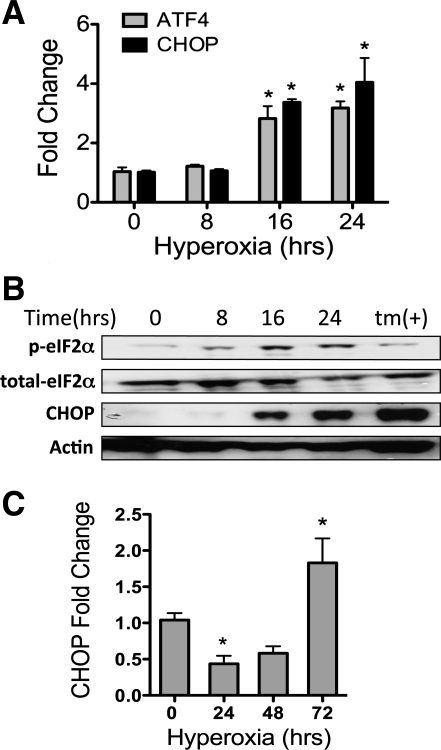
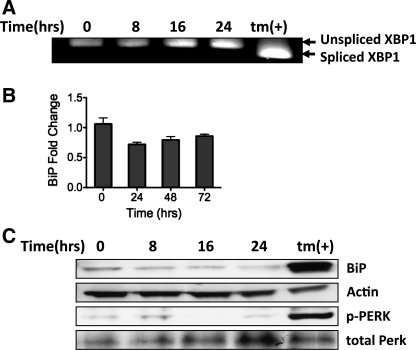
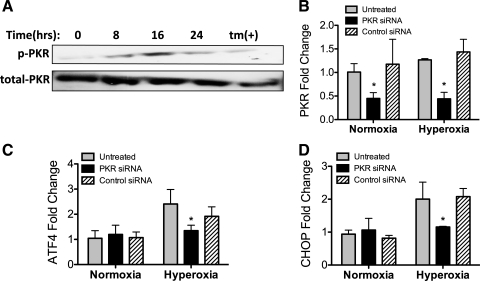
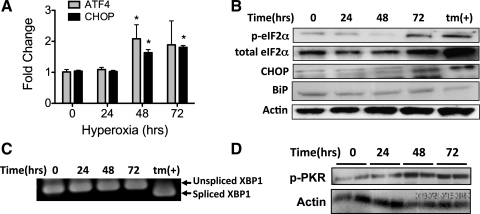
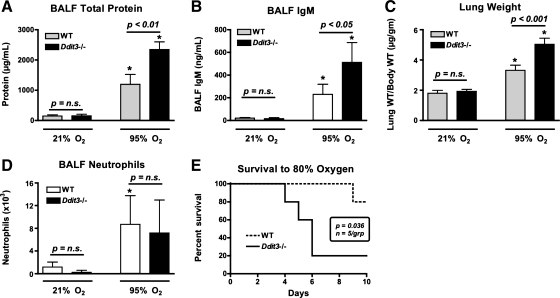
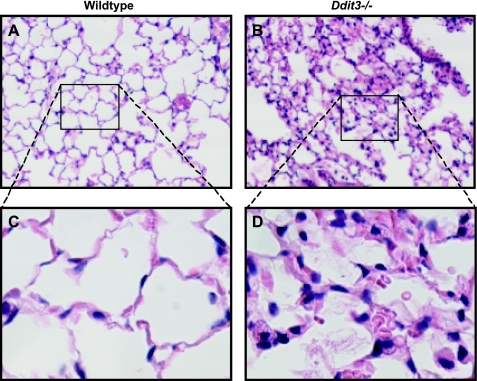
Supplemental O(2) is commonly employed in patients with respiratory failure; however, hyperoxia is also a potential contributor to lung injury. In animal models, hyperoxia causes oxidative stress in the lungs, resulting in increased inflammation, edema, and permeability. We hypothesized that oxidative stress from prolonged hyperoxia leads to endoplasmic reticulum (ER) stress, resulting in activation of the unfolded protein response (UPR) and induction of CCAAT enhancer-binding protein homologous protein (CHOP), a transcription factor associated with cell death in the setting of persistent ER stress. To test this hypothesis, we exposed the mouse lung epithelial cell line MLE-12 to 95% O(2) for 8-24 h and evaluated for evidence of UPR induction and CHOP induction. Hyperoxia caused increased CHOP expression without other evidence of UPR activation. Because CHOP expression is preceded by phosphorylation of the α-subunit of the eukaryotic initiation factor-2 (eIF2α), we evaluated the role of double-stranded RNA-activated protein kinase (PKR), a non-UPR-associated eIF2α kinase. Hyperoxia caused PKR phosphorylation, and RNA interference knockdown of PKR attenuated hyperoxia-induced CHOP expression. In vivo, hyperoxia induced PKR phosphorylation and CHOP expression in the lungs without other biochemical evidence for ER stress. Additionally, Ddit3(-/-) (CHOP-null) mice had increased lung edema and permeability, indicating a previously unknown protective role for CHOP after prolonged hyperoxia. We conclude that hyperoxia increases CHOP expression via an ER stress-independent, PKR-dependent pathway and that increased CHOP expression protects against hyperoxia-induced lung injury.
Figures
References
-
- Altemeier WA, Sinclair SE. Hyperoxia in the intensive care unit: why more is not always better. Curr Opin Crit Care 13: 73–78, 2007 - PubMed
-
- Beck KC, Vettermann J, Rehder K. Gas exchange in dogs in the prone and supine positions. J Appl Physiol 72: 2292–2297, 1992 - PubMed
-
- Bernales S, Papa FR, Walter P. Intracellular signaling by the unfolded protein response. Annu Rev Cell Dev Biol 22: 487–508, 2006 - PubMed
-
- Bhandari V, Elias JA. The role of angiopoietin 2 in hyperoxia-induced acute lung injury. Cell Cycle 6: 1049–1052, 2007 - PubMed
Publication types
MeSH terms
Substances
Grants and funding
LinkOut - more resources
Full Text Sources
Molecular Biology Databases
Research Materials
