


Anhedonia associated with stimulant use and dependence in a population-based sample of American adults
- PMID: 21186931
- PMCID: PMC3307593
- DOI: 10.1037/a0021964
Anhedonia associated with stimulant use and dependence in a population-based sample of American adults
Abstract
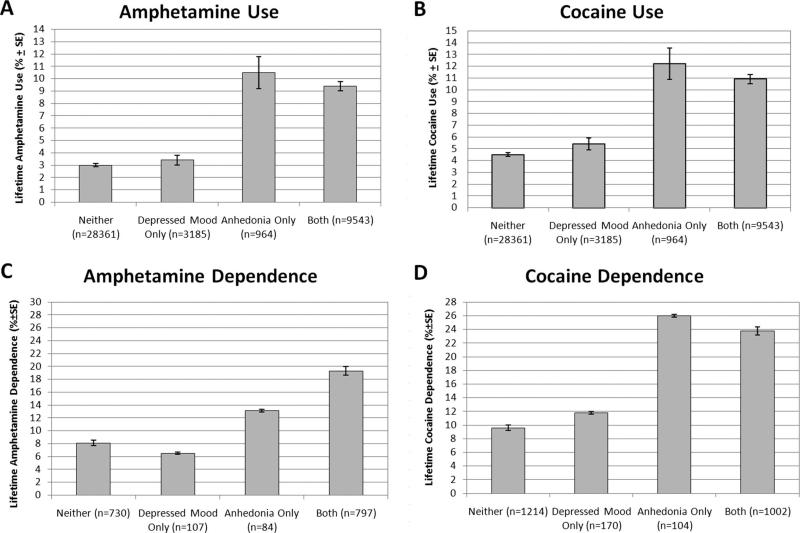
Prior research suggests an association between anhedonia--diminished interest or pleasure in rewarding activities--and stimulant use in selected samples. However, it is unclear whether this association generalizes to the overall population and is consistent across stimulant drug types (amphetamine vs. cocaine) and outcome characteristics (any lifetime use vs. dependence). Questions also remain as to whether the anhedonia-stimulant relationship is unique from covariance with depressed mood, psychiatric disorders, and nonstimulant substance use. The current study addressed these questions by examining anhedonia-stimulant relationships in a cross-sectional population-based sample of 43,093 American adults. Results indicated that lifetime anhedonia and depressed mood each were positively associated with lifetime stimulant use and lifetime dependence among those who reported stimulant use. Anhedonia-stimulant relationships were consistent across amphetamine- and cocaine-related outcomes and distinct from covariance with depressed mood, which exhibited no association over and above the effect of anhedonia. After adjusting for demographic, psychiatric, and nonstimulant substance use characteristics, anhedonia-stimulant associations remained significant, although effect sizes were partially attenuated. Lifetime anhedonia was also more prevalent among respondents who initiated use but did not eventually progress to dependence in comparison with individuals who never once used a stimulant drug. Anhedonia appears to be uniquely associated with lifetime use of cocaine and amphetamines and lifetime progression from use to dependence in the American population. Albeit cross-sectional in nature, these findings add further support to the generalizability and specificity of the anhedonia-stimulant relationship. Future research utilizing longitudinal and experimental designs are warranted to clarify the underpinnings of this association.
PsycINFO Database Record (c) 2010 APA, all rights reserved.
Figures
References
-
- American Psychiatric Association . Diagnostic and statistical manual of mental disorders. 4th ed. Author; 1994.
-
- Coffey SF, Dansky BS, Carrigan MH, Brady KT. Acute and protracted cocaine abstinence in an outpatient population: A prospective study of mood, sleep and withdrawal symptoms. Drug and Alcohol Dependence. 2000;59:277–286. - PubMed
-
- D'Souza M, Markou A. Neural substrates of psychostimulant withdrawal-induced anhedonia. In: Self D, Staley J, editors. Behavioral neuroscience of drug addiction. Vol. 3. Springer Berlin Heidelberg; New York, NY: 2009. - PubMed
-
- Gawin FH, Kleber HD. Abstinence symptomatology and psychiatric diagnosis in cocaine abusers: Clinical observations. Archives of General Psychiatry. 1986;43:107–113. - PubMed
-
- Grant B, Moore T, Shepart J, Kaplan K. Source and accuracy statement for Wave 1 of the 2001–2202 National Epidemiologic Survey on Alcohol and Related Conditions (NESARC) National Institute on Alcohol Abuse and Alcoholism; Bethesda, MD: 2003.
