


Assessment of synovitis with contrast-enhanced MRI using a whole-joint semiquantitative scoring system in people with, or at high risk of, knee osteoarthritis: the MOST study
- PMID: 21187293
- PMCID: PMC4180232
- DOI: 10.1136/ard.2010.139618
Assessment of synovitis with contrast-enhanced MRI using a whole-joint semiquantitative scoring system in people with, or at high risk of, knee osteoarthritis: the MOST study
Abstract
Objectives: To introduce a comprehensive and reliable scoring system for the assessment of whole-knee joint synovitis based on contrast-enhanced (CE) MRI.
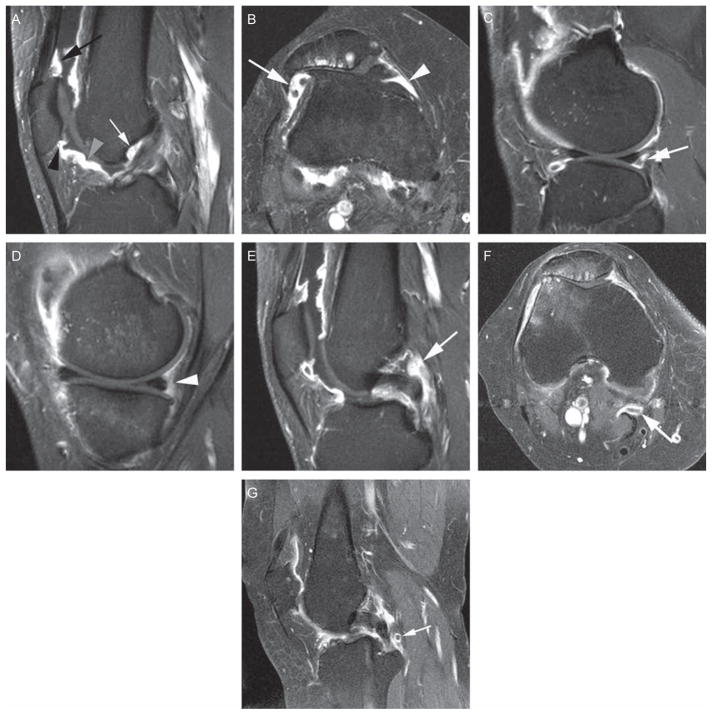
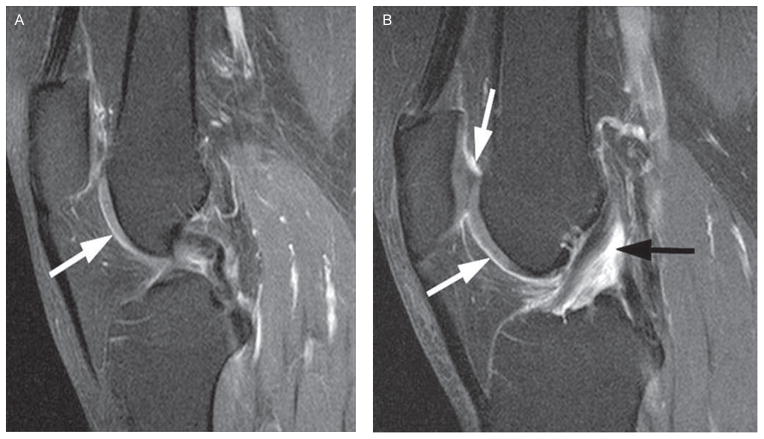
Methods: Multicenter Osteoarthritis Study (MOST) is a cohort study of people with, or at high risk of, knee osteoarthritis (OA). Subjects are an unselected subset of MOST who volunteered for CE-MRI. Synovitis was assessed at 11 sites of the joint. Synovial thickness was scored semiquantitatively: grade 0 (<2 mm), grade 1 (2-4 mm) and grade 2 (>4 mm) at each site. Two musculoskeletal radiologists performed the readings and inter- and intrareader reliability was evaluated. Whole-knee synovitis was assessed by summing the scores from all sites. The association of Western Ontario and McMaster Osteoarthritis Index pain score with this summed score and with the maximum synovitis grade for each site was assessed.
Results: 400 subjects were included (mean age 58.8±7.0 years, body mass index 29.5±4.9 kg/m(2), 46% women). For individual sites, intrareader reliability (weighted κ) was 0.67-1.00 for reader 1 and 0.60-1.00 for reader 2. Inter-reader agreement (κ) was 0.67-0.92. For the summed synovitis scores, intrareader reliability (intraclass correlation coefficient ( ICC)) was 0.98 and 0.96 for each reader and inter-reader agreement (ICC) was 0.94. Moderate to severe synovitis in the parapatellar subregion was associated with the higher maximum pain score (adjusted OR (95% CI), 2.8 (1.4 to 5.4) and 3.1 (1.2 to 7.9), respectively).
Conclusions: A comprehensive semiquantitative scoring system for the assessment of whole-knee synovitis is proposed. It is reliable and identifies knees with pain, and thus is a potentially powerful tool for synovitis assessment in epidemiological OA studies.
Conflict of interest statement
Figures
References
-
- Lawrence RC, Helmick CG, Arnett FC, et al. Estimates of the prevalence of arthritis and selected musculoskeletal disorders in the United States. Arthritis Rheum. 1998;41:778–99. - PubMed
-
- Kornaat PR, Ceulemans RY, Kroon HM, et al. MRI assessment of knee osteoarthritis: Knee Osteoarthritis Scoring System (KOSS)–inter-observer and intra-observer reproducibility of a compartment-based scoring system. Skeletal Radiol. 2005;34:95–102. - PubMed
-
- Peterfy CG, Guermazi A, Zaim S, et al. Whole-Organ Magnetic Resonance Imaging Score (WORMS) of the knee in osteoarthritis. Osteoarthr Cartil. 2004;12:177–90. - PubMed
-
- Hunter DJ, Lo GH, Gale D, et al. The reliability of a new scoring system for knee osteoarthritis MRI and the validity of bone marrow lesion assessment: BLOKS (Boston Leeds Osteoarthritis Knee Score) Ann Rheum Dis. 2008;67:206–11. - PubMed
Publication types
MeSH terms
Substances
Grants and funding
LinkOut - more resources
Full Text Sources
Medical
