


Improving marginal likelihood estimation for Bayesian phylogenetic model selection
- PMID: 21187451
- PMCID: PMC3038348
- DOI: 10.1093/sysbio/syq085
Improving marginal likelihood estimation for Bayesian phylogenetic model selection
Abstract
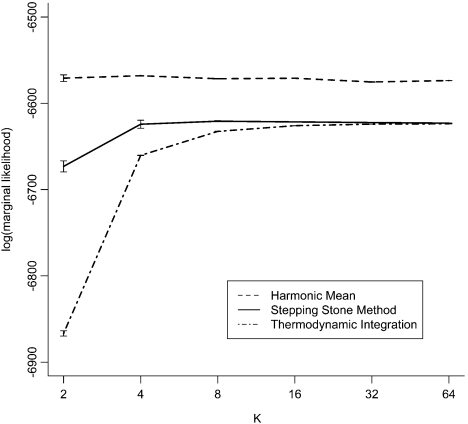
The marginal likelihood is commonly used for comparing different evolutionary models in Bayesian phylogenetics and is the central quantity used in computing Bayes Factors for comparing model fit. A popular method for estimating marginal likelihoods, the harmonic mean (HM) method, can be easily computed from the output of a Markov chain Monte Carlo analysis but often greatly overestimates the marginal likelihood. The thermodynamic integration (TI) method is much more accurate than the HM method but requires more computation. In this paper, we introduce a new method, steppingstone sampling (SS), which uses importance sampling to estimate each ratio in a series (the "stepping stones") bridging the posterior and prior distributions. We compare the performance of the SS approach to the TI and HM methods in simulation and using real data. We conclude that the greatly increased accuracy of the SS and TI methods argues for their use instead of the HM method, despite the extra computation needed.
Figures
 .
.
References
-
- Akaike H. A new look at statistical model identification. IEEE Trans. Automat. Contr. 1974;19:716–723.
-
- Bleidorn C, Eeckhaut I, Podsiadlowski L, Schult N, McHugh D, Halanych KM, Milinkovitch MC, Tiedemann R. Mitochondrial genome and nuclear sequence data support Myzostomida as part of the annelid radiation. Mol. Biol. Evol. 2007;24:1690–1701. - PubMed
-
- Brandley M, Schmitz A, Reeder T. Partitioned Bayesian analyses, partition choice, and the phylogenetic relationships of scincid lizards. Syst. Biol. 2005;54:373–390. - PubMed
-
- Brown JM, Lemmon AR. The importance of data partitioning and the utility of Bayes factors in Bayesian phylogenetics. Syst. Biol. 2007;56:643–655. - PubMed
