Review
. 2011 Jan;21(1):55-70.
doi: 10.1038/cr.2010.182. Epub 2010 Dec 28.

NF-κB signaling pathways regulated by CARMA family of scaffold proteins

Affiliations
Review

NF-κB signaling pathways regulated by CARMA family of scaffold proteins

Marzenna Blonska et al. Cell Res. 2011 Jan.

Abstract

The NF-κB family of transcription factors plays a crucial role in cell activation, survival and proliferation. Its aberrant activity results in cancer, immunodeficiency or autoimmune disorders. Over the past two decades, tremendous progress has been made in our understanding of the signals that regulate NF-κB activation, especially how scaffold proteins link different receptors to the NF-κB-activating complex, the IκB kinase complex. The growing number of these scaffolds underscores the complexity of the signaling networks in different cell types. In this review, we discuss the role of scaffold molecules in signaling cascades induced by stimulation of antigen receptors, G-protein-coupled receptors and C-type Lectin receptors, resulting in NF-κB activation. Especially, we focus on the family of Caspase recruitment domain (CARD)-containing proteins known as CARMA and their function in activation of NF-κB, as well as the link of these scaffolds to the development of various neoplastic diseases through regulation of NF-κB.


Figures
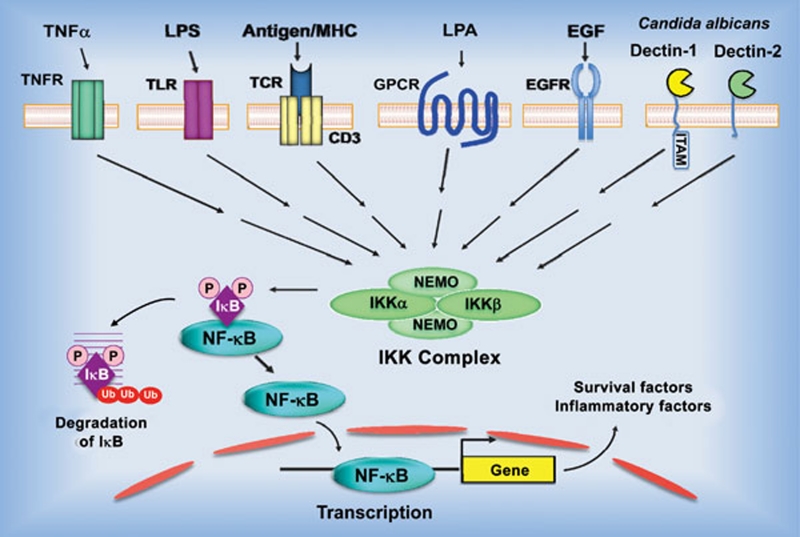
Figure 1
Figure 1
Model of NF-κB activation by the canonical pathway. Stimulation of the surface receptors by different inducers initiates several proximal signaling events resulting in activation of the IκB kinase (IKK) complex, composed of two kinases, IKKα and IKKβ, and the regulatory subunit NF-κB-essential modulator (NEMO). IKK phosphorylates inhibitor of κB (IκB), which leads to its ubiquitination and subsequent degradation. NF-κB is then translocated into nuclei and initiates the target gene transcription. TNFR – tumor necrosis factor receptor; TLR – toll like receptor, LPS – lipopolysaccharide; TCR – T-cell receptor; GPCR – G protein-coupled receptors; LPA - lysophosphatidic acid; EGFR - epidermal growth factor receptor; ITAM - immunoreceptor tyrosine-based activation motif; Ub - ubiquitin.
Figure 2
Figure 2
Structures of CARMA1-3, CARD9, Bcl10 and their tissue distribution. CARMA - caspase recruitment domain (CARD)- and membrane-associated guanylate kinase-like domain-containing protein; Bcl10 - B-cell lymphoma 10; CARD - caspase-recruitment domain; C-C - coiled-coil domain; MAGUK - membrane-associated guanylate kinase (GuK)-like domain; S/T rich – Ser/Thr rich domain.
Figure 3
Figure 3
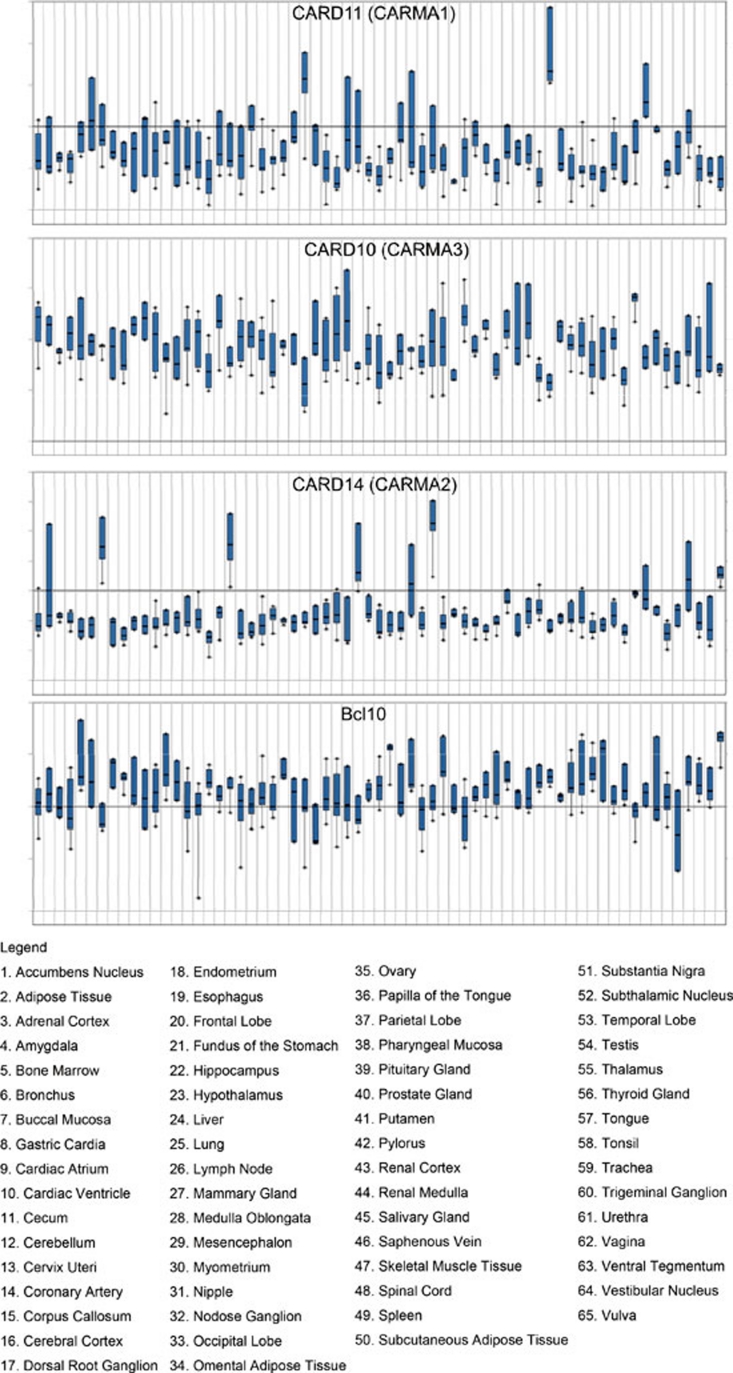
Expression patterns of CARMA1, CARMA2, CARMA3 and Bcl10 in 65 different human tissues. Microarray data from the public database were analysed using Oncomine 4.4 tools (www.oncomine.org). Log2 median intensity is shown on Y-axis.
Figure 4
Figure 4
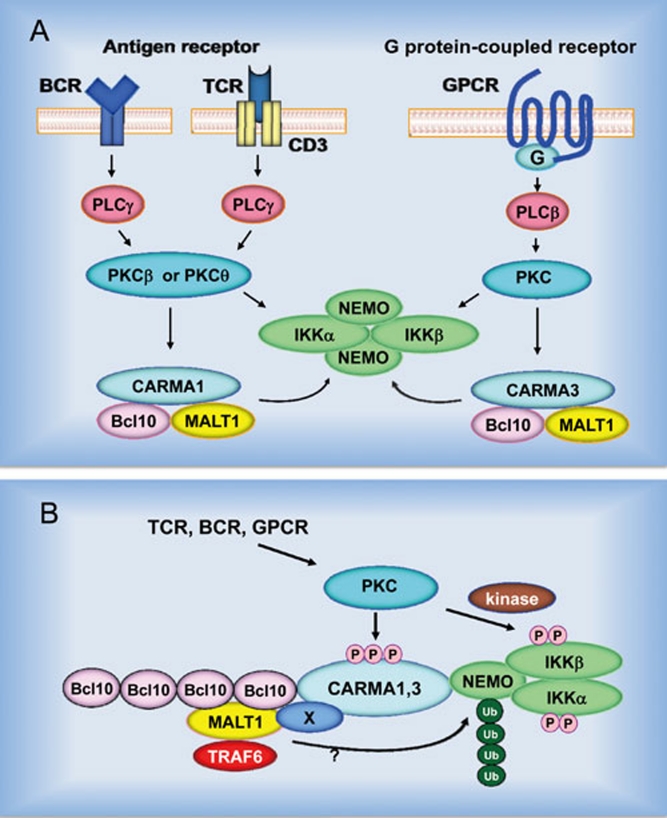
Schematic model of the B-cell receptor (BCR)-, T-cell receptor (TCR) and G protein-coupled receptor-induced NF-κB activation. (A) Stimulation of the surface receptor initiates several proximal signaling events that lead to activation of phospholipase C (PLC) and protein kinase C (PKC). The activated PKC phosphorylates CARMA and enables CARMA to associate with the downstream signaling components, Bcl10 and MALT1. Formation of the CBM complex leads to activation of the IKK complex. (B) The CBM complex cooperates with tumor necrosis factor receptor-associated factor 6 (TRAF6) and possibly some unidentified protein (X) to mediate ubiquitination of NEMO. The IKK complex is also phosphorylated in a PKC-dependent manner and both modifications are essential for the IKK kinase activity.
Figure 5
Figure 5
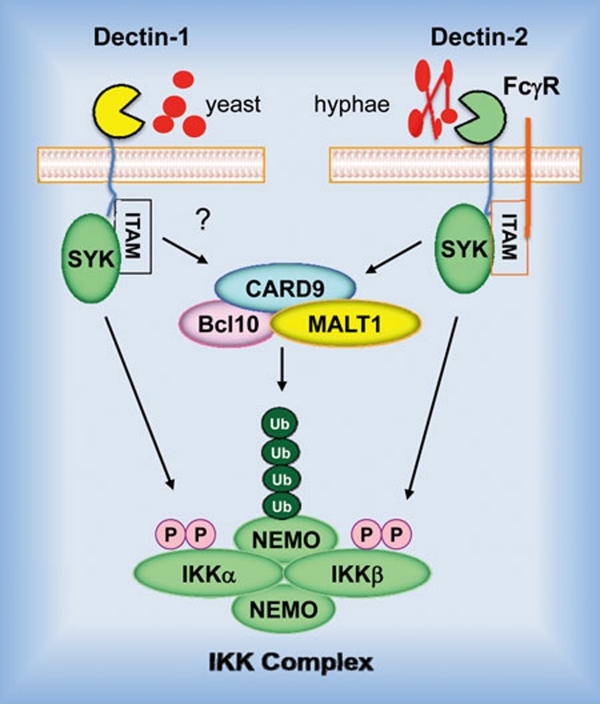
CARD9 in the C-type lectin receptor signaling. Activation of the Dectin-1 receptor by the yeast-like, unicellular form of C. albicans or the Dectin-2 receptor by the hyphal form of C. albicans leads to a sequential activation of tyrosine kinase Syk, the CARD9-Bcl10-MALT1 complex and IKK. In this signaling cascade Syk mediates IKK phosphorylation, whereas CARD9 controls NEMO polyubiquitination.

References

    1. Shaw AS, Filbert EL. Scaffold proteins and immune-cell signalling. Nat Rev Immunol. 2009;9:47–56. - PubMed
    1. Defea KA.Beta-arrestins as regulators of signal termination and transduction: How do they determine what to scaffold Cell Signal 2010. Oct 12. doi: 10.1016/j.cellsig.2010.10.004 - DOI - PubMed
    1. Burack WR, Cheng AM, Shaw AS. Scaffolds, adaptors and linkers of TCR signaling: theory and practice. Curr Opin Immunol. 2002;14:312–316. - PubMed
    1. Locasale JW, Shaw AS, Chakraborty AK. Scaffold proteins confer diverse regulatory properties to protein kinase cascades. Proc Natl Acad Sci USA. 2007;104:13307–13312. - PMC - PubMed
    1. Hayden MS, Ghosh S. Shared principles in NF-kappaB signaling. Cell. 2008;132:344–362. - PubMed

Publication types

MeSH terms