


Revisiting immune exhaustion during HIV infection
- PMID: 21188556
- PMCID: PMC3144861
- DOI: 10.1007/s11904-010-0066-0
Revisiting immune exhaustion during HIV infection
Abstract
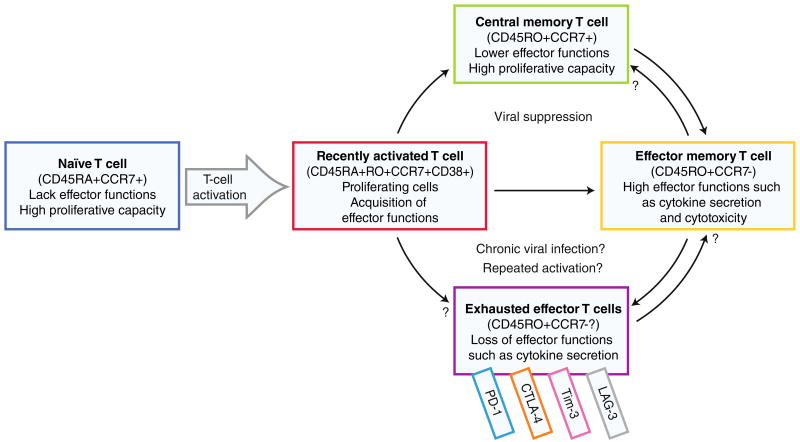
Chronic immune activation is a hallmark of HIV infection, yet the underlying triggers of immune activation remain unclear. Persistent antigenic stimulation during HIV infection may also lead to immune exhaustion, a phenomenon in which effector T cells become dysfunctional and lose effector functions and proliferative capacity. Several markers of immune exhaustion, such as PD-1, LAG-3, Tim-3, and CTLA-4, which are also negative regulators of immune activation, are preferentially upregulated on T cells during HIV infection. It is not yet clear whether accumulation of T cells expressing activation inhibitory molecules is a consequence of general immune or chronic HIV-specific immune activation. Importantly, however, in vitro blockade of PD-1 and Tim-3 restores HIV-specific T-cell responses, indicating potential for immunotherapies. In this review we discuss the evolution of our understanding of immune exhaustion during HIV infection, highlighting novel markers and potential therapeutic targets.
Figures
References
-
- Lane HC, Masur H, Edgar LC, et al. Abnormalities of B-cell activation and immunoregulation in patients with the acquired immunodeficiency syndrome. N Engl J Med. 1983;309(8):453–8. - PubMed
-
- Hellerstein M, Hanley MB, Cesar D, et al. Directly measured kinetics of circulating T lymphocytes in normal and HIV-1-infected humans. Nat Med. 1999;5(1):83–9. - PubMed
-
- Hazenberg MD, Stuart JW, Otto SA, et al. T-cell division in human immunodeficiency virus (HIV)-1 infection is mainly due to immune activation: a longitudinal analysis in patients before and during highly active antiretroviral therapy (HAART) Blood. 2000;95(1):249–55. - PubMed
-
- Valdez H, Lederman MM. Cytokines and cytokine therapies in HIV infection. AIDS Clin Rev. 1997:187–228. - PubMed
-
- Giorgi JV, Liu Z, Hultin LE, et al. Elevated levels of CD38+ CD8 + T cells in HIV infection add to the prognostic value of low CD4 + T cell levels: results of 6 years of follow-up. The Los Angeles Center, Multicenter AIDS Cohort Study. J Acquir Immune Defic Syndr. 1993;6(8):904–12. - PubMed
Publication types
MeSH terms
Substances
Grants and funding
LinkOut - more resources
Full Text Sources
Other Literature Sources
Medical
Research Materials
